From Consumers to Producers?

We Can Do It! Rosie the RiveterIt must be something in the air or drinking water, but I am coming across this consumer vs. producer idea more and more lately.  Just today, someone posted on Facebook a story about how Cuba, which became an engineering and technological wasteland after the US left and the Soviet Union’s economy stalled, has pulled itself– out of necessity — into the 21st century by a new DIY ethic – one might even say ‘chic.’

The other item that floated to my desktop was that in Greece, whose economy is in dire straits,  young people have given up looking for jobs in urban areas and are going back to the land.  The reason they can is that, somewhere in their backgrounds, there is a homestead that belonged to a grandparent or other relative, a house and a garden in a village.  Romantic?  I doubt it.  Practical, yes.  They are returning to places where they can learn what previous generations took for granted about self-sufficiency and making a decent life without so goddam much stuff.  Many are taking up farming or learning to prepare food.  They are acquiring survival skills and building community at the same time.

Maybe these are important models for us to study in the post-consumer age we may be entering.  Consumers  — especially those wired to their electronic ‘friends’ — don’t generally make for great neighbors.  But people who make things (or create ideas), have to connect with others: mentors, partners, co-workers, and customers.  Producers live in a world of ideas and possibilities that encourages generativity, in the sense of “making your mark” on the world, creating or accomplishing things that matter.

It’s not too late to get our hands dirty, to build things, to maintain and repair the things we have, to share our new found skills with others.  In fact, in a future where the cult of go-it-alone individualism is sure to be severely tested, it is about time.

Photo credit: Mike Licht, NotionsCapital.com / Foter / CC BY

Jersey Shore: Still Standing Strong?

Standing StrongYou want to believe it, and on our recent visit to Long Beach Island, NJ, the signs of apparent recovery were everywhere.  Gov. Chris Christie makes regular reassuring visits, and in truth, the affluent summer residents — LBI swells in season to a population of 100,000 with the influx of second-home owners from New Jersey and neighboring states — have already rebuilt or are well on their way to restoring properties.  It’s salad days for the contractors and landscapers of LBI, though how many of them are locals is uncertain.  Areas with protective dune systems built in a controversial U.S. Army Corps of Engineers project, have been the fastest to return to normal.

In August, at the height of season, normalcy means beaches thronged with bright umbrellas and excited children, packed shops and restaurants, and bumper to bumper traffic on State Route 72, the only way in and out, and therefore the great leveler in times good or bad. On the South end of the island where Hurricane Sandy brought  nine-foot storm surge and 18-foot seas an open field marks the place where a trailer park once stood; dumpsters filled with debris; and many homes are, well, barely standing.  Although everyone with a stake in Long Beach Island felt the effects of Hurricane Sandy, property damage, like wealth, is unevenly distributed.  It’s no mystery why those who have want to keep what they believe is rightfully  theirs.  The puzzle is why those to whom the economic system has been less munificent — the Abandonedretired teachers, fire fighters and police, the small business owners, the middle managers, who built the modest dreams and modest homes in this little piece of paradise — aren’t taking to the streets like their cohort in Brazil, Spain, and Greece, to protest our deepening inequities.  Or not in any significant numbers.  Yet.

Media scholar, Marty Kaplan, blames “weapons of mass distraction,” the fact that we the people have allowed ourself to become addicted to a state of constant arousal about all the wrong things, things we can do little about and are, in many instances, utterly meaningless to our daily lives and our future and that of our children.  Meanwhile, the democratic process atrophies.  Here’s Kaplan in a recent interview on Moyers & Company:

[T}he stuff that is being reported on the news tends not to be the kind of stuff that we need to know about in order to be outraged. Climate change is one of the great tests of journalism…There was “The New York Times” headline about the first time that carbon dioxide in the atmosphere reached 400 parts per million. Which “The Times” said that carbon dioxide had reached a level not seen in “millions of years.” My jaw fell. You would think that that would cause a worldwide stir. And instead, it was a one-day story, onto the next thing.

“We have unemployment and hunger and crumbling infrastructure and a tax system out of whack and a corrupt political system. Why are we not also taking to the streets is the question. And I want us to…”  

Me, too, Marty.  That would be a ‘standing strong’ one could believe in and act on before the next Katrina or Sandy arrives.

HOA’s May Not Prohibit Solar Panels

FreeDigitalPhotos.net

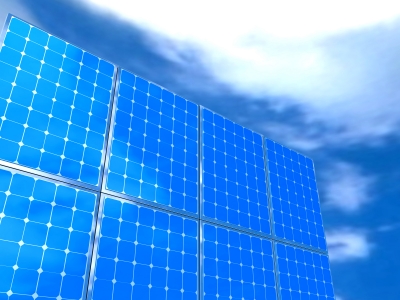
Who knew?  I didn’t until I started searching through the terrific West Palm Beach Office of Sustainability website and discovered that Homeowners Associations are prohibited by Florida Statute 163.04 — Energy Devices Based on Renewable Resources to prohibit solar panels (as well as rain barrels, clotheslines, etc.)   This is very good news for those of us in Sunshine State condo-land where solar energy is an obvious choice.  The only surprise is how slow we have been to adopt it and HOA’s rules and regulations may have contributed to the foot-dragging.  That could change quickly if enough people want it.

Another plus for solar energy: the recent signing of Florida HB 277 which means that adding solar panels (or other renewable energy systems) to your home will not increase your property taxes.  Admittedly, this is not quite as strong an incentive as the Federal tax credit for electric vehicles, but we’ll take it.  The law goes into effect July 1, 2013 for installations after January 1, 2013.  Nice going, Florida!  This cheered me as much as reading that Boulder, CO, has a one-year fracking moratorium.

This year, solar panels, next year, backyard chickens!

Get educated and motivated about solar energy.  A few links to prime the pump.
One Block Off the Grid http://1bog.or and  http://howsolarworks.1bog.org
Vote Solar Initiative: http://votesolar.org/who-we-are/
Florida Solar Energy Industries Association http://www.flaseia.org .


2013 Walk for Our Grandchildren

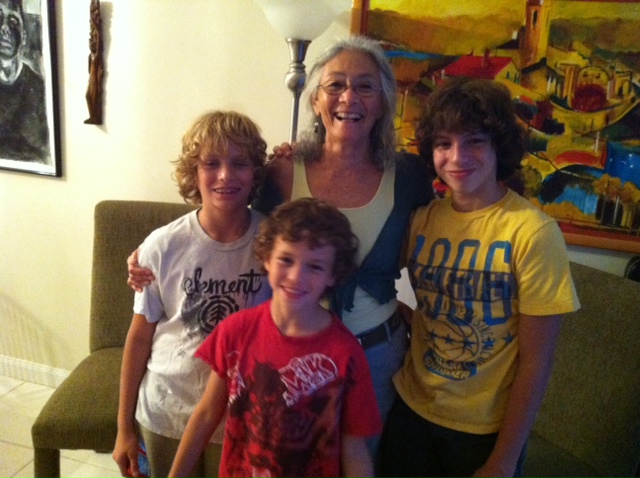
Here I am with three of my five grandchildren, the reason we (my husband and I) will be joining the 2013 Walk for Our Grandchildren this July and rallying with 350.org’s  Summer Heat campaign in front of The White House, July 27.  We mean to hold President Obama to his inaugural promise on the environment.

Me and the Brothers Cole

I’ll leave the arguments over whether global warming (or climate change, if you prefer) is caused by humans to those who believe there is value in assigning blame.  I believe it was settled by James Hansen decades ago.  We are taking responsibility for what happens next because it will affect the young people in this photograph and our other two grandchildren, and millions of children who did nothing to deserve the mess we are leaving them, and will have to deal with the consequences of our profligacy.

I don’t know if this walk on Washington will have the impact on the power base that other walks did, for civil rights, women’s rights, the end of the Vietnam War.  And it certainly won’t mean that I will stop shrinking my carbon footprint by all means possible: food choices, energy, transportation, consumption in general.  If Colin Beavan could go ‘no impact’ in Manhattan, the least I can do is go ‘low impact’ in Florida.

Walking the walk also doesn’t mean that I am giving up on the Transition movement (not when founder, Rob Hopkins, took his first flight since 2006 to make his case to American funders), although I am learning how challenging it can be to find common ground beyond personal agendas, my own included!   We all need to do more, much more, than recycle, reduce, reuse, and sooner rather than later, without any certainty that they will change the future.  As  Elizabeth Kolbert writes in The New Yorker, May 27, inaction is a “march to disaster.”

Food in My Kitchen

Emalee veggies

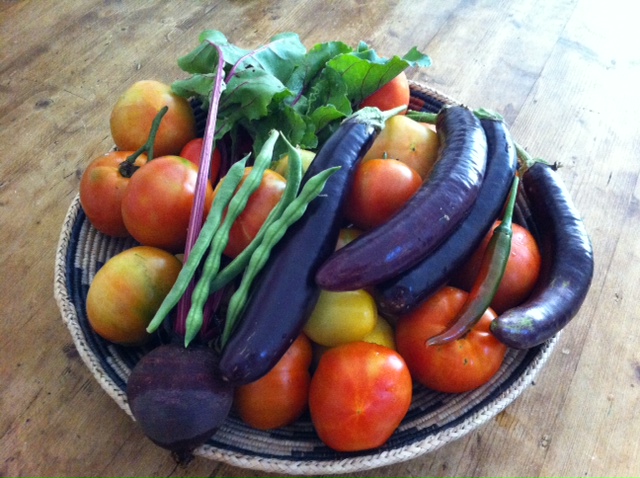
See this basket?  All of it came from my friend, Emalee’s backyard, a no-till vegetable patch established in 2012 with compost from the city of West Palm Beach (you have to provide the truck, some muscles and a wheelbarrow) and still going strong.  I came home with Japanese eggplants and tomatoes in abundance.  What to do?

This morning, I started chopping and slicing and sautéing, O Mio Babbino Caro playing in the background, and by noon, I had the base for a Vegetable Korma — I’ll add the yoghurt just before I serve it — and a caponata from the Kripalu cookbook series (a good way to preserve tomatoes and eggplant).  The curry was going to be our lunch, then my spouse called from the dentist to say he needed to have an all liquid lunch.  So, I quickly turned some broccoli, CSA and home-grown, into a soup.  Here’s the recipe for the Broccoli Garlic Soup:

Two cups of tender, washed broccoli stalks
4 cloves of garlic mashed
2 T.  olive oil
1/3 – 1/2 cup of water
Sea or kosher salt to taste

Put everything into a heavy saucepan, cover and cook until most of the liquid has evaporated and the broccoli stalks are tender but not mushy.  Time varies, but about 7-10 minutes should do it.  Pour it into the blender jar.  Add water to just cover and puree until smooth.  Serve room temperature with a dollop of yoghurt on top.   The broccoli prepared this way is delicious as a side as well, and I have Dr. Andrew Weil to thank for the basic recipe.  I’ve used it for green beans and broccoli rape, and it’s simple and good.

I realize that many people, e.g. the single mother of two in A Place at the Table , the documentary about hunger I’ve been writing about, do not have ready access to fresh, local produce.  And that’s something that can change as more people start-up community gardens in  urban ‘food deserts’.  But there is also much she could do with staples like lentils, black beans, and chick peas, if there was somewhere she could go to learn.   Great nutrition for her kids and herself at very low-cost prepared without fancy pots or gadgets, now that’s social action through food, and well worth working on.   

Since seeing the documentary, I’ve been surfing around looking at food bloggers, especially those with a social conscience, and yesterday, I hit a bonanza.  The Giving Table.  I like their slogan, too: Doing Good With Food.  On April 8, bloggers were invited to add content to their sites in recognition of hunger in America.  http://www.givingtable.org/food-bloggers-against-hunger  There is a ground-swell of passion for solving this intractable problem and it gives me hope.

The Seat is Going Anyway…

This summer, I want to be in the Northeast for about a month, to visit family and friends, give my yoga practice a boost with a few days at Kripalu Center in The Berkshires, and slake my thirst for art and culture in New York City.

Along with millions of other Americans, I hear the siren call of summer ‘elsewhere.’ Except that I am trying to figure out how to travel with the smallest possible carbon impact. I share my dilemma with a friend who is bemused that I am considering taking a train (awful food, noisy) because I believe flying takes the biggest toll on the environment. Yes, I know the seat is going anyway.

Probably driving is the least bad way to haul me, spouse and stuff some 1,600 miles in one direction and back. I have driven up and down the East Coast enough times to own a dog-eared Road Atlas with notes about interesting food stops (Gulf oysters at St. Augustine Beach), good radio stations, clean toilets, as well as places to avoid. When planes were temporarily grounded after 9/11, we drove from California to New York, four nights, five days on the road. I’ve never added up all the miles, but the call of the open road is pretty well out of my system. Anyway, driving a fuel-efficient car even with two passengers doesn’t beat traveling by bus — hands-down the most energy-efficient, least carbon-loaded way to get anywhere. Hey, rock stars do it, albeit in luxurious coach-style.

Truth is I’m more of a homebody than I used to be, even before I began to be alarmed about the environment enough to do something personally. Come to find out that when you add up heating/cooling, washing and drying clothes (a biggie) and even computer usage, our homes are where we burn through the most energy. Yikes!

If you find yourself agreeing that it’s our obligation as world citizens to take our contributions to climate change personally, you’ll find a lot of helpful calculators on the Internet. Here’s a gem I just stumbled upon which handily compares itself to other popular ones:
http://michaelbluejay.com/electricity/carboncalculator.html

You may be surprised as I was to discover that you can do more good by giving up meat and walking and/or biking more than you drive, than by swearing off flying (obviously, frequent flyers were not included in the tally). Another nugget that I am definitely tucking into my toolkit for future reference: traveling by cargo ship across the Atlantic, then using train and bus to get around.

You might want to poke around some of Michael Bluejay’s other sites as I did. In fact, I was having so much fun, I had to remind myself that I was in the midst of a blog post about my travel dilemma for this summer!

I’ve got my sights on The 100-Mile Diet: A Year of Local Eating, one couple’s answer to saving the planet, http://en.wikipedia.org/wiki/The_100-Mile_Diet, in a future post.