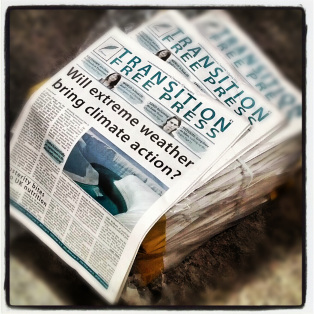
Transition Free Press: Slow News

TFP img_20130130_190624

The words ‘free press’ are always going to get my attention, and not only because I once worked at – and adored — a daily independent newspaper whose editor was known for straight-talking opinion pieces.   By the time it was shuttered by the military dictatorship that took over my country, I was – unlike said editor — safely out of harm’s way, and yet I felt the loss.  Freedom of speech is a given in Western democracies, and we’ve made heroes of comedians like Jon Stewart for their sharp, fearless pursuit of what’s real.   And yet…

We live with media 24/7, steadily exposed to sophisticated and nuanced blurring of facts, opinion and motivational message.  Anyone can learn to Tweet effectively.  On Facebook, you can be Someone.  Where are the fact-checkers?  Facts are ‘marketed’ so they can be easily digested by the targeted demographic (see my last post).  Most of us get our news from television and the Internet, attention grabbing clips repeated, sound bites (like political slogans) designed to lodge in brains made lazy by a steady barrage of infotainment.  Wag the Dog, all over again.  Or TMI?

So why relaunch Transition Free Press (May 2014), a print newspaper you can hold in your hands, copy, highlight, and pass around?  It seems so throwback, retro, so slow.  Exactly!

…many of us want to explore and voice another sound, another story. One of those stories is about the Transition movement, in essence how we, as a people and as a network, respond to the triple drivers of climate change, resource depletion and economic breakdown.

 [Transition Free Press] is a publication in its own right: it is not part of a corporate strategy, or a mainstream business. It is pure editorial run by seasoned Transitioners, and in a time where the media is controlled every which way by government propaganda that is an extraordinary thing.  ~ Charlotte Du Cann, editor

Here’s my gift to you:  a sample edition of Transition Free Press. http://issuu.com/transitionfreepress/docs/tfp_1final_online to page through on your screen (for now).  If you’ve wondered how people all over the world are responding to crisis…You can in the space of a few minutes flick through 24 pages and see what Transition means as a culture, a whole new way of living on the planet. It’s a multi-voiced operation. It’s a We thing. During the pilot over 100 contributors wrote stories, telling us about their projects, writing them from the field, from experience. Here I am! Here we are!

Embrace it.  Become a subscriber (I did).  Share Transition Free Press with your Transition group or wanna be’s.  Talk about it.  Learn from it.  Slow news we can trust and put to use.

Charlotte Du Cann also writes a stunningly erudite blog at  Charlotteducann.blogspot.co.uk,

What’s Your Position As The Ship Goes Down?

This Low Carbon Life Archive

Want everyone else to buy into environmentalism? Never say “Earth”

Wrote about the communications issue here: https://transitiontales.wordpress.com/2013/08/ Think I need a new tag line for this blog!

Downtown Alleys

“Let’s start the day with a revolution – one that happens inside your mind!  It is not about thinking outside the box, but rather realizing there is NO box to begin with!  ~ Sherryl Muriente

Back alleys don’t usually get much respect, and the alleys of West Palm Beach are no exception.  FAU School of Urban and Regional Planning instructor, Sherryl Muriente, aims to change that, with the help of her students and a diverse group of area residents and organizations.  We came together at C’est La Via – Rethinking the Alleyways, a visioning workshop held at 312 Clematis, a gallery on one of the busiest downtown streets.

Downtown Alley2I got invited because Sherryl had read a Transition Tales blog post and saw synergy between Transition and her passion for this work.  Indeed there is! After she messaged me, we spoke at length on the phone and I got very excited about the concept of urban acupuncture: small-scale interventions to transform the larger urban context.

Yoga, which I practice and teach, offers something similar: small, incremental changes in the body/mind that add up to better health and relationships over time.  Transition works like that, too: small groups of committed people who just do stuff with what they have, right where they are.  The core group was FAU graduate students, eager to interact with the community to make things happen.  I chatted with Jesse Bailey of  West Palm Beach Downtown Association who blogs at WalkableWPB (read his post about how Asheville redesigned itself into one of the most livable cities in the country), and with Aaron Wormus, creator of the lively blog, A Guy On Clematis.  My Transition colleagues, Mary Jo Aagerstoun of EcoArt South Florida , Ashley Moore of Permadigm Initiative, and my ever-supportive spouse, were in the group.   My tribe!

downtown alleys3“Think from your gut,” Sherryl instructed us, as we trooped out into the alleyway parallel to and south of Clematis to see what we had to work with.  It was a cool evening; the light was lovely, and the excitement infectious.   The block-long alley is perfect for pedestrians and has, as they say, good bones.  Better lighting and lots of paint would do wonders, of course, but through the lens of Transition, it wasn’t difficult to envision edible landscaping planted in a lovely courtyard; an instant community garden take shape in an open lot; murals on the walls of the narrow alleys; food carts, a mini-farmers market, sidewalk cafes, musicians, puppeteers and other street performers.  It could become a mini-festival; a win-win for building owners, merchants, residents and visitors.

Everyone was abuzz with ideas.  Soon, we would have a chance to share them back in the gallery, as helpers scribbled words and pictures on flip charts – Open Source in practice!  It made me think of Rob Hopkins’ description of Transition as more “party than protest” and exactly the model I aspire to for Transition Palm Beaches.

C’est La Via will be meeting against this week to talk about where we go from here, and April 12 has been tentatively set for our work day.   Let the revolution begin!

WalkableWPB

AGuyOnClematis

Why Compost?

Because it is a zero waste strategy ~ Because it restores and remediates the soil  ~ Because it is quiet activism you can do without leaving home or carrying protest signs

Today, thousands of young people like Rachel Walsh of Transition Tallahassee are in Washington to protest against the KXL Pipeline, much as my spouse and I did last summer in the Walk for Our Grandchildren.  Standing up, speaking out, boycotts, even subjecting one self to arrest, are effective ways to oppose injustice in all its forms.   If enough people participate, e.g. Gandhi’s march to the sea, the March on Selma, even the original Boston Tea Party, these actions can rock the known world.

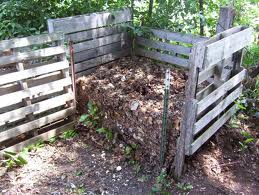
Jean's compostWhat if take-to-the-streets activism of this nature isn’t in your nature?  Food activism, in which composting is a key element, is the perfect local DIY project that contributes to a healthier, more sustainable community right away.  As the documentary, Symphony of the Soil (now available in DVD) showed us, reclaiming our soil even on a small-scale can be effective because everything is connected.   Doesn’t it make sense to convert yard trimmings and organic food scraps – yes, even conventionally-grown vegetables – into next growing season’s soil instead of paying to have them removed?  Not that I’m advocating any more lawns for South Florida however much carbon they might sequester, but this is Green Gold just waiting to happen.  Take a look at Composting 101 from the US Composting Council, a national, non-profit and trade association, and see how this all works.

Composting is very much on my mind these days because, thanks to Margaret and Norm Robson, two revered elders and pillars of my UU faith community, we are going to soon have a place where we can put these ideas about composting into practice – a mini-revolution in the making.   We do a fair amount of food service already, some of it prepared in our commercial-sized kitchen, and every Sunday there is an ample deposit of coffee grounds.   Habits are sticky, so I don’t have any illusions that it will be easy to get everyone on the composting bandwagon right away.  Even if we convince half of our congregation to participate, this will be – like our vegetable patch and butterfly garden – another small model to practice and experiment with.  Nonetheless, I am optimistic because activism is a core principle; we already support Fair Trade coffee and chocolate with our purchases; we recycle clothing and household items through our thrift shop.   Small, committed effort works; it is “the only thing that ever has.”

If you are among the shrinking number of people who grew up on a small family farm, the value of composting will not be news to you.  I didn’t, yet managed to glean a little bit of knowledge from my generous next-door neighbor who grew the most flavorful, succulent New Jersey tomatoes in a small bed in the middle of his back lawn, using coffee grounds and egg shells as fertilizer, and picking off the bugs by hand.  Another source was a family elder who would enrich the soil around his citrus trees with ground up fish bones.  I experienced my first Victory Garden in the UK, carefully tended  by my aunt and uncle, who would bring what they couldn’t consume to the weekly farmers market in the main square.   It was a small supplement to their modest income, and a social time for them.  It’s no surprise that the Transition Movement is flourishing in the centuries-old small town cultures of Europe.

Most of us of a certain age have memories of food coming directly from local producers, unmediated by supermarkets, which is one reason I believe our compost benefactors are so enthusiastic about this project.  Possibly they share many of my environmental passions although it’s hard to imagine them hugging a tree or chaining themselves to a fence.

It will become increasingly important that we share our memories of where food comes from with our grandchildren, especially if they are urban- or suburban-raised and can’t tell a carrot from a cabbage when it’s in the ground.  Accompany them to the farmers market – better yet a real farm! — and let them see, smell and taste for themselves.

Let’s all remind ourselves that, as Wendell Berry wrote: “Eating is an agricultural act.”  It is also an act of social activism.  Composting completes the cycle, transforming our so-called waste into next year’s crop.  So it has been, and could be again, but only if we understand and act accordingly.

A Lifesized Lego Set for Farmers and Makers

Open source ecology. Bring it on!

Shawndra Miller's avatarShawndra Miller

I was invited to visit the Indiana Small Farm Conference this past weekend, and was I ever glad I went. I got to reconnect with some farmer friends and make new connections. I learned about the challenges facing the people who grow our food on a small scale. And of course lunch was delicious, as well it should be with food supplied from local farms and prepared by the stellar whole-foods caterer known as The Juniper Spoon.

But the highlight was a session with a representative from Open Source Ecology. This is a group I’ve had my eye on for a while because of the radical way they are working to take back the building blocks of modern life. The goal is nothing less than a modular, low-cost, DIY “Global Village Construction Set” of 50 machines that would meet the major needs of civilization.

The best part? The plans are…

View original post 358 more words

End Factory Farming; Stop Runaway Climate Change

Will Allen, organic farmer ~ Change Your Diet ~ Buy Local

… the largest elephant in the room of climate chaos is our food and farming system. And hardly anyone is talking about it … We need to change our food habits. We need to stop eating factory-farmed meat and milk products. Since over 90 percent of all non-organic meat, dairy and eggs in the U.S. come from factory farms, we need a nationwide boycott and marketplace pressure, in the form of a CAFO labeling campaign.

Will-Allen-01-200x200Will Allen, Ph.D., organic farmer/teacher/activist and author of The War on Bugs, isn’t one to mince his words, and his keynote at the second Healing Our World and Ourselves Conference at the Unitarian Universalist Fellowship of Vero Beach last week, documented exactly what kind of mess we are in and what we have to do to get out of it.

Like Vandana Shiva and the permaculture community, Allen delivers a clear message: since agriculture as it is currently practiced is “the single largest contributor of greenhouses gases,” we must eliminate the products of factory farms and create new markets for local, organic, sustainable agriculture by voting with our food dollars. That such a shift in diet could also eliminate some of the diseases of the so-called rich world is already in the popular culture via books (Michael Pollan. “Eat food. Mostly plants. Not too much.) and television shows (the ubiquitous Dr. Oz).  (And yes, it will reduce belly fat.)

Compared to some of the latest techno fixes for “energy shortfalls” (some euphemism!) that come across my desk regularly, e.g. the moon as a solar plant, the switch to organic, locally-sourced crops and humanely-raised livestock seems like a reasonable strategy. The myth that organic food is too costly has been debunked, see my post Externalities.  And it wins the taste test, hands down.  But it would be naïve to imagine that Big Ag will give up without a fight, any more than Big Oil will suddenly switch to renewables.

What to do?  For one thing, you might post the link (see below) to Will Allen’s article to your social media circles.  You could pay a virtual visit to Cedar Circle Farms and see how he is training the next generation of farmers.  Perhaps you can fund a scholarship or two while you’re at it.  Educate yourself on the subject (see More Reading).  If you want to join the next march against Monsanto, have at it!  But look into your own eating and food-sourcing habits first.  With a 4°C warmer world already looming, we can’t afford the decades it took to make cigarette smoking decidedly uncool, or to get folks to routinely recycle.

Here are a few more things you can do today: check labels in your own pantry of staples and make a plan to eliminate all GMOs; don’t eat or minimize consumption of processed foods; ask your supermarket for more organic produce; let the meat and dairy departments know you want products from pastured, humanely raised livestock.

Here are a few things you can do in the coming weeks/months:  Go meatless as much as possible (here’s a great recipe for Hummus); grow something, however limited your space.  It just feels good; when you buy organic produce, SAVE YOUR SEEDS; compost your vegetable wastes; get familiar with the laws in your community – on the books or unspoken – against backyard vegetables and/or small livestock.   You don’t know until you check.  For example, most of us think we don’t have the right to solar panels if we live in an HOA.  Actually, this is not true.  Use your farmers markets to support the farmers and ranchers in your area.  Get to know your farmer.  Some, like our CSA Kai-Kai Farms, use pesticide-free sustainable methods, but are not certified organic.  We trust them.  That’s good enough for us.

If you have an idea for a good PSA on this or related topics, let me know.  If the idea of using social media to spread the word lights you up, let’s collaborate.  Let’s plant some virtual seed bombs around our neighborhoods and get this started.

More reading:

Climate Chaos: Boycott Genetically Engineered and Factory-Farmed Foods, Will Allen and Ronnie Cummins
Organic Consumers Association
Cedar Circle Farm
USDA Organic
Food Growing Summit 2014
Beyond Pesticides

Transition and Occupy

Transition and Occupy  *  Rob Hopkins responds  *  Can We All just Get Along?

Is Transition like Occupy?  A good question can raise the stakes; inject some excitement, into any presentation. I’ve experienced this fewer times than I would like.  But last Saturday, I was the person on the receiving end during my presentation on Transition to Ashley Moore’s permaculture course at Gray Mockingbird Community Garden in Lake Worth.

SONY DSCIt’s always helpful to say, Good question! and in this case, I meant it.  The answer is, No, and … Occupy and Transition have some obvious similarities.  Both are grassroots movements; both emerged from a conviction that the economic/political system was broken; both were rooted in action: Occupy, in the physical occupation of public spaces to demand change; Transition in community projects to make change.  Occupy is against business-as-usual; you could say Transition is focused on a better way to do business.

Many in my liberal religious congregation were very supportive of Occupy.  We have a strong tradition of social justice and our own martyrs of the Civil Rights Movement.  So in no time, there arose a cadre of people willing to demonstrate regularly on the sidewalks in front of our property. We held a Saturday workshop on Occupy, including a session on Single Payer and another on songs of protest.  Protesting can produce a high, no doubt.  And, whatever happens to the Occupy movement now, we will not soon forget its identification with the 99%.

Although it’s not my thing, I have supported and/or engaged in protest actions for a specific goal:  equal rights for women, Move to amend, stopping the KXL pipeline.  So, although I agree that business-as-usual is in great need of a major course correction, I decided to remain on the sidelines of Occupy, and have happily found a home in the Transition movement.

Attempting to differentiate between Occupy and Transition led to some lively conversation and I’m very grateful that the question was raised.  But there is no more articulate spokesperson than Rob Hopkins himself in how the movements differ.  Here’s a response after he visited as a speaker during the Occupy London action in 2011.  Here are some key quotes (links to the entire article and others follow).

First, like the appreciative enquirer that he is, Hopkins gave tribute to the value of Occupy:

What Occupy is doing that matters so much is that it is holding a space.  It is holding a space where the discussions can take place on their own terms about what is broken and what needs fixing.  It is underpinned by a realisation that this is a crucial time of change where everything is on the table, where business-as-usual is no longer an option.  It isn’t making demands because that would put the power in the hands of the people in power to decide whether or not to respond to them.  It is holding the space for the conversations, and is doing so on its own terms.  I admire that.

And here were some key divergences:

You can’t … just base deep change on an analysis of what is wrong.

Transition says to people “take this model and do it where you are”, whereas Occupy suggests coming together to suspend your life while you explore, with others, the question of what’s the best thing to do now.  Transition is about building that into your own life, right now.

…what everyone can do, in a time when it is increasingly clear to anyone who thinks about it, that business as usual is no longer a runner and that new thinking is needed and soon, is to occupy, in their own lives, that sense of possibility, that space for asking the questions that matter.

You might say that Occupy suggests occupying, for example, Wall Street, while Transition suggests occupying your own street, putting up runner beans and solar panels rather than tents.

Can We All Just Get Along?

That is the bigger question.  What would it look like if we reached beyond our differences and found common cause?  Sometimes, it seems possible, see: Fissures in G.O.P. as Some Conservatives Embrace Renewable Energy.  And A Green Tea Party?

So whether you are a 20-something in a tent city demanding change in the current system that rewards wealth at the expense of everyone else, or a 70-something grandmother who believes that we have to live with less so that others – including future generations – can simply live, we have to work together.  Because putting to rest the notion that we can grow or technologize ourselves out of this unprecedented planetary crisis, is too big a job for any one movement.

A Day at Occupy London
Comments are interesting, too.

How to Engage Occupy Movement

The Green Tea Coalition

In Search of a Transition Town

totnespoundfinal_02This week, I was out meeting with people to talk about the Transition movement, none of them in my home community.   Why is that? You may ask, and I’ve asked myself.  Some answers.

First, though mine is a pedestrian- and bike-friendly town, we drive far more than we walk or bike.  Whether or not one is conscious of it, cars make us feel rushed and busy.  Most drivers tear up to a red light.  Our 25 mph speed limit is routinely broken.  I’m no social scientist, but from my observations, people who depend on their cars for every errand, do not make good neighbors or stronger neighborhoods.  In my townhome community, it is the dog-walkers and the young parents out with a stroller who get to know each other.  We don’t have to become best friends, but friendlier and more helpful would go a long way.

Second, we have no walkable downtown or town center with the mix of diverse small merchants to draw residents in for those casual encounters and conversations that connect us.  Manufactured downtowns are no substitute, no matter how many musicians they hire or networking events they sponsor.  (I’ll save my riff on networking vs. community for another time.)

Shoppers conditioned to the mall atmosphere with mind-numbing music are not generally interested in other people.  We are a fairly affluent town dominated by the largest shopping mall in the region.  Big Box stores, fast food and restaurant chains, line a major thoroughfare, offering impersonal service, at best.  I would trade them all for a friendly chat with the guy at my local hardware store about which hose won’t kink up on me.

In a sense, we’ve designed for things like privacy, personal space and comfort, and security – the number of gate-secured communities here is astounding given the relatively low crime-rates —when, the truth is, what the world needs is people who are more trusting, capable of sharing (e.g. the Open Source revolution), creative and flexible.

On Wednesday, I had lunch with a young permaculture teacher who was about to launch a four-week course.  We agreed that we both do our best thinking outdoors, so although it was a day of heavy rain, we sat in a Tiki hut in an environmental education center where she is a graduate assistant.  As you may know, the Transition movement was founded by Rob Hopkins, a permaculture teacher himself.  It draws on many of the principles of this nature-centered discipline, so I am excited by her invitation to talk about Transition with the students in the course and to learn from them.

That I had to drive nearly a half-hour to have this meeting wasn’t lost on me, of course.  I live in a county the size of Rhode Island, with a population perhaps even more socio-economically diverse.  Also like RI, much of our wealth is a fact of location: the Atlantic Ocean washes both our shores, bringing us tourism and high-end real estate, and all the services that support both.  To have the two major sources of our wealth at risk from a rising sea should be a fact that brings us together to search for solutions, right?

My next meeting with a veteran community organizer took me to a town also some distance from mine.  I was there to explore the possibility of introducing the ideas of Transition.  This community more closely resembles the small towns and cities where the Transition movement has caught on, all around the world.  It is walkable, with a vibrant downtown, many festivals, an up-and-coming community garden, and a lot of civic pride.  As an outsider, albeit an enthusiastic and frequent visitor, I am at something of a disadvantage here as I would be anywhere I don’t have roots (though I do have friends). So I was really grateful for the honest assessment I took away, that the Transition message might not be welcomed by all, that is could be controversial.  I couldn’t help but remember Rob Hopkins’ caveat: there were no guarantees that Transition will work everywhere…or at all.

I decided this morning to research sources other than my Transition texts on  what makes a community respond to climate change with action, rather than denial in one form or another.  The answers (from a NASA study) may surprise you.  In some cases, a community gets activated because of an obvious problem like flooding or drought or a Sandy-size storm.  The 911 response, you might say, where people who may not agree on what the underlying causes of the crisis are, can still come together to rebuild smarter and prevent or mitigate future crises.  In other words, they are not waiting for action from the government.

” Successful groups take action against climate change even though they don’t completely understand everything that might be needed to reach their long-term goal. They proceed by trial and error to make progress step by step. “— Dr. Ron Brunner, University of Colorado

But in many others, economic opportunity is the impetus.  There are numerous examples, but one of my favorites is the Danish island of Samsø which began working on reducing its carbon foot print in 1998 (via locally-funded wind turbines) and today produces excess energy it can sell.  Closer to home (and pre-Transition movement), there is the Ithaca Hour, a form of currency invented in 1991 in Ithaca, NY, that keeps money circulating in the community, about $100,000 at the moment.

Communities that support local businesses, grow (or raise) much of their own food, find ways to save money on energy, and clean up their air, water and soil, are not only better positioned to withstand future uncertainties.  They are places most of us want to call home.

Visit Samsø

Creating Economic Democracy

Seeking Balance

DAncing-Warrior-2As a yoga devotee and Libran, I understand the importance of balance.  These days, it is especially challenging to find mine.  On Saturday, I gathered with a diverse group of artists, scientists, teachers, entrepreneurs, and community organizers in what I hope is the first of meetings that will breathe new life into the Transition movement in our area.  Flip the coin.  Today, I started a free, 4-week online course called Turn Down the Heat: Why a 4°C World Must Be Avoided, designed by The World Bank and with a multi-national enrollment of over 15,000.

Week 1 has begun with a series of videos and texts taken from a report for the World Bank by the Potsdam Institute for Climate Impact Research and Climate Analytics.  That this report by such an organization exists at all should be enough to stop the insanity of climate change denial.  But I live in Florida where fundamentalism infects politics and business-as-usual is everywhere evident in rampant coastal development, so I’m not holding my breath.

I’ve been reading extensively about climate change for the last two years, and watching it move from bad to much worse in the same time frame.  Turn Down the Heat has not yielded any big surprises so far.  It has just provided more statistics – presented in the level tones of academia – to better understand the catastrophe that is coming if we continue to live (eat, transport ourselves, consume) as we have been.  And if that ‘we’ gets bigger as more of the developing world enters the home- and car-owning status we consider our birthright in the wealthy world.

As I told the group of eight on Saturday (during our go-around), being introduced to the Transition movement by a friend pulled me out of a tailspin of despair that began with the Deep-Water Horizon spill in the Gulf of Mexico.  It drew me toward activism in a way that all the reading (Limits to Growth, 1972 and its sequels, George Monbiot’s Heat, 2006) and films like Food, Inc., and Gasland, Part II, had not.  So I beg to disagree with the course presenters that knowledge alone can bring about a transformation in society.   It will take a village, small town, and city — everyone in: one conversation,  vegetable plot, eye-opening documentary,  potluck,  book group,  vote,  policy changed — in short, a movement.  Our grandchildren deserve a revised standard of prosperity,  a slower, kinder, more mindful way of life, even if the future at 4°C were not so horrifyingly unthinkable.  The truth is, we all do, and many of us long for it.

Transition appeals to so many people because becoming more resilient as a community – supporting local businesses, growing our own food, sharing our tools and skills more widely  – is just that kind of revision, a welcome remedy to hyper-consumerism and outsourcing jobs and wealth, even if climate change were not a growing threat.  That was, I sense, what made our newly-forming group feel so exciting and full of promise.  We have so much to offer each other and our communities.  Gaining traction may not be easy, but it’s worth the effort.  May we be able to move ahead with a shared sense of urgency.  May we attract more people into the process itself, the fun of making new friends and learning new things, the power of just doing stuff.  

Want to know more about Transition?  Start here:

http://www.resilience.org/stories/2013-11-11/rob-hopkins-introduces-new-yorkers-to-the-transition-movement

Free pdf of The Transition Handbook by Rob Hopkins, http://www.cs.toronto.edu/~sme/CSC2600/transition-handbook.pdf

Rob Hopkins’ The Power of Just Doing Stuff, widely available and a book group possibility.

Why Transition? Five Good Reasons

Transition imageSome things are so forehead-slapping obvious, you can miss them.  (From my journal entry, Sunday, January 19.)  A year ago, I had put together a tour of Just One Backyard, Dr. John Zahina-Ramos’ amazing urban edible garden project.  Everyone who attended was excited by the possibilities.  In the interim, my core Transition group of  ‘mullers’ — that is, people who are thinking about what we need to do to launch a movement in our community — lost membership (to relocation) and momentum.  Other projects, e.g. a vegetable patch at my congregation, First UU of the Palm Beaches, the Walk for Our Grandchildren last summer, Symphony of the Soil in the fall, came my way and claimed my attention.  

Clearly, the time for a self-administered Transition booster shot has arrived.  Obvious choice: back to basics — the ideas and practical tools of the Transition Movement, shared as widely as possibly.  Yesterday I began posting direct quotes from Rob Hopkins’ The Transition Companion in the Transition Palm Beach Startup Facebook page and other FB groups to which I belong. Think of them as seed-bombs (another tool about which more in a forthcoming post).

Here are five reasons for investing in Transition that speak to me strongly, mostly quoted from The Transition Companion.  In some cases, I’ve cited the original source to facilitate tracking it down.  If you are uncertain about what the Transition Movement is, this list will help, and so will the links that follow.  If enough of us clear-thinking individuals really grasp the fact that the climate has already changed, we could stop confusing social media for action and find the thing we can do together.  

So Why Do Transition?

1. Because it’s fun! Transition is a community-building response to climate change and looming resource inequality that is “more exciting, nourishing and rewarding than not doing it.” ~ Rob Hopkins, The Transition Companion: Making Your Community More Resilient in Uncertain Times. (You could make some new friends and learn some new skills.)

2. “…because a more local economy in which assets and key enterprises are owned and managed by and on behalf of the local community, offers a better route to social justice, as well as local economic resilience than business-as-usual does.” ~ Rob Hopkins, ibid.  (Commit 10% of your purchases to your local businesses as a start.)

3.a  Because of climate change.  “It may seem impossible to imagine that technologically advanced society could choose, in essence, to destroy itself, but that is what we are now in the process of doing.”  ~ Elizabeth Kolbert, Field Notes from a Catastrophe: A Frontline Report on Climate Change.  (Kolbert is of course speaking from the perspective of an overwhelming majority of scientists.)

3.b  “It is clear that the challenge of climate change is about far more than low-energy bulbs, solar panels and slower driving speeds.  It is about a profound shift in what we do and how we do it; a complete adjustment of what we imagine to be lying in front of us, of our expectations of the future.“ Rob Hopkins, ibid.  

4. Because of economic crisis.  “Conventional economic growth and cheap oil have marched hand-in-hand for the best part of 60 years; within a few years, it will have become increasingly apparent that both are on their last legs.”  Jonathan Porritt, Capitalism: As if the World Matters.  

5.  Because it gives me hope.  “We often underestimate the power of hope – what in Transition we call ‘engaged optimism’. Getting started and making change in our lives is a hopeful activity that touches people deeply.”  Rob Hopkins, ibid.  (Change is easier in the company of friends.)

You can find more reasons and longer excerpts here: The Transition Network Sign up for Rob’s blog while you’re at it.  And check out the latest news about Transition: http://www.transitionnetwork.org/transition-free-press