From Consumers to Producers?

We Can Do It! Rosie the RiveterIt must be something in the air or drinking water, but I am coming across this consumer vs. producer idea more and more lately.  Just today, someone posted on Facebook a story about how Cuba, which became an engineering and technological wasteland after the US left and the Soviet Union’s economy stalled, has pulled itself– out of necessity — into the 21st century by a new DIY ethic – one might even say ‘chic.’

The other item that floated to my desktop was that in Greece, whose economy is in dire straits,  young people have given up looking for jobs in urban areas and are going back to the land.  The reason they can is that, somewhere in their backgrounds, there is a homestead that belonged to a grandparent or other relative, a house and a garden in a village.  Romantic?  I doubt it.  Practical, yes.  They are returning to places where they can learn what previous generations took for granted about self-sufficiency and making a decent life without so goddam much stuff.  Many are taking up farming or learning to prepare food.  They are acquiring survival skills and building community at the same time.

Maybe these are important models for us to study in the post-consumer age we may be entering.  Consumers  — especially those wired to their electronic ‘friends’ — don’t generally make for great neighbors.  But people who make things (or create ideas), have to connect with others: mentors, partners, co-workers, and customers.  Producers live in a world of ideas and possibilities that encourages generativity, in the sense of “making your mark” on the world, creating or accomplishing things that matter.

It’s not too late to get our hands dirty, to build things, to maintain and repair the things we have, to share our new found skills with others.  In fact, in a future where the cult of go-it-alone individualism is sure to be severely tested, it is about time.

Photo credit: Mike Licht, NotionsCapital.com / Foter / CC BY
Revolution: Orderly and (Mostly) Quiet

As revolutions go, the local foods movement is relatively well-behaved and filled with activists who are not afraid to get their hands dirty.  Its goal is ambitious: to get people to  switch their allegiance from farm products shipped thousands of miles at an unsustainable carbon cost, to locally-grown and raised foods.  If enough of us do this, the reasoning goes, we will not only have fresher, healthier foods to eat, we will develop community resilience that can withstand disruptions in the food supply chain many foresee as inevitable as the climate changes.

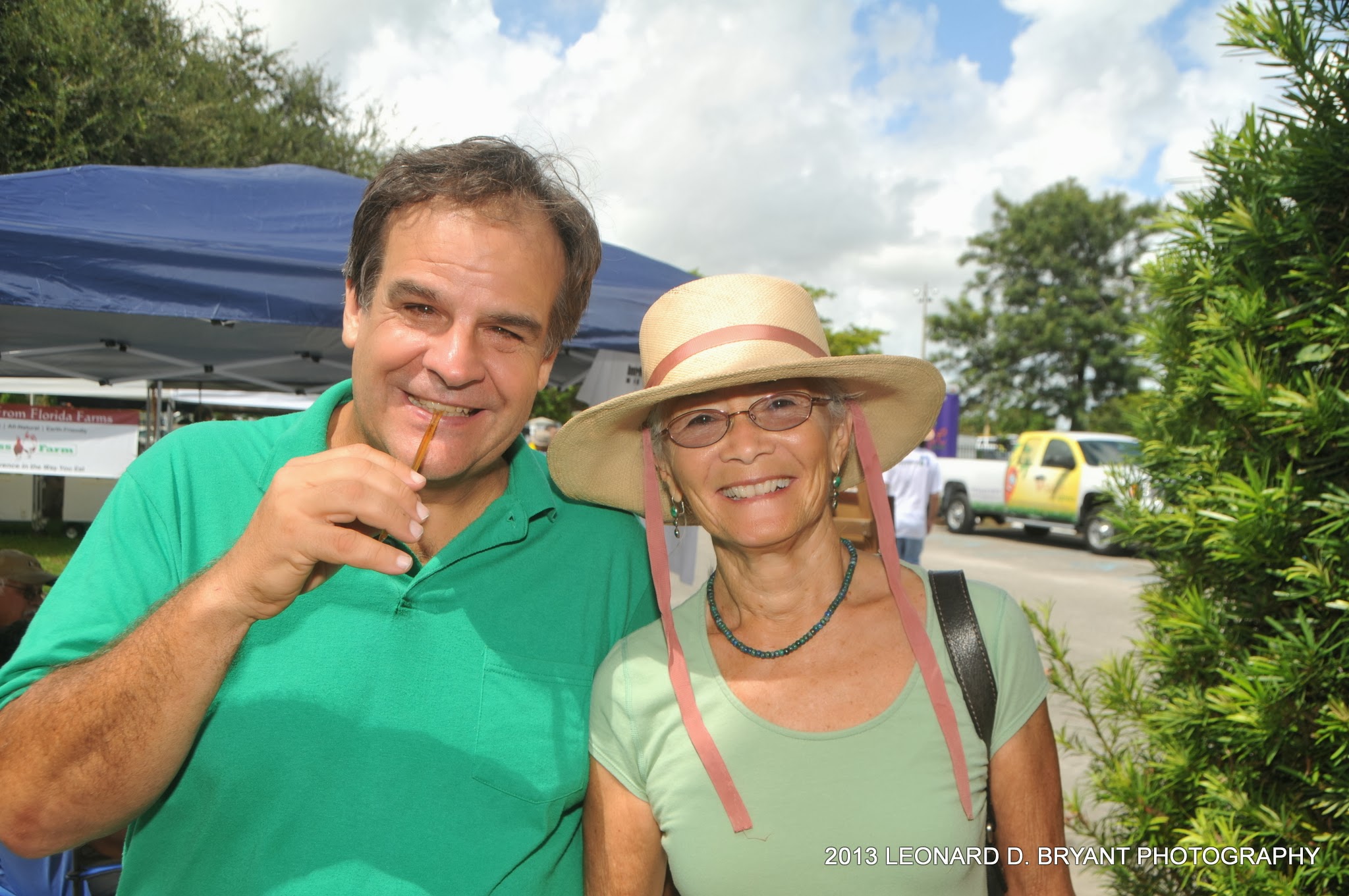
In Palm Beach Country where I live, the movement is embryonic compared to, say, the San Francisco Bay Area or most of the state of Vermont.  But on a sunny Saturday at Gray Mockingbird Community Garden, with the lively sounds of the Lake Worth High School Steel Drum Band making my feet tingle, it was possible to dream big.  The occasion was Local Foods/Local Gardens and I was on hand Brian and Marikawith partners, Brian Kirsch of Gray Mockingbird Gardens, Mary Jo Aagerstoun of EcoArt South Florida, and my spouse, Howard, to talk up and sell tickets to a special screening of Symphony of the Soil, a  documentary by award-winning filmmaker and Palm Beach County native, Deborah Koons Garcia,  November 17 at the Muvico Parisian in City Place, West Palm Beach.  The film makes a powerful connection between reclaiming our soil (and farms) from Big Ag and food security for all of us.

The timing could not be better.  In about a year, Solid Waste Authority which has been providing free compost to local backyard and community gardens in Palm Beach County, will phase out of this service.   The screening, and a Q&A with the filmmaker and other local soil and gardening experts, is intended to help launch a conversation with all parties concerned on how to address our composting needs in the future.

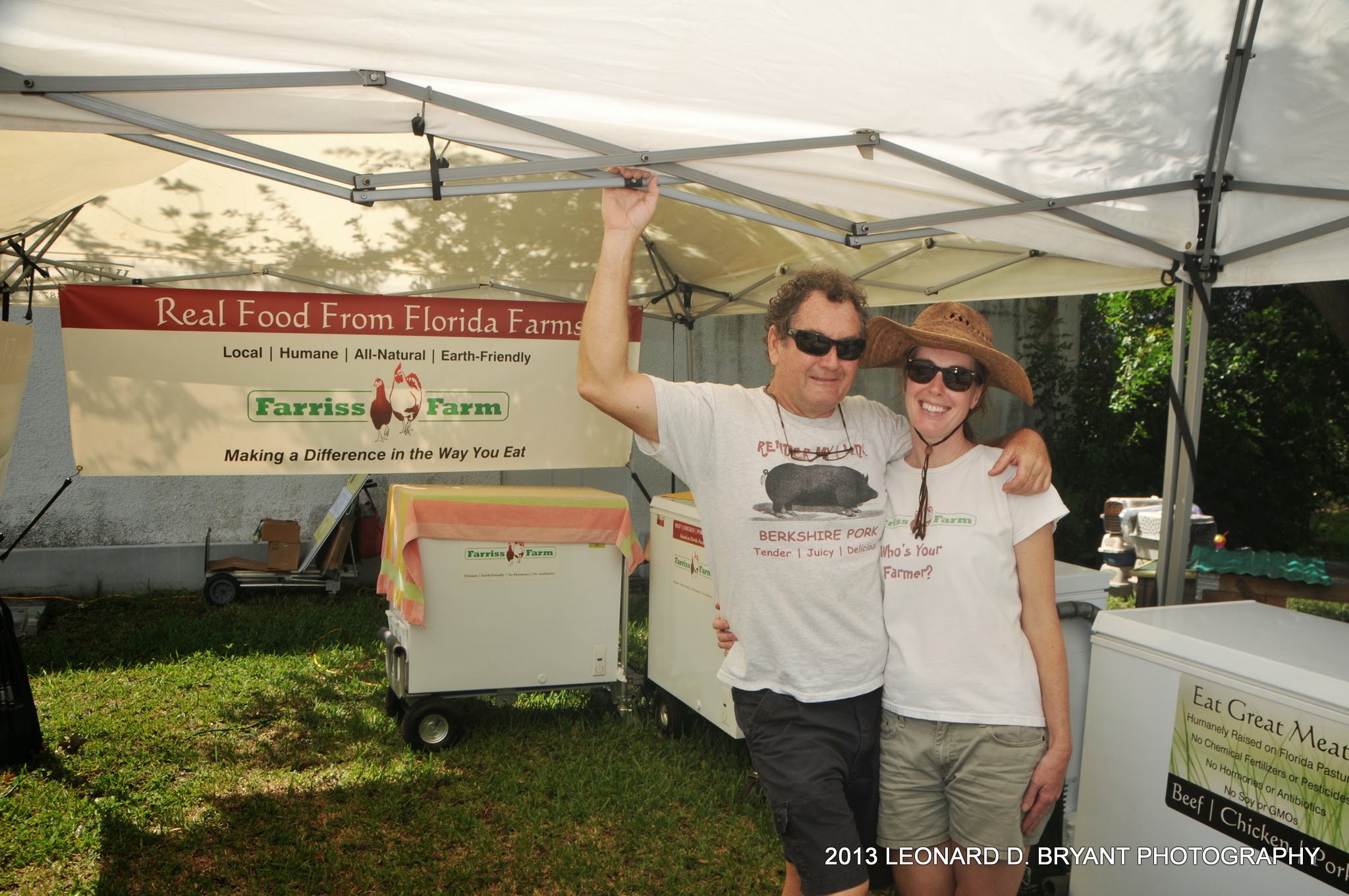
Robert and Paula FarrissWhen I wasn’t in the Gray Mockingbird booth, I was schmoozing with people like Robert and Paula Farriss of Farriss Farm who offer free-range eggs that taste like eggs, and  100% grass-fed, pastured livestock.  The term ‘pastured’ denotes animals that have been raised humanely, without hormones and antibiotics because, simply, they do not need them to thrive.  It is encouraging to know that there is a burgeoning market for products like this, for both health and ethical reasons.  I’m not likely to be a convert to mammal meat (though I have recently sampled pastured duck), but I do come away from conversations like this with a better understanding of why large herbivores are necessary for sustainable agriculture.

I had a good chat with John Zahina-Ramos of Just One Backyard about the challenge of getting the foodservice industry, restaurants included,  to understand how composting their vegetable scraps could actually impact their operating budgets.   John is an ecologist and  makes a convincing case for a more holistic way of agriculture.  JoJo Milano of Goodness Gracious Acres was also there, promoting her goat-milk based soaps.  Currently, unpasteurized goat’s milk cannot be sold as food for human consumption, a situation that I hope will change.  Joanna Aiken, Community Service Coordinator of Solid Waste Authority, also stopped by the Symphony of the Soil table and I feel confident we’ll work together well on a composting solution.  I bought some honey sticks from the Palm Beach County Beekeepers Association booth (yum!), and met Facebook friend, Susan Lerner of the Rare Fruits Council.

A fun morning invested in a cause I am passionate about.  Let the revolution spread!

(Photo credits: Leonard D. Bryant, 2013)

Thinking About Water

A water drop
sliding from the faucet
responds to the pull of gravity,
follows the path
of least resistance.  It will
find its own way back to the Source,
flowing through, over, under
or around any obstacles it encounters.

Have you ever observed
how the water molecule
cannot be separated
from others of its kind,
or how water assumes the shape
of whatever it is poured into,
or how amenable it is to change?

Have you allowed yourself imagine
the lengths to which water must go
before it returns to us,
as runoff, rain, mist, ice or snow?

What do you do with the knowledge
that six-tenths of you is water?
Do you wonder what would happen to you,
to everything you can see, touch, taste, feel, smell,
if water went away?

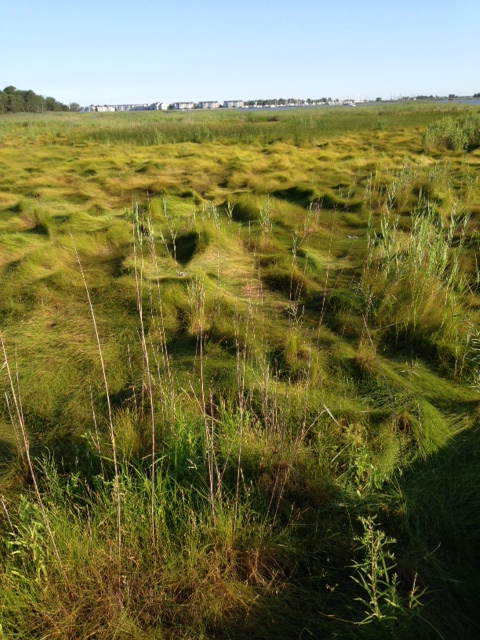
Howie at Grassy WatersWhen I was a teenager living in Rangoon, Burma in the 1950’s, water was not the reliable resource we take for granted here.  From 2-4 pm every day, water came through the tap, courtesy the municipality, and it was our job to store it in large wooden barrels located in the kitchen and bathrooms, to satisfy all our household and personal needs, including manually flushing the toilets.  Water wasn’t safe to drink without additional treatment.   We stored drinking and cooking water in recycled liquor bottles, and although I’d never heard of ‘gray water’ then, it was exactly what we were using for the small grove of bananas in our backyard and flowers in the front.

It was a lesson about how precious water is that I’m glad to say I have carried with me into adult- and elder-hood.  It really resonates today in South Florida where I live now,  at risk from too much of one kind (storm-driven flooding, beach erosion, and salt-contamination) and not enough of the other kind (fresh waters springs like Grassy Waters which supplies West Palm Beach).

If you think that a water crisis here (the topic of sea level rise is on most municipal agendas) will arrive before we feel the effects of higher prices for fossil fuels and everything that depends on them, you may want to deepen your own education about water as well as water usage awareness (Navy showers, anyone?)  Which is probably why I stumbled upon Last Call at the Oasis  (Pivot TV) one rainy (yes!) evening and was reminded just how extreme the water issue is.  It isn’t just that huge swathes of the Western  United States and Australia are suffering severe, crippling drought.  It is also that our predominant way of farming is poisoning our water supply even as its adherents (chiefly the biotech companies who profit mightily from pesticides and herbicides) claim we couldn’t live without their help.  And it’s also that energy generation itself  takes water to produce (see the University of Colorado link below), lots of it.

If you are like most people (myself included) you find education without the aura of crisis is much easier to absorb and process (which is the problem with so much that is written about climate change and the environment these days).   But I’m ready to swallow the pill, however bitter, if it means I can make some better, wiser choices about my future, and help others do the same.   Here are a few links to information I’m working with.

Water – University of Colorado Boulder — see the other videos too

Last Call at the Oasis

New York Times Review

Environmental Health News on Atrazine

Battling Syngenta

High Tide on Main Street

Signer 12,353 Reporting for Duty

You were the 12,353rd supporter to take action on ‘Stand Up to Koch Brother Obstruction’!  ~ Environmental Defense Fund

Every day, I get as many messages from environmental organizations I support (like the EDF) as from marketers or friends.  That’s a fact that worries me, although as a blogger, I am contributing to the ‘messaging’ without any real way to be sure that it leads to anything other than more of the same.  (I have the same concern about Facebook and other social media, and if someone wants to talk me out of that, I’m all ears.)

It isn’t that signing petitions and financial support, or even my 14-mile Walk for Our Grandchildren or the Climate Ride, aren’t important or effective ways to keep the focus (and heat) on the issues.  But we would be mistaken if we imagine these actions are sufficient given the acceleration of climate change and the big money obstructionism throughout all levels of government.  Not to mention that email blitzes about the environment are (mostly) preaching to the converted.  (Probably this one, too, but one can hope.)

Military metaphors are not my thing, but we ARE  in a fight to capture the attention (dare I say, imagination)  of a distracted, wired, over-worked population about the social and economic turbulence ahead wrought by climate change, if only to help them think clearly about its direct impacts on them and those they care about.

I believe all of us working on environmental issues could usefully study the Don’t Text and Drive PSA campaign now at your neighborhood theater.  Normally, I zone out while commercials run but these were impressively skillful: clever copy, great music, attractive young people (the obvious target, though by no means the only texting-addicted.)   See It Can Wait and others, readily available on You Tube.

Until recently (thank you, Bill McKibben et al for removing the gloves), U.S. environmentalism has been a “polite movement” (says journalist, Mark Dowie).  As Americans, we have been conditioned to prefer the simple and easy to swallow (however dire the reality), e.g.  Top 10 Ways to Save the Planet and its ilk.   We won’t ‘tweak’ our way out of this mess with ‘no interruption in service.’   Small steps matter as long as there are many of them, and of many different kinds, consistently applied (see the Transition movement).  As activists, we have to be as tough and relentless as the Brothers Koch, as savvy and creative as the best marketers, in making the facts known, our ideas heard, our actions powerful and enduring.

Jersey Shore: Still Standing Strong?

Standing StrongYou want to believe it, and on our recent visit to Long Beach Island, NJ, the signs of apparent recovery were everywhere.  Gov. Chris Christie makes regular reassuring visits, and in truth, the affluent summer residents — LBI swells in season to a population of 100,000 with the influx of second-home owners from New Jersey and neighboring states — have already rebuilt or are well on their way to restoring properties.  It’s salad days for the contractors and landscapers of LBI, though how many of them are locals is uncertain.  Areas with protective dune systems built in a controversial U.S. Army Corps of Engineers project, have been the fastest to return to normal.

In August, at the height of season, normalcy means beaches thronged with bright umbrellas and excited children, packed shops and restaurants, and bumper to bumper traffic on State Route 72, the only way in and out, and therefore the great leveler in times good or bad. On the South end of the island where Hurricane Sandy brought  nine-foot storm surge and 18-foot seas an open field marks the place where a trailer park once stood; dumpsters filled with debris; and many homes are, well, barely standing.  Although everyone with a stake in Long Beach Island felt the effects of Hurricane Sandy, property damage, like wealth, is unevenly distributed.  It’s no mystery why those who have want to keep what they believe is rightfully  theirs.  The puzzle is why those to whom the economic system has been less munificent — the Abandonedretired teachers, fire fighters and police, the small business owners, the middle managers, who built the modest dreams and modest homes in this little piece of paradise — aren’t taking to the streets like their cohort in Brazil, Spain, and Greece, to protest our deepening inequities.  Or not in any significant numbers.  Yet.

Media scholar, Marty Kaplan, blames “weapons of mass distraction,” the fact that we the people have allowed ourself to become addicted to a state of constant arousal about all the wrong things, things we can do little about and are, in many instances, utterly meaningless to our daily lives and our future and that of our children.  Meanwhile, the democratic process atrophies.  Here’s Kaplan in a recent interview on Moyers & Company:

[T}he stuff that is being reported on the news tends not to be the kind of stuff that we need to know about in order to be outraged. Climate change is one of the great tests of journalism…There was “The New York Times” headline about the first time that carbon dioxide in the atmosphere reached 400 parts per million. Which “The Times” said that carbon dioxide had reached a level not seen in “millions of years.” My jaw fell. You would think that that would cause a worldwide stir. And instead, it was a one-day story, onto the next thing.

“We have unemployment and hunger and crumbling infrastructure and a tax system out of whack and a corrupt political system. Why are we not also taking to the streets is the question. And I want us to…”  

Me, too, Marty.  That would be a ‘standing strong’ one could believe in and act on before the next Katrina or Sandy arrives.

Maryland Takes Lead in Climate Activism

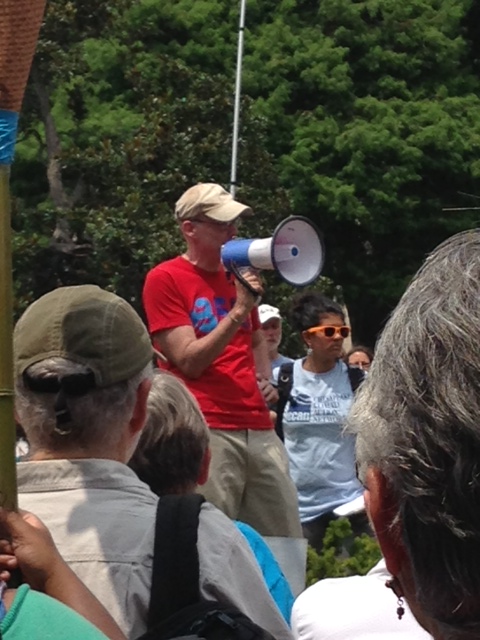
Bill McKibben DCYou might think, had you been at Lafayette Park for the Summer of Heat demonstration Saturday, July 27, that climate change is a fringe issue.  Under 300 people is my estimate of the crowd so in purely numerical terms, it was disappointing.  After all, as we were reminded by the Newseum exhibits, 200,000 people came out for Civil rights and more for the rally to end the draft and the war.  Numbers get media attention and often generate more numbers, so they remain a measure of a movement’s success. Yet numbers tell only a partial story at best.  So while we were a relatively small group gathered in Washington DC to cheer on the Green Grannies, the testimony of children, and listen with rapt attention to Bill McKibben, a great many people have begun to change their behavior as if the argument was settled decades ago (as it was).  Some of them are not afraid to use their positions of leadership to, well, lead.

Take Maryland Governor Martin O’Malley (we would!).  On Thursday, while participants of the Walk for Our Grandchildren were nearing our goal to rally at the White House, Gov. O’Malley offered a new plan for Maryland to a climate summit of hundreds of environmental advocates, scientists and business leaders.
He was blunt about the state’s “moral obligation” to address climate change and argued that retooling for sustainable goals will mean more jobs.

Chesapeake Bay Enviro Cntr2We didn’t have to look too long to see what is already happening in the state.  In Grasonville, MD, where we spent a couple of nights, there is the Chesapeake Bay Environmental Center, miles of trails through bay and wetland restoration projects, a summer camp and ongoing education.  In 2008 CBEC opened a new LEED certified arts and education facility to meet the growing needs of its educational programs. The new facility itself, the first of its kind on the Eastern Shore, is a demonstration site that ‘going green’ is feasible, aesthetically pleasing and economically smart.  It serves as a resource center for developers engaging in smart growth.  Florida, are you listening?

Walking for Our Grandchildren

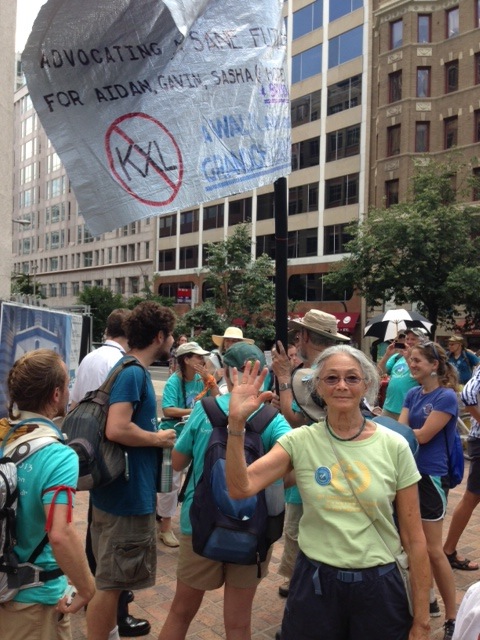
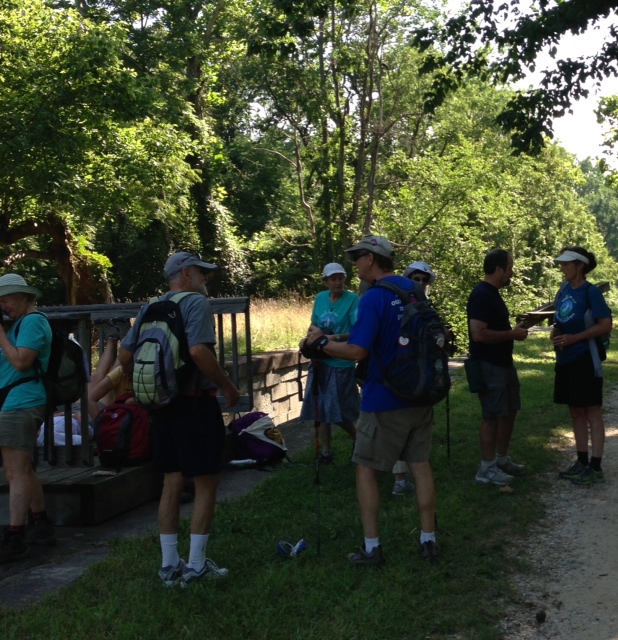
We made it!  At the end of our 13-plus mile walk (60-plus miles for those who started at Camp David, MD., we were tired, ready for a cold drink, and elated to be among this amazing group of people: a student from Asheville, NC, (where we had just been) considering a major in environmental studies, and a couple from Harrisonburg, VA, former dentist and high school counsellor, both environmentalists and fellow UU’s, among our walking partners for the day.
Here I am at the headquarters of Environmental Resources Management,
an organization (1776 Eye Street) that green-lighted the Keystone XL pipeline, where 54 of our number submitted themselves to arrest for trespassing.

Marika at Walk endIt was almost surreal leaving the easy camaraderie and natural beauty of the walk  from the Mardsen Tract where people camped overnight, along the tow paths of old canals, material-moving technology of another century, into Georgetown.   Our route took us down  “M” Street, the shopping and dining hub, packed on a Friday with brand-name bag toting shoppers and people sampling the upscale restaurants.  (In another life, we have been both!)  Thanks to the yogurt shop for handing out free samples.  Impressions and echoes of the conversations from the day drift back to me now, and no doubt will in the next few days.  This is an unusual group by any reckoning: Charlie and Kathy, who volunteer regularly for hurricane relief (Katrina and Greneda) and who gave us valuable information about solar panels and the Chevy Volt; folks who report from the fronts of community action (Liz Schmitt — Did I give you my card?) from Sojourners: Faith in Action for Social Justice; Walk organizer, Bill Repsher, who cheerful helped us GPS our way to a parking area for the Marsden Tract;  Mark, who made sure we got our van ride back to our car.  Special thanks to Greg Yost for articulate, inspiring posts about each day
Howie at Walk startof the Walk.  At the end of the day, we also had a new appreciation for good shoes, socks, and feet (no blisters!).  For peanut butter and jelly sandwiches (our lunch) and water when you are really, really thirsty. For the excellent camera that comes with the smart phone, and for GPS that gets you from anywhere to where you want to go, including all the Metro stops in the Washington D.C. area   Within the hour, we leave The Bolger Center in Potomac, MD, where we have been most comfortably sheltered these few nights, for our rendezvous with the group at Lafayette Park for a noon rally.  We’ll hear Bill McKibben and others about what we have accomplished with this action, and what more we can do.  This is, after all, just one action among many planned and/or carried out in this Summer of Heat.  In the spirit of the quote from Chief Seattle, just in from our buddy in Florida, Laura Kirsner, “We do not inherit the earth from our ancestors; we borrow it from our children,” we have just begun.

Deja Vu

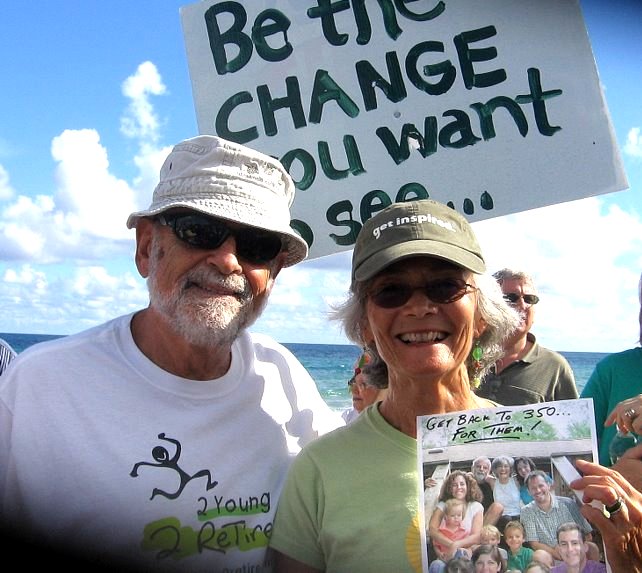
activistsBefore there was the Transition Movement, there was the  Center for the New American Dream, a non-profit organization whose mission  is to “help Americans to reduce and shift their consumption to improve quality of life, protect the environment, and promote social justice.”  Before my spouse and I decided that we had to become activists for the environment (that’s us at a rally on a Florida beach), we were activists of another kind.  Our mission was to prevent the loss of the experience and talents of millions of older people to retirement, and to prevent premature aging to which a life devoted entirely to leisure leads.  We had a website, a coach training program, and we wrote a book: Too Young to Retire: 101 Ways to Start the Rest of Your Life which we are happy to say is still ‘in print.’  In fact, the link above will take you to a virtual bookstore where you can read the reviews and buy it.

Last year, we passed the baton to one of our coaches (we call them certified facilitators) who runs the website and trains others now.  Friends joked that the anti-retirement couple were, gasp! retiring.  But that was not the case.  We were simply shifting the focus, to translate what we learned in our separate careers and our joint endeavor, into environmental activism.  As grandparents, we never wanted to have to face our grandchildren in the future and say we did nothing about the climate crisis.

We had a link to New American Dream in our book and were aligned with their vision that consumerism and the ideology of endless economic growth was not sustainable, and that ordinary citizens like us could do make changes in our own lives that shrink our ecological footprint.  So it was a great honor to be approached by an editor at New American Dream looking to profile us for their Living the Dream series!  Their questionnaire gave us a reason for a life review; we got to take stock of where we are in our lives, what we believe in, and what matters most to us.  It’s a worthwhile exercise at any age, but particularly when you have a lot of life already lived to examine.  We were also motivated to pour through our photo album to find some suitable photos for the profile.  It will be out soon.  In the meantime, you might enjoy reading the current Living the Dream profile, about Montana homesteader, Ashley Browning.  

HOA’s May Not Prohibit Solar Panels

FreeDigitalPhotos.net

Who knew?  I didn’t until I started searching through the terrific West Palm Beach Office of Sustainability website and discovered that Homeowners Associations are prohibited by Florida Statute 163.04 — Energy Devices Based on Renewable Resources to prohibit solar panels (as well as rain barrels, clotheslines, etc.)   This is very good news for those of us in Sunshine State condo-land where solar energy is an obvious choice.  The only surprise is how slow we have been to adopt it and HOA’s rules and regulations may have contributed to the foot-dragging.  That could change quickly if enough people want it.

Another plus for solar energy: the recent signing of Florida HB 277 which means that adding solar panels (or other renewable energy systems) to your home will not increase your property taxes.  Admittedly, this is not quite as strong an incentive as the Federal tax credit for electric vehicles, but we’ll take it.  The law goes into effect July 1, 2013 for installations after January 1, 2013.  Nice going, Florida!  This cheered me as much as reading that Boulder, CO, has a one-year fracking moratorium.

This year, solar panels, next year, backyard chickens!

Get educated and motivated about solar energy.  A few links to prime the pump.
One Block Off the Grid http://1bog.or and  http://howsolarworks.1bog.org
Vote Solar Initiative: http://votesolar.org/who-we-are/
Florida Solar Energy Industries Association http://www.flaseia.org .


2013 Walk for Our Grandchildren

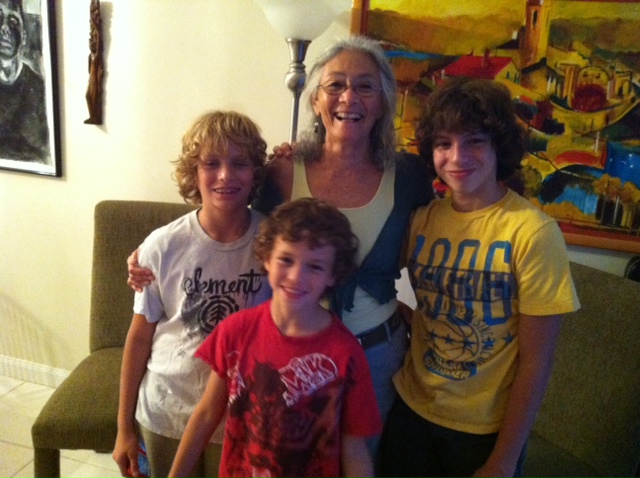
Here I am with three of my five grandchildren, the reason we (my husband and I) will be joining the 2013 Walk for Our Grandchildren this July and rallying with 350.org’s  Summer Heat campaign in front of The White House, July 27.  We mean to hold President Obama to his inaugural promise on the environment.

Me and the Brothers Cole

I’ll leave the arguments over whether global warming (or climate change, if you prefer) is caused by humans to those who believe there is value in assigning blame.  I believe it was settled by James Hansen decades ago.  We are taking responsibility for what happens next because it will affect the young people in this photograph and our other two grandchildren, and millions of children who did nothing to deserve the mess we are leaving them, and will have to deal with the consequences of our profligacy.

I don’t know if this walk on Washington will have the impact on the power base that other walks did, for civil rights, women’s rights, the end of the Vietnam War.  And it certainly won’t mean that I will stop shrinking my carbon footprint by all means possible: food choices, energy, transportation, consumption in general.  If Colin Beavan could go ‘no impact’ in Manhattan, the least I can do is go ‘low impact’ in Florida.

Walking the walk also doesn’t mean that I am giving up on the Transition movement (not when founder, Rob Hopkins, took his first flight since 2006 to make his case to American funders), although I am learning how challenging it can be to find common ground beyond personal agendas, my own included!   We all need to do more, much more, than recycle, reduce, reuse, and sooner rather than later, without any certainty that they will change the future.  As  Elizabeth Kolbert writes in The New Yorker, May 27, inaction is a “march to disaster.”