Take a Stand for the Earth

Yoga in the West often looks like just another way to consume: books, DVDs and music, classes with celebrity yogis, trainings, cool clothing, accessories and adventure  travel to exotic locales. Magazines like Yoga Journal with their glossy covers and good-looking cover models often performing advanced poses perpetuate the idea that we are not good enough as we are, but this or that product or service will surely do the trick.

429021_10151271075540247_1797111207_nSo, it was refreshing to find another article by environmentalist, Bill McKibben, in the May edition of YJ, delivering to the yoga community the same message he is known for: that if we don’t change our consuming ways, and soon, “the thing we call ‘civilization’ will simply become a sputtering mechanism for responding to emergencies.” Not even Iron Man will be able to save us.  In other words, it is truly past time to get off our mats and start living our yogic principles where they matter the most: in the world.

Question.  Can yoga (meditation, veganism, the local food movement, Occupy, Transition, or _____ fill in the blank with your favorite cause) act as a catalyst for social change? In this article in Yoga Brains, three writers weigh in on the subject. Shannon Gannon, co-founder of Jivamukti (roughly translated, freedom in this lifetime) Yoga, is bang on that practiced as it was intended, yoga cannot and should not be separated from activism.

Keep doing yoga and read more:
Reality Sandwich
Yoga Brains
Elephant Journal

Survival Skills for the 21st Century

My mother was something of a hoarder, an echo of her refugee experiences during and after World War II no doubt. I used to tease her about the boxes of soap, matches, and candles she kept in her linen cupboard, along with extra sheets, towels and bedding, ‘just in case’. She knew a lot about preserving food and would turn a bumper crop of citrus growing around our shared condo in California that most residents ignored, into a marmalade to die for. She kept some of her wealth in gold, too, mostly 18K bangles and neck chains she wore until the day she died. My mother had seen things change quickly, where one moment you had a shelter, clothing and food, and the next moment, you were running for your life.

This is a scenario that the majority of people in the fortunate part of the world don’t have to face on a daily basis, but as we approach the 400 ppm tipping point, I find myself more interested articles like this one from the current edition of Orion Magazine, 10 Skills to Hone for a Post-Oil Future. In fact, I have added my own suggestion to the list of 10, and over the last hour find myself in an engaging conversation with others who presumably are not taking the status quo where you jump into your car for a quick ride to the supermarket for under ten items, for granted. (My mother would have so enjoyed hearing that hoarding, far from being a pathological behavior in need of remedy, happens to be one of the Ten Skills.)

By the way, post-oil doesn’t necessarily mean that we ‘run out of oil.’ Apparently, we still have plenty of fossil fuel we haven’t tapped, though accessing it means ‘game over’ for Planet Earth, as James Hansen has repeatedly warned. To me, post-oil means we have the wisdom to leave the stuff in the ground and find other, better, more sustainable ways to live without it. Actually, for all but the wealthiest who can insulate themselves against the impacts of global warming, there may not be a choice. We are going to have to wean ourselves from this addiction.

But back to survival skills. In my comment, I agreed with another poster about the shift to multi-generational living, a phenomenon that is already happening with in-law suites and ‘granny flats’ and is bound to accelerate as people realize how much we really need each other, and how much we now duplicate effort, skills and equipment/tools in the nuclear family format. I like my privacy as much as the next person, yet I’m willing to trade it for the security of community. I’m also excited about the idea of learning new things (well, new to ME), so I added foraging as an important survival skill. I’m ready to stalk the wild asparagus a la Euell Gibbons, or if that isn’t available then Spanish Needle, a delicious green widely available in my locale that my friend, Jean, once prepared for me. One person’s weeds is another’s healthy meal. See Eat The Weeds.

Now you can track the inexorable progress of climate change on Twitter

Walked by the Atlantic this morning with my honey. Lots of fishermen — and one woman — catching foot-long pompano. Came across one carcass bitten cleanly in half so obviously where there are big schools of pompano there will be some hungry sharks. Nature is neither cruel or kind, but she is certainly consistent. This lastest item from Grist about tracking global warming data comes to us courtesy Twitter. It isn’t good news, but then it really isn’t news at all. Just Nature’s feedback to us what we have dumped and continue to dump on her.

Raising Kale in a Raised Bed

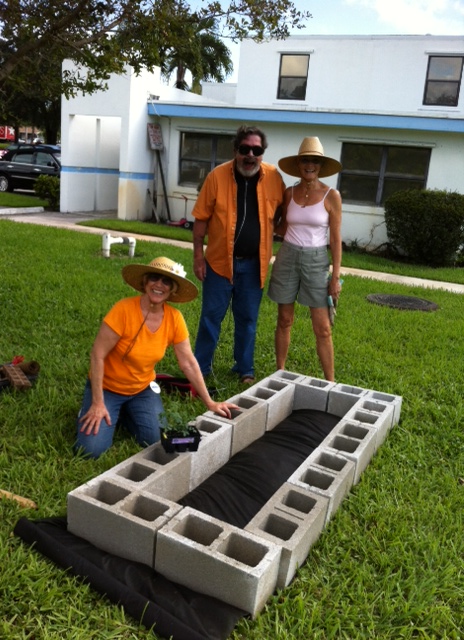
laying out the garden
When I was a kid in England, I was well fed from vegetable garden my aunt and uncle planted each year on their ‘allotment.’ They had married at the end of World War II and just about everyone grew vegetables either on their own property or in a shared community space. It was one of those acts of keep-calm-and-carry-on patriotism that most certainly contributed to the Allied victory.

As we discover that small (and local) is indeed beautiful, the time for such kinds of community enterprise is most certainly here…again.

The photo shows our church community garden getting started. While it is small as veggie patches go, just 10 cinderblocks arranged in a rectangle 2.7′ x 5.2′ on a bed of ground cloth and cardboard, filled with bagged cow manure or compost, it has been planted intensively with kale, broccoli, onions, tomatoes, peppers, squash and marigolds around the rim (to keep the bugs at bay). The directions for the raised bed garden are from The University of Florida IFAS Extension and it came together quickly with four pairs of hands and a lot of enthusiasm.

As an experiment in community gardening, it has attracted more curiosity than volunteers willing to get their hands dirty (though I’m hopeful that may change). And even though the squash sort of ran away from home and the peppers got all leggy, I’m calling it a success nonetheless. Every few days for the past couple of months, we have harvested some kale and broccoli and occasionally a tomato or onion. Obviously, one cannot rely on a patch this size to supply one’s vegetables needs — our CSA does a great job of that. But it does demonstrate what is possible with very little effort and a small plot of soil. May you be so inspired.

Food in My Kitchen

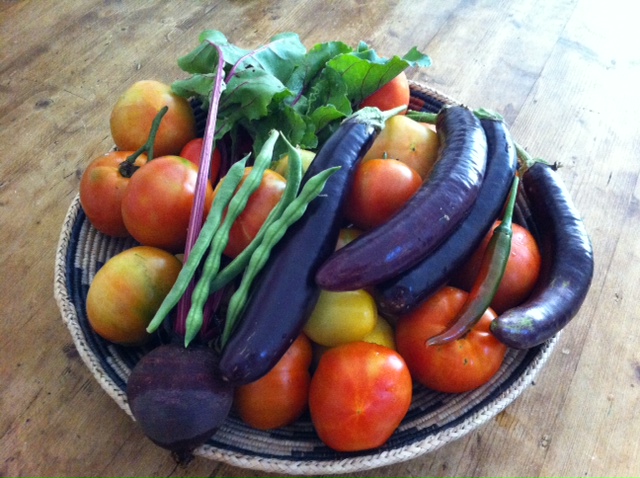
Emalee veggies

See this basket?  All of it came from my friend, Emalee’s backyard, a no-till vegetable patch established in 2012 with compost from the city of West Palm Beach (you have to provide the truck, some muscles and a wheelbarrow) and still going strong.  I came home with Japanese eggplants and tomatoes in abundance.  What to do?

This morning, I started chopping and slicing and sautéing, O Mio Babbino Caro playing in the background, and by noon, I had the base for a Vegetable Korma — I’ll add the yoghurt just before I serve it — and a caponata from the Kripalu cookbook series (a good way to preserve tomatoes and eggplant).  The curry was going to be our lunch, then my spouse called from the dentist to say he needed to have an all liquid lunch.  So, I quickly turned some broccoli, CSA and home-grown, into a soup.  Here’s the recipe for the Broccoli Garlic Soup:

Two cups of tender, washed broccoli stalks
4 cloves of garlic mashed
2 T.  olive oil
1/3 – 1/2 cup of water
Sea or kosher salt to taste

Put everything into a heavy saucepan, cover and cook until most of the liquid has evaporated and the broccoli stalks are tender but not mushy.  Time varies, but about 7-10 minutes should do it.  Pour it into the blender jar.  Add water to just cover and puree until smooth.  Serve room temperature with a dollop of yoghurt on top.   The broccoli prepared this way is delicious as a side as well, and I have Dr. Andrew Weil to thank for the basic recipe.  I’ve used it for green beans and broccoli rape, and it’s simple and good.

I realize that many people, e.g. the single mother of two in A Place at the Table , the documentary about hunger I’ve been writing about, do not have ready access to fresh, local produce.  And that’s something that can change as more people start-up community gardens in  urban ‘food deserts’.  But there is also much she could do with staples like lentils, black beans, and chick peas, if there was somewhere she could go to learn.   Great nutrition for her kids and herself at very low-cost prepared without fancy pots or gadgets, now that’s social action through food, and well worth working on.   

Since seeing the documentary, I’ve been surfing around looking at food bloggers, especially those with a social conscience, and yesterday, I hit a bonanza.  The Giving Table.  I like their slogan, too: Doing Good With Food.  On April 8, bloggers were invited to add content to their sites in recognition of hunger in America.  http://www.givingtable.org/food-bloggers-against-hunger  There is a ground-swell of passion for solving this intractable problem and it gives me hope.

Food on My Mind

Not enough of it for some. Too much of it for others. The wrong kind in both cases, i.e. too much fat, sugar and salt, the stuff of a future of disease and a foreshortened life, especially for the most vulnerable among us: our malnourished children. Who’s to blame? We are. For allowing our family farms to melt into Big Ag (read your Wendell Berry). For accepting over-stuffed military budgets, bank bailouts, and Beltway fat cats calling the shots because we want to protect our ever-shrinking common good.

Taking back our food supply, making sure that people who are hungry — children who are trying to learn on a school lunch of grease and sugary sauce — get nourished and get educated about what real food is and why it matters to their future, is #1 on my list of world-changing initiatives. If we get it right, it will also address global warming because it will interfere with the way we currently grow (monocultures, factory farming, control of seeds) , process (inhumane treatment of livestock, augmented mush squeezed into food-like shapes, see Mark Bittman’s great reporting on this) and ship (food miles, energy-hungry storage) food. What a conundrum! What sustains us, is unsustainable.

If any of this resonates with you, here’s a short list of films/sites you must take the time to view and think about. I will add more as I find them.

A Place at the Table (in current release)
Forks Over Knives
Food Babe — her review of Subway is must reading
Books by Michael Pollan, Mark Bittman (and other writers they recommend)
Wendell Berry — too many to list, but here’s a favorite: http://thesunmagazine.org/issues/391/digging_in

Eat Local and Fresh, Help the Planet (and Yourself)

The 100-Mile Diet: A Year of Local Eating is the kind of book that induces humility in even the most ardent enthusiast of local foods and all the environmental reasons this choice makes sense (i.e. the high cost of food miles, for one). I speak from experience. Mea culpa, I find it really difficult to give up tea (Assam, Ceylon), coffee (Costa Rica) and even papayas – although why Publix and Costco keep importing these from Belize when they grow in our backyards is a question for another blog post.

So I was really happy to see that Don Hall of Transition Sarasota is doing well with his local food guide and festival – Greater Sarasota’s Eat Local Resource Guide and Directory, now in its third year. Imagine! A whole week dedicated to exploring what’s in season and available locally. It is exactly the kind of action that engages people, climate politics – and even politics – aside. For me, signing the 10% Local Food Challenge was a no-brainer. It’s a little step everyone can take that leads to bigger steps.

Farmers Markets make sourcing locally relatively easy year round here in South Florida where I live, although be aware that not every vendor is offering 100% local produce. You have to ask the question. I am totally crazy about Diane Cordeau and Karl Frost of Kai-Kai Farms for their dedication to growing sustainably and delivering a box of beautiful food to us and other CSA members at the market every two weeks. On off-weeks, I can also pick up whatever I need to fill in at a discounted price. No, it isn’t ‘cheap’ food and it certainly isn’t fast, um, you have to actually cook it. The truth is, cheap and fast are inaccurate because the long-range effects of the processed food industry will be calculated in poor health, obesity and lives foreshortened.

To that point, I was surfing around today and came across Stephen Colbert’s interview with Dr. Robert Lustig a few weeks ago. You really need to watch it. Kudos and deep gratitude to our comedians for having the courage few politicians do!

The Seat is Going Anyway…

This summer, I want to be in the Northeast for about a month, to visit family and friends, give my yoga practice a boost with a few days at Kripalu Center in The Berkshires, and slake my thirst for art and culture in New York City.

Along with millions of other Americans, I hear the siren call of summer ‘elsewhere.’ Except that I am trying to figure out how to travel with the smallest possible carbon impact. I share my dilemma with a friend who is bemused that I am considering taking a train (awful food, noisy) because I believe flying takes the biggest toll on the environment. Yes, I know the seat is going anyway.

Probably driving is the least bad way to haul me, spouse and stuff some 1,600 miles in one direction and back. I have driven up and down the East Coast enough times to own a dog-eared Road Atlas with notes about interesting food stops (Gulf oysters at St. Augustine Beach), good radio stations, clean toilets, as well as places to avoid. When planes were temporarily grounded after 9/11, we drove from California to New York, four nights, five days on the road. I’ve never added up all the miles, but the call of the open road is pretty well out of my system. Anyway, driving a fuel-efficient car even with two passengers doesn’t beat traveling by bus — hands-down the most energy-efficient, least carbon-loaded way to get anywhere. Hey, rock stars do it, albeit in luxurious coach-style.

Truth is I’m more of a homebody than I used to be, even before I began to be alarmed about the environment enough to do something personally. Come to find out that when you add up heating/cooling, washing and drying clothes (a biggie) and even computer usage, our homes are where we burn through the most energy. Yikes!

If you find yourself agreeing that it’s our obligation as world citizens to take our contributions to climate change personally, you’ll find a lot of helpful calculators on the Internet. Here’s a gem I just stumbled upon which handily compares itself to other popular ones:
http://michaelbluejay.com/electricity/carboncalculator.html

You may be surprised as I was to discover that you can do more good by giving up meat and walking and/or biking more than you drive, than by swearing off flying (obviously, frequent flyers were not included in the tally). Another nugget that I am definitely tucking into my toolkit for future reference: traveling by cargo ship across the Atlantic, then using train and bus to get around.

You might want to poke around some of Michael Bluejay’s other sites as I did. In fact, I was having so much fun, I had to remind myself that I was in the midst of a blog post about my travel dilemma for this summer!

I’ve got my sights on The 100-Mile Diet: A Year of Local Eating, one couple’s answer to saving the planet, http://en.wikipedia.org/wiki/The_100-Mile_Diet, in a future post.

Getting Real

After a fruitless couple of hours trying to figure out how to get a playlist from my MacBook Pro into my iPhone so I can use it for my yoga classes tomorrow, I signed up for a One-on-One session at my local Apple store next week. In the meantime, I will have to resort to the old familiar technology of popping a CD into the player. Which reminds me (good word, remind) that I don’t want to ever become so dependent on my electronic tools that I can’t chop wood and carry water should the day arrive that simple tools of survival are necessary.

Along comes a new (and gratis) chapter to Richard Heinberg’s The End of Growth: Adapting to Our New Economic Reality. This Extra gets up close and personal. I plan to read and absorb it, especially the part on what to do with one’s money, and I recommend you do also. Yes, investing in my local community is part of my action plan for the future. Food, done. Energy, next.

Last week, David Bornstein, author of How to Change the World, did an Opinionator piece for The New York Times that offers a lot of information about how Crowdsourcing is making it possible to invest in clean energy. It is worth your attention, whatever your level of income. I have re-quoted the final quote by Billy Parrish of Mosaic elsewhere:

“If we are going to solve this problem (the environment)…We need to build a propositional movement, not just an oppositional movement. We’ll need to tap into people’s enlightened self interest.”

Amen.

First, Heal Yourself

It’s a commonplace that activists often neglect their own health and well-being in the pursuit of larger goals. The fact is, we all know that the place to start is with oneself. From the perspective of the Buddhist and Yogic teachings to which I subscribe, human beings are already whole. Healing is remembering who we are, and that we are more than our thoughts, our preferences, our opinions, the work we do, and the roles we play. If this were easy for anyone, the great teachers wouldn’t have addressed it so frequently. It wouldn’t require Practice, that is, the discipline to show up, work with what we have — mind, body, breath, the present moment — and to do it again and again. We practice not to get it right, but because it is worth doing. Path and goal are the same. I bring these teachings into my yoga classes whenever I can as much to share them as to hear myself repeat them.

When one begins to look more closely at what we have collectively allowed to happen to Planet Earth, our only home, the heart turns over in despair. And then, if you are willing, it awakens into action. There is no way back from this moment, even if those closest to you think you’ve lost all reason. And sometimes you question your own sanity, so pervasive is the dominant view of reality: we can grow (shop, entertain, gadget-ize ourselves) out of this crisis. Even seasoned environmentalists can’t always see the forest for the trees. Because I have been supporting environmental causes for many years, I get urgent messages nearly every day about what will happen if I don’t ‘chip in’ another $3 to save polar bears or stop the Koch Brothers in their assault on progressive policies. Focusing on what is wrong gives a fragmented view of reality. Demonizing the other must also be healed.

This is where personal practice to stay present, moment to moment, can support a sense of wholeness. With regular attention to one’s inner environment, discernment and care can blossom. Then, like Krishna admonished Arjuna, you do your best and let others judge the results of your actions.