The Martian

It’s 4: pm on July 20, 1969 on a quiet street in the yet-to-be Yuppie-ized suburb of Montclair, New Jersey. My infant daughter is propped up in her kid carrier plus cushions on the backyard swing while her 4-year old brother keeps cool in an inflated pool. We’re building a porch ourselves off the back of the colonial house we purchased the previous year (for $28,000). While I hold a 2′ x 4′ steady, my husband hammers it into place. In case the date doesn’t immediately resonate with you (confession: I had to Wiki it for precision), it is the day three American astronauts landed on the moon. We have a small black and white TV with a long extension cord sitting on a plank-saw horse stand, and we are, like millions of other people, waiting for the words soon to be uttered by Commander Neil A. Armstrong: The Eagle has landed. Cheering broke out from houses all around us. Reading the log of Apollo 11 now still gives me goosebumps. That Edwin E. (Buzz) Aldrin, Jr. was a Montclair boy and would next year be marching in our July 4th parade, only adds spice to the momentous occasion.

After a week that brought personal horror and loss to many people, and unleashed a firestorm of paranoid, xenophobic trash-talking that recalls the worse of the McCarthy era here, The Martian, starring Matt Damon, Jessica Chastain, Jeff Daniels and a sterling supporting cast, was a balm for the soul. And not only because it recalls a time when for a few days, large numbers of people put aside their national identities and petty concerns and celebrated ‘One small step for a man, one giant leap …”
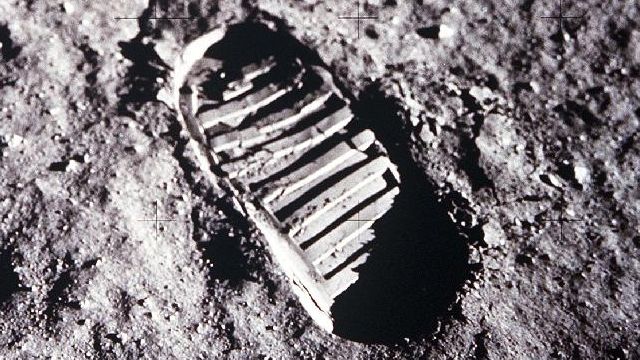
Apollo 11 bootprintIn case you’ve yet to see the film, I’m not going to spoil it for you with too many details about ‘the making of…’ which you could better read afterward. You’ll turn up a lot via a Google search, but one of my favorite citations is about the central role played by the Jet Propulsion Lab in getting the details accurate. Suffice to say that: “The Martian” is steeped in decades of real-life Mars exploration that JPL has led for NASA.  If they handed out film awards for length of time on camera, Matt Damon would win hands down (though Sandra Bullock in Gravity, another plausible space adventure, comes close). But as space castaway/astronaut, Mark Watney, Damon earns his actor stripes in perhaps his best performance to date. See interview with director, Ridley Scott, for a fascinating glimpse into how the film was made.

My takeaways on The Martian (and why you must see it), in no particular order:

  • It makes a strong case for science education
  • It reinserts NASA and JPL into the public consciousness at a time when funding is falling
  • We see the important role of international cooperation (U.S. and China)  — the Russians get left out of this one
  • We are reminded of our common humanity, the risks we will take to save the life of another
  • It helps put into perspective the current political climate and reminds us we are better than media suggests we are.

It bears repeating that we owe a great deal to the space program (by-pass surgery and digital photography, the tip of the iceberg), and this Thanksgiving week seems like a good time to acknowledge that.  If The Martian gets you newly excited about and appreciative of science as a worthy human enterprise, and awakens your support for the space program in particular, mission accomplished!

Technology from space program

Apollo 11 overview

Apollo 11 log


Looking Back

Last November, I posted about a proposal from attorney, Mitchell Chester, on how to adapt to sea level rise in South Florida, Raising Fields: What History Can Teach Us.  If you own property in South Florida now, are considering moving or investing in property here, or do business in any of these sectors: construction, tourism or agriculture to choose three biggies mentioned in State of Florida Facts, you need to listen up.  In fact, if you are in any way betting your future prosperity on the State of Florida, you need to take the optimistic language of the state government documents and local business journals with a huge grain of salt.

Let’s agree that you don’t need convincing of the scientific facts of sea level rise (SLR) and are ready to prepare and protect yourself, your family, home, and business against the likelihood of severe financial shocks ahead. Far from gloom and doom, Mr. Chester offers a calm, reasoned and even optimistic approach to the challenges that make us Floridians, as coastal dwellers on a porous limestone landmass, exceptionally at risk from a rising ocean. Mr. Chester proposes we adopt financial adaptation tools like a SLR Relocation Account to ease the financial burden of relocation should it come to that.  He argues for a more vigorous involvement from the insurance industry than has been evident so far. Industry and government partnership, Chester believes, could make necessity the mother of invention as adaptation and mitigation strategies across the spectrum of financial products become new economic opportunity.  Check out the Tools Menu for more.

SLR 2030

If you are confused as some of our politicians seem to be about the difference between natural variations in weather cycles and climate change, the section Shoreline Adaptation Land Trusts: A Concept for Rising Sea Level (SALT) by John Englander, author of High Tide on Main Street (recommended) will be helpful.  In addition to proposing a new political/legal strategy for threatened coastal regions, it distinguishes between frequent occurrences of coastal flooding and beach erosion which many communities already experience, and the irreversible effects on coast areas caused by melting glaciers “which will inexorably work to reshape all the continents.” Here’s how the summary to Englander’s position paper concludes: Strategic Adaptation Land Trusts could be a useful tool and catalyst for this unprecedented transition upwards and inland. We can rise with the tide –– if we anticipate it in time.

A year ago, Mitchell Chester wanted to save Florida’s agriculture with a proven method for raising fields (“For [Florida’s] agriculture, it’s either up or out.”) His latest work (see below) reminds us that we are all stakeholders in what happens here in the decades just ahead.  He invites us to brainstorm on how we can face the risks as well as seize the opportunities a new geography for this state demands of all its citizens, and possibly model it for the rest of the world.

Go Deeper
The Invading Sea: Florida and the Climate Crisis

Black Friday

Once upon a time, store closings for Thanksgiving wouldn’t have been remarked upon. It is not only a Federal and Stock Exchange holiday, but a sacred, Norman Rockwell moment in American life and we need more, not less, of them. This year, it has become a thing that some stores are closed, like Costco, Staples, and TJ Maxx. In fact, a far larger number are not, starting their Black Friday sales a day earlier. (You know who you are.) I empathize with the staff who have no choice but work on this holiday, and with those who count on these sales to do their holiday gift buying. But I won’t be in those checkout lines on principle and for my mental health. I suspect I’m not alone in a desire to skip the whole fracas that has become the holiday season, and this year I’m getting off to a good start thanks to an unexpected gift: a serendipitous catch on the internet.

So here’s what we’re planning for Black Friday: the Ground Floor Farm’s Really Really Free Market, 2-8 pm, November 27, 100 SE Martin Luther King Jr. Blvd., in Stuart, Fl.  This is a ‘pop-up marketplace of diverse goods and services where absolutely everything is free. No money, no barter. Just come and take what you want, and ideally give something too!’ To make giving possible, on Monday and Tuesday of Thanksgiving week, they’ll be accepting donations of goods. On the day of the event, you can show up with your own sign (table and chair) and offer a free service, e.g. haircut, massage, yoga class, musical serenade, financial planning – you get the idea. I don’t need any more stuff, but I could probably fill a bag or two of items for donation.  And who could say no to a free massage or serenade?  http://www.groundfloorfarm.com/freemarket

Ground Floor Farm is the brainchild of three young farmers, Jacki, Micah and Mike, whose vision is to be part of a ‘hometown renaissance’ by modeling and educating others about small space urban farming, and becoming a hub of cultural and social events. In addition to a regular booth at the Sunday Stuart Farmers Market, they offer classes in homesteading arts like medicinal herbs, and the making of cheese, bread, sauerkraut and candles, plus a free yoga class every Sunday. There is also a young adult program and a three-day camp for grades 2-8 this December.

free veggiesThe Really Really Free Market is a local example of the gift economy I’ve touched on in previous posts, and I’m really really excited to experience it and possibly borrow the idea. Other current examples include the little free libraries of Lake Worth organized by local residents (it’s a national movement), and accessory and/or clothing swaps for frugal fun and charitable fund-raising turning up in women’s circles. Seed and/or cuttings swaps, tool libraries, time banks, and guerrilla gardening are familiar to the Transition Town culture, and a reliable source of community resilience. For free and excellent online learning, see Coursera for adult learners and Khan Academy for school children. Recently, I participated in the Mindfulness Summit, an Australian-based project providing 31 days of interviews and instruction with renowned meditation teachers, each segment available for 24 hours for free (the package for future viewing was $79). Even large-scale projects like our national parks system, the lending libraries, community-supported projects like Wikipedia, in fact, the internet itself, all fall into the category of gift: something freely given.  This is my idea of a free market.

Gifts have an old and complex history linked with matriarchal societies, beginning with the fact that mothers bestow the gift of life on their children, with no expectation of return (though the occasional phone call wouldn’t hurt). Gifts are based on the philosophy of abundance and generosity as opposed to exchange which is tied to scarcity and susceptible to hoarding and greed. The gift economy predated capitalism, so it is especially fascinating to see it re-emerge in mainstream culture today.  Charles Eisensteins’ Sacred Economics, a history of money (recommended reading) offers four useful principles for a successful gift economy that you may find helpful in the often fraught experience of giving and receiving on a smaller scale.

  1. Over time, giving and receiving must be in balance.
  2. The source of a gift is to be acknowledged.
  3. Gifts circulate rather than accumulate.
  4. Gifts flow towards the greatest need.

All make sense to me, especially #4.  I’m re-gifting these to my readers, paying (and playing) them forward, you could say. ‘Tis the season to be mindful about how and why and for whom we buy holiday gifts, and whether there is something more precious we can give.

More on this topic:

Reconomy: http://www.reconomy.org/economic-enablers/alternative-means-of-exchange/the-gift-economy-and-community-exchanges/

The Moneyless Manifesto: http://www.moneylessmanifesto.org/book/the-moneyless-menu/the-gift-economy/

Business As Usual — Not

When I used to rail against corporations ruling the world, my entrepreneur friend, the late Jim Kirsner, used to argue that the business community had to be part of the solution to the problem of climate change. I’m sure he’s right in the ‘we need everyone’ sense, but where I live, business as usual looks like complete folly.  After a punishing few years, real estate is said to be recovering in South Florida. On the high end new construction, this appears to be true. En route to my yoga classes, I cross a bridge over the Intracoastal Waterway where mansions arise on one side facing a dazzling new high-end community called Azure on the other. Phase I of its $900K-2.8M condos with marina and optional boat slips is almost sold out; building has commenced on Phase II. Aging, wealthy Boomers are still thinking of Florida as an ideal ‘luxury lifestyle’ destination, and climate change deniers in state government couldn’t be happier. It’s mini-Miami, and prefab-tiny-houseonly marginally less at risk for sea level rise.

But shift is happening, and though Elon Musk and the Tesla are have achieved rock star status, it is far more likely that if/when a tipping point toward sanity is reached, it may well be because, to paraphrase Margaret Mead, a small group of thoughtful, committed business people become vocal critics of the status quo and, more importantly, transform themselves.

One recent example: Robert Politzer, CEO of Greenstreet Inc., a New York City-based construction firm whose mission is to “prove the business advantage of triple bottom line: profit, people, planet,” writes about how frequent, intense rain is already affecting his business practices and increasing his costs. Who should pay, Politzer asks: his clients, the government, or those responsible for emissions accelerating climate change? He argues, as does New York Times columnist, Thomas Friedman, frequently, for a price on carbon. Carbon fees “potentially in the hundreds of billions of dollars” — could conceivably generate economic stimulus and “a major push toward a more sustainable sector and … economy.” Link to the original article here.  It’s hard to imagine entrenched power ceding any of it, given the current political climate. But there are those who are banking on it.

Scratch the surface and you’ll learn a lot about that triple bottom line and the idea of “tackling climate change through market-based solutions” from think tanks like The Rocky Mountain Institute, founded in 1982 “to create a clean, prosperous and secure low-carbon future” to the more recently formed B Team, a group of star power entrepreneurs (think Ariana Huffington) and civil servants, on the principle that “business needs a Plan B.” In December 2014, RMI formed a strategic alliance with Carbon War Room, an initiative of Sir Richard Branson, so that they could go ‘further, faster together.’

The B Team (Branson is also co-founder) has been busy, too. In July, it released Seizing the Global Opportunity: 2015 New Climate Economy Report which includes 10 points, e.g. invest at least US$1 trillion a year in clean energy, and implementing effective carbon pricing, and insists that “we don’t have to choose between economic growth and taking action on climate change.”

If you click on the links above and spend even a few minutes scrolling around these beautifully designed websites, you might think with all these smart entrepreneurial people involved, mission accomplished. A win-win. You might even be tempted to jump on their bandwagon. Just last week, I could have attended the Aruba Sustainable Week for $550 plus airfare and hotel. Paris in December sounds appealing.

Well, I don’t mean to rain on this parade (or maybe I do). It’s just that I am suspicious of the have-our-cake-and-eat-it-too ideology that is enriching the already well-heeled. The notion that growth could be a problem, even the problem, isn’t a popular view in our culture.  I won’t wait for Throwback Thursday to retrieve my copy of Small is Beautiful for alternate solutions that are neither ‘further’ nor ‘faster.’

An economy founded on the growth paradigm and the pursuit of wealth is not sustainable, by definition.
~E.F. Schumacher

Simplify, simplify …

Our life is frittered away by detail… simplify, simplify.  ~  Henry David Thoreau

Have you ever felt, as I have, a strangely wonderful sense of liberation when you pack for a trip?  Limiting yourself to only what will fit into a suitcase or backpack really makes you think about what you really need to carry with you while you’re away from your familiar environment.  For me, it usually turns out to be surprisingly little!  And that always makes me surprisingly happy.

Seventeen years ago, I enrolled in a month-long yoga teacher training (YTT, as we call it) at The Kripalu Center for Yoga and Health in Stockbridge, Mass.  The main building at Kripalu used to be a Jesuit monastery so the rooms are cell-like (though windowed) and the bathroom is down the hall.  Unless I wanted to spring for a big increase in my tuition to upgrade to a single room (I didn’t), I would be sharing this space with another student and all our stuff.  For.  Four.  Weeks.  Yes, I was assured, there was laundry on premises and a large sliding drawer under each bed, but room for hangers, fugetaboutit.  We would have, my roommate and I, two drawers each of a very small four-drawer chest.

Since March is cold in the Berkshires and I knew I would want to get outdoors, I wondered where I would find space for the jackets, sweaters, warm socks, hats, gloves, and a pair of boots I planned on bringing.  Yikes!  True, we would be spending most of our time in class (in fact, we didn’t get a day off or visitors for two weeks) so I knew I would need to bundle up and get outside to avoid cabin fever.

Summer camp with the ample footlocker for little more than shorts and t-shirts and bathing suits was nothing like this.  So, there I was, age 57, fronting the fact, in my best Thoreauvian guise, that I had too much stuff. I had only to spread it all out on the bed to realize that half of it wasn’t going anywhere but back in the closet or chest.  I got a quick, necessary lesson in the art of layering for warmth. Fortunately, yoga clothing doesn’t crush — I wear it outside of class even now for this reason — and is eminently packable and quickly washed and dried.  And as meditation master instructor, Jack Kornfield points out, after the ecstasy, the laundry.

DSC01587When I remember how much better I was able to focus on my yoga training when I didn’t have a lot of choices about what to wear (and no hairdryer or makeup), not to mention all the time I saved for more worthy activities, it takes my breath away.  Even as a couple who enjoys our comforts, we’re hardly shopaholics.  Our kids know better than to give us stuff without a lot of careful thought, so when they do, it is almost always an in-the-moment treat like a terrific assortment of special teas.  Birthday or holiday gifts tend to be certificates for a massage or to an interesting restaurant. When you realize how full of redundant things your life is, a fun exercise is how much stuff you can pack into donation bags for the Vietnam Veterans of America who come right to your door to pick them up.  Even so, in moments of mindfulness, we know we’re living a far from simple life.  We travel; we have a huge library of books; we’ve failed the 100-mile food challenge.  We like our AC, our Internet access, our smartphones.

From a planetary perspective. I believe simplicity is a vastly unrated strategy for dealing with the materialism that we Americans have adopted as a lifestyle and are so busily exporting elsewhere.  Or even worse, creating working condition we would never endure domestically, in distant factories that churn out so-called ‘cheap’ clothes and the stuff that clutters our homes.  The mantra, “recycle, repair and reuse,” is merely the choice we’re left with when we couldn’t resist buying whatever it was in the first place.  And the three R’s are no match for the wanting that comes naturally to us as humans, but is sharpened to a fever pitch by, well, the endless pitch.  This isn’t news to you, but here’s an example: a moment ago, I wanted to find the name of a book I have stored on my Kindle app in my phone.  So I click on it, and up pops this message:

Stay Connected.  By enabling notifications, we’ll occasionally send relevant book recommendations, tips, and other updates to help you get more out of reading.

Thanks, but no thanks.  I am on a 30-day trial because I need (or want?) to refresh the music playlists for my yoga classes.  When I’ve accomplished that, we’ll part company.  No wonder The Life-Changing Magic of Tidying Up: The Japanese Art of Decluttering and Organizing by Marie Kondo soared to best-seller heights, despite the truly terrible writing (or translation, perhaps).  In the middle of a Joseph Goldstein talk on You Tube, he asks the audience how many could resist pouring through a catalog because, surely, there must be something here I want. Embarrassed laughter.

Wanting (aka craving) is one of the instinctive responses our ancestors needed because their survival depended on getting enough of what was often difficult to get, or in short supply.  In times of crisis, humans often resort to these behaviors, witness the fights breaking out in the refugee encampments or when potable water is delivered to a rural area in the developing world.  Advertising appeals to that primitive part of our brain by creating desire or manufactured need. Voluntary simplicity suggests that we don’t have to be slaves to wanting, that we can override these behaviors, and learn — as the great UU Minister, Forrest Church, put it, “to want what we have.”  As our planet struggles to absorb the end result of our rampant materialism, this sounds like very sound and timely advice.

Walking for Our Grandchildren, II

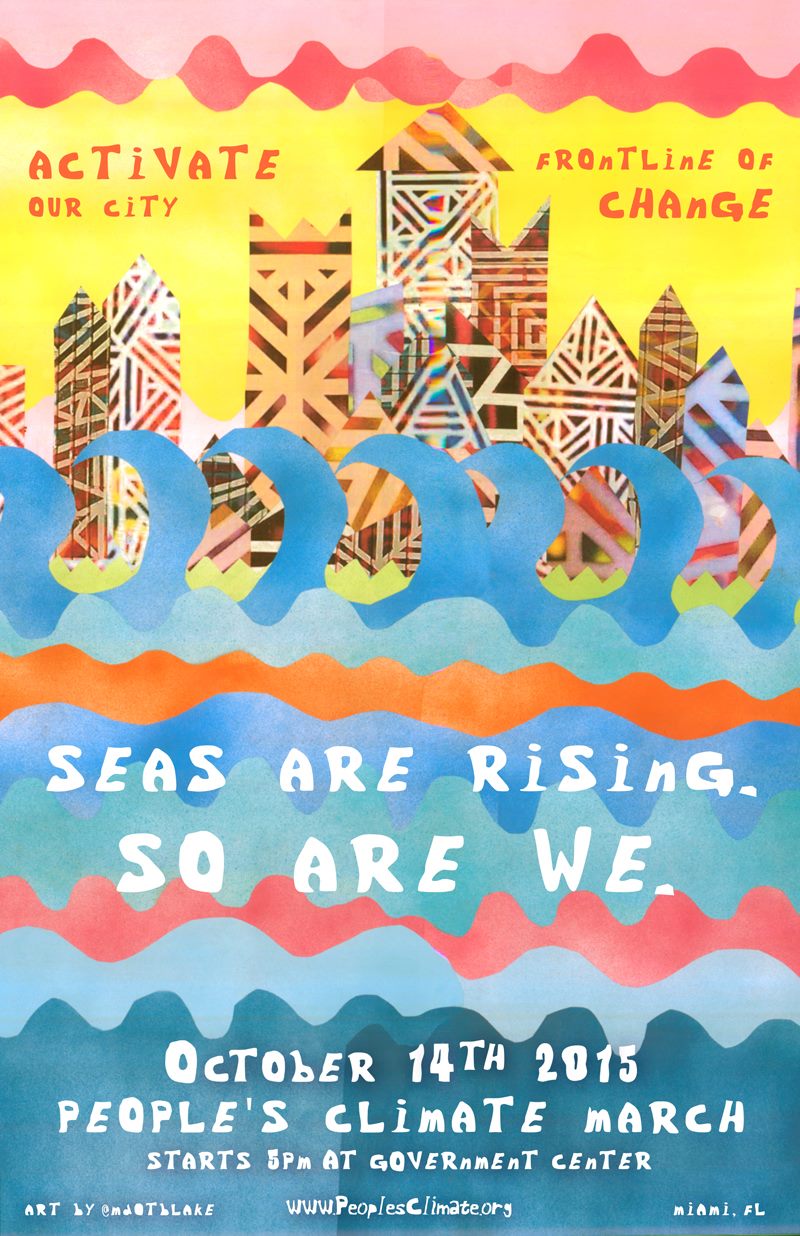
Miami Climate MarchIt has been two years since my spouse and I participated in the Walk for Our Grandchildren in Washington DC. This Wednesday, we are joining the People’s Climate March in Miami. If you live there and are paying attention, it won’t be news that rising seas combined with geology are already playing havoc with the city’s drainage system, regardless of storm activity. How Miami would come through a major hurricane no one seems willing to address, at least, not officially. It would hurt the booming economy, is the political mantra of the denial crowd.

Grandparents tend to have more at stake in the future than other people, so I find it strange that these marches are not bringing hundreds if not thousands of us into the streets in nonviolent demonstrations. The 2013 Washington Grandparent march drew about 300 people, a small number given the credentials of the speaker, longtime activist and author, Bill McKibben.  A handful of marchers were arrested. It made the news. OK, that action and others like it may have succeeded in killing the KXL Pipeline, but that is clearly more symbolic than a real shift in direction. The reality is, trains carrying oil roll through suburban towns like mine every single day. Organizers of the Miami march project between 500-8,000 people, a far cry from the 40,000 that assembled in New York last fall even at the high point.  Not close to the 250,000 Germans who protested the TPP this week.

Meanwhile, despite clear danger and plenty of implementable plans in the Southeast Florida Regional Climate Action Plan that could at least put some brakes on the inevitable, coastal cities are bristling with construction cranes. Realtors are talking recovery. New celebrity restaurants and name boutiques are opening in areas vulnerable to flooding. And Dr. Oz recently dropped a reported $18 million on a Palm Beach mansion. Go figure.

All of this sharpens my concern for our five grandchildren, especially the two 17-year-old grandsons in their final year of high school, looking ahead to college next year. Graduates are finding work in the shadow economy or grabbing jobs well below their qualifications now. It’s hard to see how this will improve in 4-5 years. The larger question that troubles my sleep is, what kind of education can prepare our grandchildren for a world completely unlike the one they grew up on, sans cheap energy?  If the COP21 Summit in Paris this November falls short of its carbon reduction targets as it appears it will, their generation could be facing climate events of an unprecedented scale and velocity; resource wars; and massive population displacements. Our military is certainly preparing for these outcomes* even as our politicians continue to fiddle, tweak data, or flat out deny the evidence.

I’m told this march will be more like a festival, with music and dancing, plus colorful banners and puppets. We will walk about a mile between the Miami government center and the Torch of Friendship where there will be another rally. It’s made up of a coalition of the like-minded, from the League of Women Voters to the Sierra Club. We’re also voters who will choose our presidential candidate through the lens of climate change. Thomas Friedman’s recent Op-Ed: Stuff Happens to the Environment, Like Climate Change doesn’t mince words “… if you vote for a climate skeptic for president, you’d better talk to your kids first, because you will have to answer to them later.” We answering to them now, before they ask. With our hearts, and our feet.

* “Climate change will affect the DoD’s ability to defend the nation and poses immediate risks to U.S. national security.” 

Wanderlust and Other Addictions

I travel not to go anywhere, but to go. I travel for travel’s sake. The great affair is to move.”  ~ Robert Louis Stevenson, Travels with a Donkey in the Cévennes

When Robert Louis Stevenson wrote this, the prototype of the automobile was still 10 years away and the four-lane highway and modern jet travel unimaginable, even for the author of Treasure Island.  About as unthinkable as travel by donkey is for us today.  Stevenson’s quote is commonly paired with images of highways and jets because it encourages us to do more of something that we cannot do without.  We, of all the living creatures capable of independent movement, have the itchiest of feet.  While it is true that everything is in motion, that many species migrate, by wing, fin, and hoof in response to seasonal change, only homo sapiens is afflicted with incurable restlessness. Life as we know it was shaped by an age of exploration and discovery.  It is who we are. Early epic masterpieces like Gilgamesh and the Odyssey were essentially travel writing, tales of adventures far from home. Why did they go? Unlike the quaint roving of an English gentleman in love with the experience itself, the epics suggest their protagonists were called to more serious, exclusively manly pursuits: war (often as paid combatants), trade, and diplomacy.  Even Buddha, the icon of peaceful abiding, had to leave his home in order to seek enlightenment.

What we have today is wanderlust on steroids, an addiction to speed — jets, fast cars, motorcycles, even bullet trains — as overpowering as any other habit.  As long as we feel compelled to get somewhere fast, as business people or tourists, and are willing to pay any price, we are stuck in fast forward.  Summer travel is barely over when the lucrative holiday travel season kicks in.  Because we have been willing to uproot ourselves for jobs or ‘a better life’ elsewhere, flying or driving across state lines or even across the continent, is inevitable for most Americans, me included. To be with the ones we love in another place, we willingly tolerate crowded highways, long, boring waits at airports, and sometimes fatigue that abates about the time we’re ready to turn around and go home. And that’s when everything goes without a hitch. Who hasn’t spent an unintended extra night en route, in an airport hotel, or even camped out on the departure lounge floor?

Here’s another lifestyle choice that keeps us in motion: the idea that everyone, not just the wealthy, deserves a getaway.  According to the National Realtor Association, the vacation and second home market just enjoyed its best year in recent history.  Flush from a decade or so when our homes were appreciating above historical trends (AKA the ‘bubble’), my 65+ cohort is packed with people on the go: two-residence Snowbirds (been there, done that), cruise junkies, serial house-sitters, and life-long RVers.  Le Mans, the Indianapolis 500 and Daytona Speedway may soon become anachronisms, yet it is evident that, with few exceptions, most of us will keep right on driving and flying until we burn through the last drop of gasoline and/or jet fuel.  (See, The Seat is Going Anyway)

ZachBrown-PhotoThat’s why I’m encouraged by a growing counterculture move on the part of the Millennials to dump cars and suburbs in favor of Walkable cities where they can walk or bike to work, take public transportation to an arts or music venue, stroll to food shops and other essential services, and skateboard to hang out with friends. Perhaps instead of lamenting their inability to achieve the standard of living of their parents and grandparents, we could be studying them for clues on how to live more creatively — not to mention in better health and degree of fitness — in a future of resource constraints. “The markets where Millennials are most highly concentrated reflect their desire to live in more socially conscious, creative environments. Austin, Texas has the highest concentration of this group—almost 1.2 times the national average—and fits the Millennial ideal, combining urban convenience with an exciting art and music scene.” (Nielsen report)

We may not be able to cure our restlessness, but perhaps we can cut it down to size.  Possibly, these new denizens of small, vibrant cities are the pioneers in a new age of travel by rail, sail, pedal and/or foot.  Bye-bye McMansions and three-car garages, farewell overstuffed cruise ships.  Hello staycations, homesteading in urban plots, mixed-use neighborhoods, and booming farmers markets where local is cool.

Why Millennials Are Ditching Cars …
ZachBrown photo

Going Sour for Good

I stumbled upon Sandor Ellix Katz’s book, Wild Fermentation: A Do-It-Yourself Guide to Cultural Manipulation at The Kripalu Center for Yoga and Health bookstore last November, and because I’m feeling greater kinship with all things wild these days as well as the D-I-Y culture of Whole Earth Catalog*, I snagged two copies.  One as a house gift for friends we were visiting when we left our yoga retreat, and one for us.

My spouse adores fermented foods.  We are never without plain yogurt and sour pickles in our larder (Bubbies or Batampte), and often I’ll catch him drinking the last bit of brine from a soon-to-be empty jar.  I used to tease him that he was embalming himself from the inside out, but his energy and stamina at age 80 are, as they say, proof of the pudding. Our Florida grandsons have picked up on Papa’s pickle habit and that makes me feel better about their otherwise almost vegetable-free diets.

One of my new women friends — a sister spoken word performer in Women Aloud — is an avid maker of pickles and every time we meet to share monologues and work on our next show, she brings everyone a jar of her latest batch. So, something wild is in the air, right in our own homes, and I believe ready to be domesticated for our own good.  In case you haven’t been following your Dr. Oz updates, probiotics (available in all fermented foods, yes, even wine) are hot. Anyway, with Sandor Katz’s wonderful book in hand, we decided to launch ourselves into sauerkraut production. If you like a laid-back prose style, e.g. “I never measure the salt, I just shake some on after I chop up each quarter cabbage,” he is your man.  Here’s our annotated recipe from Wild Fermentation:

First, you steal two cabbages…bada-bing.

Actually, homemade sauerkraut really begins with a quest for a good, old-fashioned stoneware crock like this one my spouse found at the local Good Will Thrift Boutique, first time lucky. Finely shredded cabbage — thanks to the new Cutco knife (if you have a college-bound grandson, the brand needs no explanation) — kosher salt and about an hour of your time. You pack the crock with shredded cabbage in layers, green and red if you like, sprinkling about a tablespoon of salt on each layer. Press down firmly with a potato masher or your fists. After all the cabbage is used up, insert an inverted clean plate into the opening. It should be sized to leave just enough space around the circumference so you can see some cabbage. We used a butter plate about 6 inches diameter. On top of the inverted plate, place a clean gSauerkraut 1lass or ceramic bowl, then pile on whatever clean weights you can find: several large cans of tomatoes is what we used.  Cover the whole thing with a clean kitchen towel to keep dust out and walk away. Needless to say, everything that touches the kraut-in-progress should be clean, but sterilization is unnecessary. Unless you keep your home on the cool side, the ambient temperature should be sufficient to cause the weighted cabbage to exude some natural brine which rises to the level of the plate. If not, slowly add about a cup of salt water until it does. Lift the cloth and give it a sniff every day until you see some liquid rising and it gives off a slight sour fragrance.  If it gets dry, repeat the addition of some salt water. In about a week, you will likely be able to scoop out enough of young sauerkraut to enjoy with your pan-grilled dogs or Reuben. Always wash the plate before you replace it into the crock and clean off any weights that may come in contact with the cabbage. We kept watch over our developing kraut as one might a sleeping child or beloved pet. A little more than a week along, some scum came to the surface of the brine, normal, said the directions, so we didn’t panic. We removed it carefully, scraping with a flexible spatula works.  At this point, you can repack and let the fermentation process continue for a more sour taste.
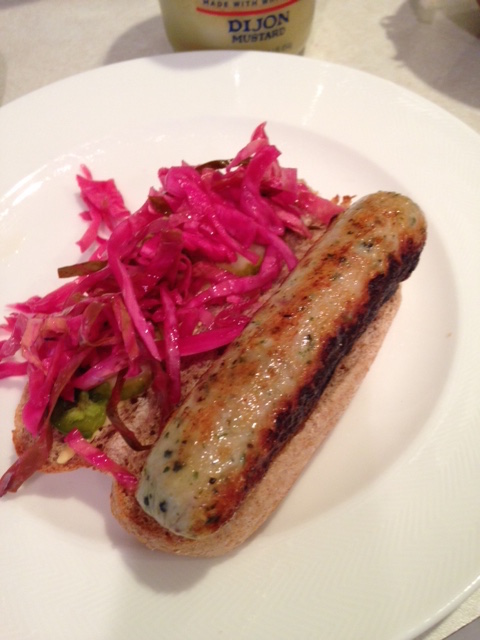
We decided our kraut was just the way we like it: slightly crunchy like cole slaw and with a delicious but not overpowering tang.  So we decanted it into several clean jars and refrigerated it.  Some for us, some for friends.  You could, according to Katz, let your sauerkraut continue to ferment for as long as you wish, assuming you are willing to repeat the steps.  You simply take what you want to use for a meal any time during, repack the crock (as above) and let sauerkraut and dogit do its thing. Eventually, the sauerkraut will compress down into something closer to the product you can find in the supermarket deli section. After it is to full strength, it can keep for a long time, which is probably why frugal societies that ‘put up’ foods in a way that preserved their nutrients for later consumption, were so keen on these fermenting techniques. The Korean staple, Kimchi, is close cousin to this European concoction, and other Asian cuisines include fermented fish products in many favorite recipes.  Our homemade sauerkraut went on this dog, with a generous helping of Grey’s Poupon mustard and Nancy’s jalapeño pickles.  Are you salivating yet?

If you enjoy preparing food, let me warn you that these adventures in the art of fermentation could be habit-forming.  As we completed this morning’s project and stored our crock for next time, I had a strong intuition that our kitchen was probably humming with live culture.  What better time to  capture what was in the air with a batch of sourdough starter? I fell in love with sourdough thanks to my mother who acquired a hand-me-down batch from a friend in Alberta Province, and kept it going for over 20 years.  She fed it weekly, and baked biscuits, rolls and bread of unparalleled flavor and texture for family, friends and neighbors. Once, she even smuggled a cup of starter through customs in her cosmetics bag. There is also something that appeals to me deeply about being part of an ancient tradition, the idea that one needs to feed ‘Mother’ every time you take some for a recipe.  A permaculture vibe: regenerative, rather than merely sustainable. I haven’t had much success with earlier attempts at sourdough starter, but that’s before my kitchen went wild.

Here is a link to a free pdf copy of Sandor Ellix Katz’s book: Wild Fermentation: A Do-It-Yourself Guide to Cultural Manipulation although I encourage you to look for it at your usual book sources, help keep a roof over his head, and his fermentation workshops full.  He is also the author of This Revolution Will Not Be Microwaved and his http://www.wildfermentation.com/, also looks amazing.

*about Stewart Brand, editor of Whole Earth Catalog, not so much.  See George Monbiot’s critique

Does Florida Have A Poet Laureate?

Happily, surprisingly, yes!  As of June 15, after a gap of three years, Peter Meinke, 82, was appointed to the position.  As it happens, I am familiar with Meinke’s work via his second volume of poems, Trying to Surprise God, gifted to me by one of his students at Eckerd College, a sister writer and friend.  Who knew then I would come to live in the home state of this poet, whose Lines from Key West, inspired both curiosity and a sense of foreboding? I’ve been feeling as optimistic about the state of poetry in this country as I do about the State of Florida, which is to say not very. But this news is somewhat encouraging on both counts, if only because Meinke’s four year term also coincides with a critical window of opportunity for Florida to get its act together about sea level rise and the rising demand for solar energy. There is, as the title of one new collection of climate-related poetry puts it, So Little Time: Words and Images For a World in Climate Crisis.  

Poets were once the rock stars of their generation, able to speak truth to power through their art. They got it, and did not fear to take a stand. Here’s T.S. Eliot, writing in 1939:  “For a long enough time we have believed in nothing but the values arising in a mechanized, commercialized, urbanized way of life. It would be well for us to face the permanent conditions upon which God allows us to live upon this planet.”

The good news: poetry is persistent enough, even in our social media, texting-crazed, wired culture — perhaps even because of it —  for questions about its demise to crop up every so often.  The latest iteration comes in a CNN report on the appointment of Juan Felipe Herrera as the next poet laureate of the United States.  Notwithstanding The Writers Almanac, and popularity of poets like Billy Collins (a former U.S. laureate) and Mary Oliver, it is clear that the number of people who read poetry is shrinking to cult status. And yet, undeniably, as the surge of interest in poetry after 9/11 indicates:

In times of national crisis, when ordinary language fails us, we still turn to poetry to express the inexpressible.  Brandon Griggs, CNN

I believe poetry can — and must — show up whenever and wherever it can make the strongest impact, where it takes us by surprise, shakes us out of our lethargy, and makes us care about what truly matters. And for that, we need more than the printed page; we need spoken word poetry, delivered at open mics, popup events, or even through campaigns such as the voicemail poetry created by poet and professor, Major Jackson, for his students at the University of Vermont.  It goes like this: you call a friend and, without any explanation, recite a poem on their voicemail. If they answer, you tell them to hang up and let your next call go to voicemail.

spoken word micThe other reason I see a future for spoken word poetry is Eve Ensler. With her launch of The Vagina Monologues in a tiny theater on the Westside of New York City, Ensler demonstrated the power of spoken word to touch people deeply. She not only shook up gender politics, she also launched an ongoing international campaign to call attention to violence against women and girls. Performing her material and the formation of a troupe that grew from that experience (Women Aloud) has me asking some new questions. What if a campaign based on spoken word poetry (or monologues) could do for climate justice activism what Ensler did for the women’s movement? And if so, what better place than Florida, climate ground zero, to test it out? When you think about it, critiques of the status quo and prophetic warning are by no means a new role for poetry through the ages. Think Shelley’s Ozymandias. I especially love Wendell Berry’s savage wit and quiet anger in Questionnaire and Manifesto: The Mad Farmer Liberation Front from which one of my favorite quotes: Be joyful though you have considered all the facts.

Beside So Little Time, this year, the UK’s Guardian launched a series of 20 original poems on climate curated by British poet laureate, Carol Duffy, because (as she wrote): If information was all we needed, we’d have solved climate change by now. The scientific position has been clear for decades. Researchers have been waving a big red flag that has been impossible for our politicians to miss.”  Her goal for the collection: “… to reach parts of the Guardian readers’ hearts and minds that the reporting, investigations, videos, podcasts and the rest had failed to reach.”  

Poets grieve, rage, and pull no punches.  An example:

Extinction

We closed the borders, folks, we nailed it.
No trees, no plants, no immigrants.
No foreign nurses, no Doctors; we smashed it.
We took control of our affairs. No fresh air.
No birds, no bees, no HIV, no Poles, no pollen
No pandas, no polar bears, no ice, no dice.
No rainforests, no foraging, no France.
No frogs, no golden toads, no Harlequins.
No Greens, no Brussels, no vegetarians, no lesbians.
No carbon curbed emissions, no Co2 questions.
No lions, no tigers, no bears. No BBC picked audience.
No loony lefties, please. No politically correct classes.
No classes. No Guardian readers. No readers.
No emus, no EUs, no Eco warriors, no Euros,
No rhinos, no zebras, no burnt bras, no elephants.
We shut it down! No immigrants, no immigrants.
No sniveling-recycling-global-warming nutters.
Little man, little woman, the world is a dangerous place.
Now, pour me a pint, dear. Get out of my fracking face.

~ Jackie Kay

More to think about:

The Dark Mountain project, a network of writers, artists and thinkers who have stopped believing the stories our civilisation tells itself. We produce and seek out writing, art and culture rooted in place, time and nature.

Poetry Outloud — an annual contest for the spoken word that offers school-age performers cash prizes include $20,000 toward a college scholarship.

Consider supporting the poetry/climate effort by your purchase of So Little Time: Words and Images for a World in Climate Crisis, by Greg Delanty and other poets and photographers.  (Green Writers Press, Brattleboro, Vermont).  I am not affiliated with the authors or publisher.

The Gift Economy*

The world was made to be free in.

Give up all the other worlds
except the one to which you belong.

Sometimes it takes darkness and the sweet
confinement of your aloneness
to learn

anything or anyone
that does not bring you alive

is too small for you.

~ Sweet Darkness, David Whyte

For those who make their livelihood in the financial markets or follow their own investments closely, this week will require seat belts, low and tight across your laps.  If you believe things are going to return to ‘normal’ for the dominant energy sector any time soon, read this from the Post Carbon Institute. It certainly calls into question whether Shell’s proposed Arctic drilling is anything but pure political theater. Although we divested from fossil fuels a while back, I have vowed not to look at our portfolio until the end of the day, but maybe end of the week is even better. I am not a fan of volatility in money matters or in human behavior (perhaps that’s redundant).

So, I’m turning my attention to what I can do When Things Fall Apart, to cite a favorite book from a favorite author.  I’m reading more poetry and attempting to write it better because, well, if not now, when?  I’m also making plans to put up a crock of sauerkraut in the hour formerly known as Sunday service because at least it will leave me with something that nourishes me for a few days.  I’m beginning to explore life in the gift economy*, the realm that exists apart from getting and spending, (although I will have to acquire about 5 lbs. of cabbage and some Kosher salt for my project) and I invite you to join me there.

Let me begin with a riff on these lines lifted from David Whyte’s poem for a few bars, and feel free to hum along (here is the complete poem from Whyte’s collection, The House of Belonging, ©1996 Many Rivers Press, and long a favorite of mine). First, I’m more than a little tickled that Elizabeth Gilbert (Eat. Pray. Love) chose this quote for her poem of the day. While I would argue against a purpose for something as impractical as a poem, David Whyte is well-known for his work with corporations and organizations to help employees break old habits of mind and ‘come alive’ on the job. Having done time myself in some stagnant workplaces, I cannot help but wonder how many people rose up from one of Whyte’s workshops and kept right on walking.

This poem, and others of his most loved verse, are an invitation, an enticement, to be more alive, moment to moment, to simply be. I read these lines as a call to free ourselves from all the boxes we put ourselves into, often unwittingly: our roles, relationships, titles, possessions, self-delusions, anything that makes us dead to the world ‘to which we belong.’ For this kind of breakthrough, Whyte suggests, we need our own ‘sweet darkness’ of meditation or reflection, so we may learn who we are, where we belong, and with whom. Discovering whatever brings us alive is the great uncompensated work of a lifetime. My short list: my long, ever-surprising marriage; poetry, especially read aloud; music, especially making it, however inexpertly; real conversations with friends and strangers; walking with no particular destination; slow food; slower everything. What’s on yours?

Of course, poetry is part of the gift economy, in the sense that it is available and of benefit to all. With very few exceptions, no one lives on poetry alone, or the making of art of any kind, for that matter. The U.S. Poet Laureate gets a stipend of $35,000, plus $5,000 travel expenses, paid by a private grant. And yet, “It is difficult,” said William Carlos Williams, “to get the news from poems/yet men die miserably every day/for lack/of what is found there.”

The library system is another such enduring gift (thank you, Andrew Carnegie). It’s anyone’s guess how many lives have been changed, lifted-up, by the simple act of reading. Some libraries have added tools and equipment.  Speaking of free access, you should be able to download an e-book version of Pema Chodron’s best-seller by clicking on When Things Fall Apart. You might consider this giveaway a smart marketing move to sell more of her books generally,  But I consider it another example of the gift economy, made possible by the Internet. In fact, one could argue that the entire Internet fits the description of gift, albeit one needs tools and access.  In one of my favorite visions of a future worth having, small farmers in the developing world generate local energy via solar panels and use technology like affordable cell phones and/or rollup computers to download necessary information, while their children logon to (free) Khan Academy.

freecycle-300x141Other gifts: the National Parks System, including the incomparable Florida Everglades, when last I checked. Public beaches, mandated by law. Public spaces, as long as you’re not breaking a local ordinance on size of group or activity.  Let’s also include, Free-cycling. Blogs, from the mighty HuffPo to this one (although you must tolerate some ads — sorry.) My favorite: foraged foods — berries, mushrooms, wild greens.  Then, the obvious freebies: trees, wild pollinators, along with clean air, water, soil, and sun, rain, wind — anything we consider held in common, available to be used and enjoyed by all. In other words, all that brings — and keeps us alive. For these gifts, may we be sufficiently grateful to pass them forward.

_______

*I am using ‘gift economy’ is a broader sense than this definition, and more akin to that suggested by Charles Eisenstein’s book: Sacred Economics: Money, Gift, and Society in the Age of Transition.