Food in My Kitchen

Emalee veggies

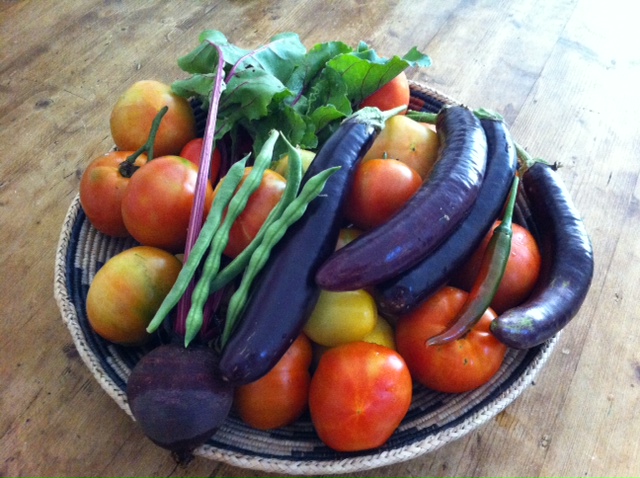
See this basket?  All of it came from my friend, Emalee’s backyard, a no-till vegetable patch established in 2012 with compost from the city of West Palm Beach (you have to provide the truck, some muscles and a wheelbarrow) and still going strong.  I came home with Japanese eggplants and tomatoes in abundance.  What to do?

This morning, I started chopping and slicing and sautéing, O Mio Babbino Caro playing in the background, and by noon, I had the base for a Vegetable Korma — I’ll add the yoghurt just before I serve it — and a caponata from the Kripalu cookbook series (a good way to preserve tomatoes and eggplant).  The curry was going to be our lunch, then my spouse called from the dentist to say he needed to have an all liquid lunch.  So, I quickly turned some broccoli, CSA and home-grown, into a soup.  Here’s the recipe for the Broccoli Garlic Soup:

Two cups of tender, washed broccoli stalks
4 cloves of garlic mashed
2 T.  olive oil
1/3 – 1/2 cup of water
Sea or kosher salt to taste

Put everything into a heavy saucepan, cover and cook until most of the liquid has evaporated and the broccoli stalks are tender but not mushy.  Time varies, but about 7-10 minutes should do it.  Pour it into the blender jar.  Add water to just cover and puree until smooth.  Serve room temperature with a dollop of yoghurt on top.   The broccoli prepared this way is delicious as a side as well, and I have Dr. Andrew Weil to thank for the basic recipe.  I’ve used it for green beans and broccoli rape, and it’s simple and good.

I realize that many people, e.g. the single mother of two in A Place at the Table , the documentary about hunger I’ve been writing about, do not have ready access to fresh, local produce.  And that’s something that can change as more people start-up community gardens in  urban ‘food deserts’.  But there is also much she could do with staples like lentils, black beans, and chick peas, if there was somewhere she could go to learn.   Great nutrition for her kids and herself at very low-cost prepared without fancy pots or gadgets, now that’s social action through food, and well worth working on.   

Since seeing the documentary, I’ve been surfing around looking at food bloggers, especially those with a social conscience, and yesterday, I hit a bonanza.  The Giving Table.  I like their slogan, too: Doing Good With Food.  On April 8, bloggers were invited to add content to their sites in recognition of hunger in America.  http://www.givingtable.org/food-bloggers-against-hunger  There is a ground-swell of passion for solving this intractable problem and it gives me hope.

The Seat is Going Anyway…

This summer, I want to be in the Northeast for about a month, to visit family and friends, give my yoga practice a boost with a few days at Kripalu Center in The Berkshires, and slake my thirst for art and culture in New York City.

Along with millions of other Americans, I hear the siren call of summer ‘elsewhere.’ Except that I am trying to figure out how to travel with the smallest possible carbon impact. I share my dilemma with a friend who is bemused that I am considering taking a train (awful food, noisy) because I believe flying takes the biggest toll on the environment. Yes, I know the seat is going anyway.

Probably driving is the least bad way to haul me, spouse and stuff some 1,600 miles in one direction and back. I have driven up and down the East Coast enough times to own a dog-eared Road Atlas with notes about interesting food stops (Gulf oysters at St. Augustine Beach), good radio stations, clean toilets, as well as places to avoid. When planes were temporarily grounded after 9/11, we drove from California to New York, four nights, five days on the road. I’ve never added up all the miles, but the call of the open road is pretty well out of my system. Anyway, driving a fuel-efficient car even with two passengers doesn’t beat traveling by bus — hands-down the most energy-efficient, least carbon-loaded way to get anywhere. Hey, rock stars do it, albeit in luxurious coach-style.

Truth is I’m more of a homebody than I used to be, even before I began to be alarmed about the environment enough to do something personally. Come to find out that when you add up heating/cooling, washing and drying clothes (a biggie) and even computer usage, our homes are where we burn through the most energy. Yikes!

If you find yourself agreeing that it’s our obligation as world citizens to take our contributions to climate change personally, you’ll find a lot of helpful calculators on the Internet. Here’s a gem I just stumbled upon which handily compares itself to other popular ones:
http://michaelbluejay.com/electricity/carboncalculator.html

You may be surprised as I was to discover that you can do more good by giving up meat and walking and/or biking more than you drive, than by swearing off flying (obviously, frequent flyers were not included in the tally). Another nugget that I am definitely tucking into my toolkit for future reference: traveling by cargo ship across the Atlantic, then using train and bus to get around.

You might want to poke around some of Michael Bluejay’s other sites as I did. In fact, I was having so much fun, I had to remind myself that I was in the midst of a blog post about my travel dilemma for this summer!

I’ve got my sights on The 100-Mile Diet: A Year of Local Eating, one couple’s answer to saving the planet, http://en.wikipedia.org/wiki/The_100-Mile_Diet, in a future post.

Speaking Up

Public speaking doesn’t terrify or immobilize me, but it’s not my favorite pastime by a long shot. I greatly admire those who can speak extemporaneously, precisely and with passion. I’ll add it to my bucket list. In the meantime, I look for and respond to any opportunities to speak about Transition because I figure the more I do of it, the easier it will become and the better at it I will be. But it’s not easy to strike a balance between reminding people of how bad things really are and inviting them to engage in a movement that, at the very least, suggests a softer, more resilient impact could be possible. So, now I’m gathering my energy for a presentation at my Unitarian Universalist congregation next week, and wrestling to get the words I want to say down on paper.

I dislike grandiosity in others and try to scour it from my own writing or speech. Yet I could not resist using quotes on the environment from President Obama’s inaugural speech. After all, his words are a major breakthrough in acknowledging the threats posed to civilization by climate change. They represent to me an intention, a direction, even if I have reservations about just exactly how ‘we will respond’ when his administration is also committed to supporting conventional energy production, fracking included. (And there’s the rub. As Einstein famously said: “Problems cannot be solved with the same mind set that created them.”)

What resonated with me was the phrase ‘We the People’ which Obama repeated several times. So, in the context of climate change, the word ‘we’ seems less about reassuring us that the government (and technology) will handle it, and more of a challenge to us all to take responsibility for how we have been, and may still be, contributing to a worsening environment, and where we can change our behavior. That is essentially what the Transition movement aims at: behavior change, one individual, household, neighborhood, town at a time, so that it will all add up to cultural shift from — as the saying goes — ‘Me’ to ‘We.’ That it may just work is what keeps me hanging in there, one blog post, speech, email or conversation at a time.