Seeking Balance

DAncing-Warrior-2As a yoga devotee and Libran, I understand the importance of balance.  These days, it is especially challenging to find mine.  On Saturday, I gathered with a diverse group of artists, scientists, teachers, entrepreneurs, and community organizers in what I hope is the first of meetings that will breathe new life into the Transition movement in our area.  Flip the coin.  Today, I started a free, 4-week online course called Turn Down the Heat: Why a 4°C World Must Be Avoided, designed by The World Bank and with a multi-national enrollment of over 15,000.

Week 1 has begun with a series of videos and texts taken from a report for the World Bank by the Potsdam Institute for Climate Impact Research and Climate Analytics.  That this report by such an organization exists at all should be enough to stop the insanity of climate change denial.  But I live in Florida where fundamentalism infects politics and business-as-usual is everywhere evident in rampant coastal development, so I’m not holding my breath.

I’ve been reading extensively about climate change for the last two years, and watching it move from bad to much worse in the same time frame.  Turn Down the Heat has not yielded any big surprises so far.  It has just provided more statistics – presented in the level tones of academia – to better understand the catastrophe that is coming if we continue to live (eat, transport ourselves, consume) as we have been.  And if that ‘we’ gets bigger as more of the developing world enters the home- and car-owning status we consider our birthright in the wealthy world.

As I told the group of eight on Saturday (during our go-around), being introduced to the Transition movement by a friend pulled me out of a tailspin of despair that began with the Deep-Water Horizon spill in the Gulf of Mexico.  It drew me toward activism in a way that all the reading (Limits to Growth, 1972 and its sequels, George Monbiot’s Heat, 2006) and films like Food, Inc., and Gasland, Part II, had not.  So I beg to disagree with the course presenters that knowledge alone can bring about a transformation in society.   It will take a village, small town, and city — everyone in: one conversation,  vegetable plot, eye-opening documentary,  potluck,  book group,  vote,  policy changed — in short, a movement.  Our grandchildren deserve a revised standard of prosperity,  a slower, kinder, more mindful way of life, even if the future at 4°C were not so horrifyingly unthinkable.  The truth is, we all do, and many of us long for it.

Transition appeals to so many people because becoming more resilient as a community – supporting local businesses, growing our own food, sharing our tools and skills more widely  – is just that kind of revision, a welcome remedy to hyper-consumerism and outsourcing jobs and wealth, even if climate change were not a growing threat.  That was, I sense, what made our newly-forming group feel so exciting and full of promise.  We have so much to offer each other and our communities.  Gaining traction may not be easy, but it’s worth the effort.  May we be able to move ahead with a shared sense of urgency.  May we attract more people into the process itself, the fun of making new friends and learning new things, the power of just doing stuff.  

Want to know more about Transition?  Start here:

http://www.resilience.org/stories/2013-11-11/rob-hopkins-introduces-new-yorkers-to-the-transition-movement

Free pdf of The Transition Handbook by Rob Hopkins, http://www.cs.toronto.edu/~sme/CSC2600/transition-handbook.pdf

Rob Hopkins’ The Power of Just Doing Stuff, widely available and a book group possibility.

Will The People Who Need to Read it, Read it?

flight-behaviorThis question, from my Book Group last Saturday, has haunted me — someone who writes regularly about my response to climate change with the certainty that I am (mostly) preaching to the choir, and a small one at that. As Winston Churchill famously asserted, Americans are a people ‘divided by a common language.’  Of course, it is much larger issue than regional dialects and accents. Miscommunication among diverse groups who do not understand each other (or attempt to) is a commonplace of a multicultural society and one that deserves more attention than it gets.

Failure to communicate is but one strand in the weave of Flight Behavior, which Kingsolver’s official site describes as: “… a heady exploration of climate change, along with media exploitation and political opportunism that lie at the root of what may be our most urgent modern dilemma.”  But it is an important theme.  Who is not reading this book is as important as who is, because a good story like this one has the power to convince when facts alone fail (and we are talking about an alarmingly high percentage of skeptics), and to motivate those who are informed and have yet to act in any meaningful way, no small number.

With her trademark empathy for the people she writes about, Kingsolver shows us what one impact of climate change looks like to a community in rural Appalachia that is 1. Out of the loop, and therefore deeply suspicious of outsiders (climate scientists, media, environmentalists toting ‘sustainability pledges”), and 2. Likely to be upended by its effects.  She describes what happens when the larger world – researchers, media, logging interests, climate activists, the curious public — comes to fictional Feathertown, Tennessee.  We begin to see, as the wisdom traditions teach, there is no Other.

“Cultural differences are really exciting territory,” Kingsolver said in an interview, “not just for the literature but for learning in general, because sparks fly when there’s friction among different viewpoints. People invest themselves differently in the same set of truths.”  So to Rev. Bobby and his congregation, the unprecedented migration of monarch butterflies takes on religious significance.  To scientist, Ovid Byron, and his research team, it is another distress signal from a world out of whack.  For the Womyn group of knitters, it is an opportunity to speak for nature. With whom do we identify?

Like the other strong female characters of Kingsolver’s best-selling fiction, Dellarobbia Turnbow, is the voice of Flight Behavior.  We are sympathetic witnesses as her understanding of what the butterfly phenomenon means, catches up with ours.  When our Book Club leader asked what we had learned from the novel, there was a thoughtful silence.  We only know what we can know.  So it comes as no surprise that the media will manipulate the protagonist’s story and ignore the experts.  We are familiar with the power of YouTube to save (or wreck) reputations.   We know Dellarobbia is smart, but it is the unexpected changes within her that make this a compelling narrative, and provide a drop of hope.  There is her growing self-respect and newfound passion for research, her appreciation for the quiet strength of her husband, and for her mother-in-law, whose rich knowledge of native plant life provides an unexpected bond. And here was a big takeaway for me: in Kingsolver’s Feathertown, despite difficult physical labor, limited career options, crushing debt, and abysmal schooling which guarantees more of the same, we find a community with admirable habits of generativity, interdependence and thrift.  Valuable lessons, all.

“The biotic consequences of climate change tax the descriptive powers, not to mention the courage, of those who know most about it,” Kingsolver writes in her Author’s Note.  With Flight Behavior, her training as a scientist and narrative gift nudge her readers in the right direction if we are willing to go.  I would like to believe that there are hundreds of readers, like the members of the Second Saturday Book Club, who having read and discussed Flight Behavior, are on to the more important question: what then shall we do?

From Consumers to Producers?

We Can Do It! Rosie the RiveterIt must be something in the air or drinking water, but I am coming across this consumer vs. producer idea more and more lately.  Just today, someone posted on Facebook a story about how Cuba, which became an engineering and technological wasteland after the US left and the Soviet Union’s economy stalled, has pulled itself– out of necessity — into the 21st century by a new DIY ethic – one might even say ‘chic.’

The other item that floated to my desktop was that in Greece, whose economy is in dire straits,  young people have given up looking for jobs in urban areas and are going back to the land.  The reason they can is that, somewhere in their backgrounds, there is a homestead that belonged to a grandparent or other relative, a house and a garden in a village.  Romantic?  I doubt it.  Practical, yes.  They are returning to places where they can learn what previous generations took for granted about self-sufficiency and making a decent life without so goddam much stuff.  Many are taking up farming or learning to prepare food.  They are acquiring survival skills and building community at the same time.

Maybe these are important models for us to study in the post-consumer age we may be entering.  Consumers  — especially those wired to their electronic ‘friends’ — don’t generally make for great neighbors.  But people who make things (or create ideas), have to connect with others: mentors, partners, co-workers, and customers.  Producers live in a world of ideas and possibilities that encourages generativity, in the sense of “making your mark” on the world, creating or accomplishing things that matter.

It’s not too late to get our hands dirty, to build things, to maintain and repair the things we have, to share our new found skills with others.  In fact, in a future where the cult of go-it-alone individualism is sure to be severely tested, it is about time.

Photo credit: Mike Licht, NotionsCapital.com / Foter / CC BY

Revolution: Orderly and (Mostly) Quiet

As revolutions go, the local foods movement is relatively well-behaved and filled with activists who are not afraid to get their hands dirty.  Its goal is ambitious: to get people to  switch their allegiance from farm products shipped thousands of miles at an unsustainable carbon cost, to locally-grown and raised foods.  If enough of us do this, the reasoning goes, we will not only have fresher, healthier foods to eat, we will develop community resilience that can withstand disruptions in the food supply chain many foresee as inevitable as the climate changes.

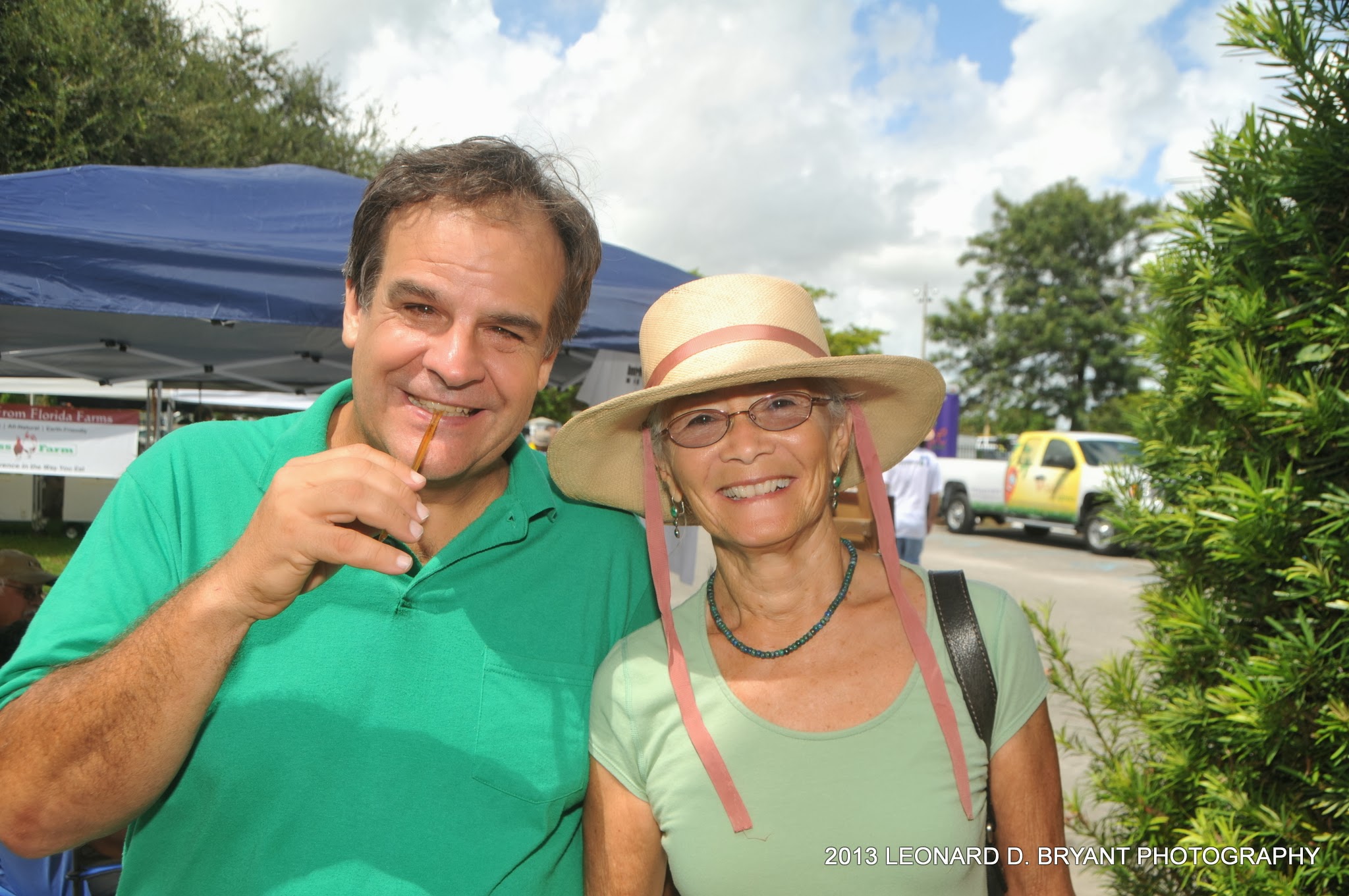
In Palm Beach Country where I live, the movement is embryonic compared to, say, the San Francisco Bay Area or most of the state of Vermont.  But on a sunny Saturday at Gray Mockingbird Community Garden, with the lively sounds of the Lake Worth High School Steel Drum Band making my feet tingle, it was possible to dream big.  The occasion was Local Foods/Local Gardens and I was on hand Brian and Marikawith partners, Brian Kirsch of Gray Mockingbird Gardens, Mary Jo Aagerstoun of EcoArt South Florida, and my spouse, Howard, to talk up and sell tickets to a special screening of Symphony of the Soil, a  documentary by award-winning filmmaker and Palm Beach County native, Deborah Koons Garcia,  November 17 at the Muvico Parisian in City Place, West Palm Beach.  The film makes a powerful connection between reclaiming our soil (and farms) from Big Ag and food security for all of us.

The timing could not be better.  In about a year, Solid Waste Authority which has been providing free compost to local backyard and community gardens in Palm Beach County, will phase out of this service.   The screening, and a Q&A with the filmmaker and other local soil and gardening experts, is intended to help launch a conversation with all parties concerned on how to address our composting needs in the future.

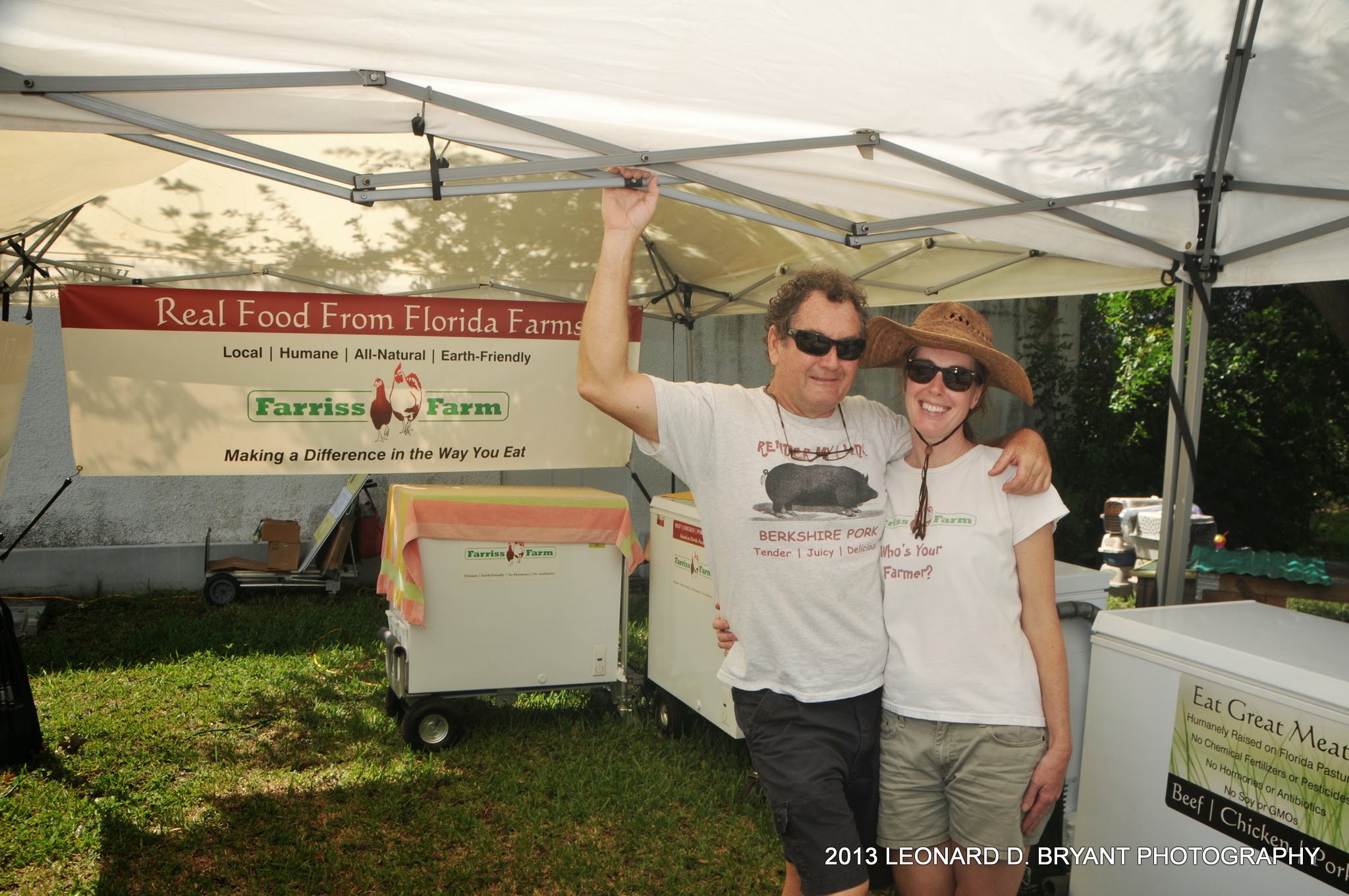
Robert and Paula FarrissWhen I wasn’t in the Gray Mockingbird booth, I was schmoozing with people like Robert and Paula Farriss of Farriss Farm who offer free-range eggs that taste like eggs, and  100% grass-fed, pastured livestock.  The term ‘pastured’ denotes animals that have been raised humanely, without hormones and antibiotics because, simply, they do not need them to thrive.  It is encouraging to know that there is a burgeoning market for products like this, for both health and ethical reasons.  I’m not likely to be a convert to mammal meat (though I have recently sampled pastured duck), but I do come away from conversations like this with a better understanding of why large herbivores are necessary for sustainable agriculture.

I had a good chat with John Zahina-Ramos of Just One Backyard about the challenge of getting the foodservice industry, restaurants included,  to understand how composting their vegetable scraps could actually impact their operating budgets.   John is an ecologist and  makes a convincing case for a more holistic way of agriculture.  JoJo Milano of Goodness Gracious Acres was also there, promoting her goat-milk based soaps.  Currently, unpasteurized goat’s milk cannot be sold as food for human consumption, a situation that I hope will change.  Joanna Aiken, Community Service Coordinator of Solid Waste Authority, also stopped by the Symphony of the Soil table and I feel confident we’ll work together well on a composting solution.  I bought some honey sticks from the Palm Beach County Beekeepers Association booth (yum!), and met Facebook friend, Susan Lerner of the Rare Fruits Council.

A fun morning invested in a cause I am passionate about.  Let the revolution spread!

(Photo credits: Leonard D. Bryant, 2013)