Earth Hour 2015: Lights Out

Where were you when the lights went out? If you are of a certain age and lived in the Northeast United States, you’ll remember at least one major blackout, with those of 1965 and 1977 perhaps the most indelible because normal life was disrupted for so many people across a vast region.

I was caught in a blackout in New York City in the early 80’s while on a research assignment in Brooklyn for Technology Magazine – the irony sank in sometime later.  Fortunately for my co-worker and me, we were above ground when the power went out, not trapped in a subway car or skyscraper office.   We, along with hundreds of others hit the streets, giddy with relief.  It was late afternoon when we crossed the Brooklyn Bridge, into Lower Manhattan and the Village. There, a party was in progress as restaurants who had lost their refrigeration, were turning out meals on make-shift charcoal grills and offering them, along with slightly warm beer, to whomever cared to take them up on their offer. Although that particular blackout would prove to be relatively local and short-lived, there was no way to know at the time.  “It’s tempting to ask why if you fed your neighbors during the time of the earthquake and fire, you didn’t do so before or after,” writes Rebecca Solnit of the San Francisco earthquake in  A Paradise Built in Hell: the Extraordinary Communities That Arise in Disaster.

Eventually, I got my foot-weary self to the Port Authority Bus Terminal that evening to wait with other New Jersey commuters for the power and interrupted bus service to resume.  Here, too, there was unusual cooperation and camaraderie.  We riders of the DeCamp 66 and 33 who barely exchanged a word before, were talking, exchanging stories and phone numbers, discovering we were neighbors after all.

unpluggedEarth Hour, 8:30-9:30 pm local time, when the Strip in Las Vegas, Times Square and the Eifel Tower intentionally go dark to raise awareness about climate change, was launched in Australia in 2007 by the World Wide Fund for Nature and has become a global movement.  Getting millions of people to power down for one hour a year doesn’t seem like much to ask, even of the electronic device-addicted populace of our century. In our home, we mark the occasion with an hour of candlelight, a glass of wine, a ukulele, some songs, enjoying the respite from the mixed blessing of an always-on, always-connected life that we have embraced so wholeheartedly.  Viewed in long-range or aerial images, Earth Hour is spectacular, and more than a little unnerving.  I would like to think that this scale of community arts activism will help us wrap our heads around what is impossible to contemplate, even for climate advocates: a world without power; life as we’ve come to know it, unplugged.

Artists of all kinds have often taken the lead in making the invisible (under-appreciated or ignored) visible, because they can.  Some are using their gifts to wake people up to the really wicked, society-transforming problem of climate change and a rising sea, e.g. The HighWaterLine project. The brainchild of artist, Eve Mosher, the HWL helps communities visualize the impact of climate change in our own neighborhoods and streets. Mosher began her work in 2007 in Lower Manhattan and Brooklyn, mapping areas predicted to be impacted by flooding during storm surges. After deep research into climate science and Google maps of flood zones, she spent six months using chalk and a sports field marker to draw the 10-ft. above sea level line in the streets and on the buildings. Yes, that was five years before Sandy.  Click here for more on the HWL.
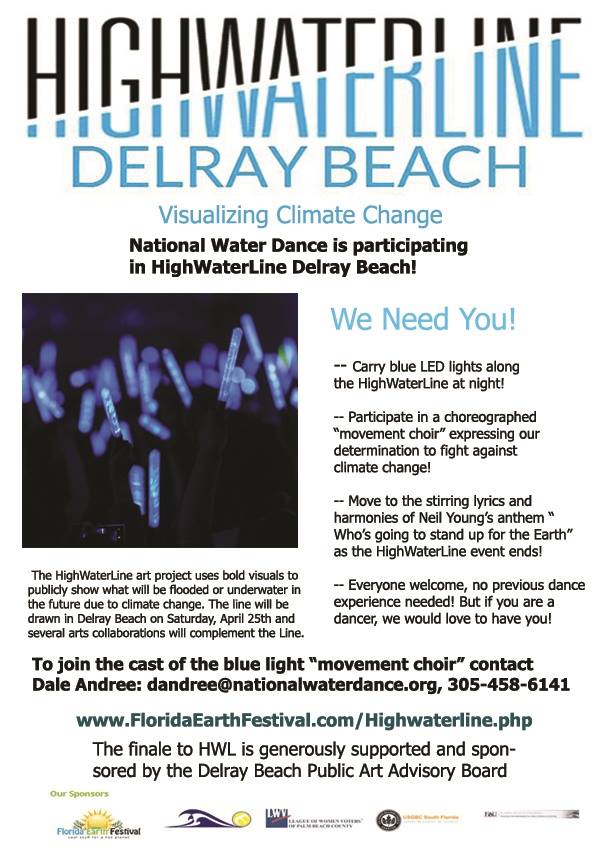
Blue LightsAs residents of one of the states most vulnerable to sea level rise, Floridians are fortunate that Eve Mosher will be making a return engagement, this time in Palm Beach County later this month, chalking sea level rise for the HighWaterLine Delray Beach event. This day-long performance is part of the 2nd Annual Florida Earth Festival, a series of workshops and demonstrations that runs April 18 through 25, including a weekend of intensives at the Unitarian Universalist Fellowship of Boca Raton, 2501 St. Andrews Blvd.  Volunteers are needed for all kinds of tasks during the festival, and if you are able, I urge you to find what speaks to you and sign up.  For this yoga instructor and lover of dance, it is the prospect of being in the grand finale of the HWL mapping: a ‘movement choir’ of dancers holding blue glow lights and moving to Neil Young’s new anthem: Who Is Going to Stand Up for the Earth.

I’ve also signed up for the Beautiful Trouble workshop in the hopes that it will help me hone my new-found voice as a spoken word artist (thanks Vagina Monologues!) into a poetry flash mob or open mic performance on environmental themes.  In any case, it sounds like way more fun than climate advocacy usually is, Greenpeace Gorilla suits and the Raging Grannies notwithstanding.  These trainings are intended to serve as “A Toolbox for Revolution.” Bring it on.
Earth Hour visuals

Earth Hour, March 19, 2016

Biggest Blackouts in History

HighWaterLine Action Guide

Naturally Enough

If there’s one thing you can’t complain about in the State of Florida (although some would disagree), it’s the weather. Even our recent two-day winter was good for a laugh, and the cozy, unaccustomed feel of a wool sweater against the skin. And today, we’re back to the high 70s and sunny, the kind of day that puts a smile on the faces of winter-weary travelers and cash into the local economy.

It’s the sort of day that has me wondering why kids raised in the Sunshine State spend so much time indoors, eyes locked onto their screens and favorite video games (many of them violent).   It’s the always-on culture, you might say, addictive behavior modeled by parents and peer group alike. You could blame the irrational, media-fueled fear of just about everything, from hidden perverts or kidnappers in the neighborhood to vaccinations. By now you’ve read about scientists, Danielle and Alexander Meitiv, in trouble with the law because they allowed their children, age 6 and 10, to play in a local park and walk home unescorted. Here’s a thoughtful piece from The Daily Beast: http://www.thedailybeast.com/articles/2015/02/15/free-range-kids-are-healthier.html.  So were things ‘safer’ for kids back in the day when I sent my 14-year-old son to school in New York City by commuter bus and subway, and my 10-year-old daughter happily walked with friends a few blocks to her classroom? Statistically, no.

Whether it is due to benign neglect or parental control on steroids, living under a rock is bad for kids and bad for the rest of us, too. We can’t expect children to love the world and want to preserve it if their only experience of it is a mediated one. Test this out for yourself. What’s better? Adventure travel or a television show about it? So kudos to Lenore Skenazy of Free Range Kids, (How to Raise Safe, Self-Reliant Children Without Going Nuts With Worry), the Boy Scouts and Girls Scouts of America, and the new White House initiative to get kids reacquainted with nature in our National Park System. http://www.whitehouse.gov/blog/2015/02/19/let-s-get-every-kid-park.  Yes!

And, although I’m basing this on my own observations and instincts as a grandmother (a relatively tiny sample), small children are ready for the real thing. They dig dirt, given half a chance. They know BS when they encounter it. They are naturally wild and free. They like to hang out in trees. They want the freedom to skateboard home from school long before they get a license to drive a car. They want to fix their own snacks, as unusual as their tastes may seem to my palate. An entire pomegranate? Sure. Broccoli sandwiches, barbecue sauce on pizza? Why not?

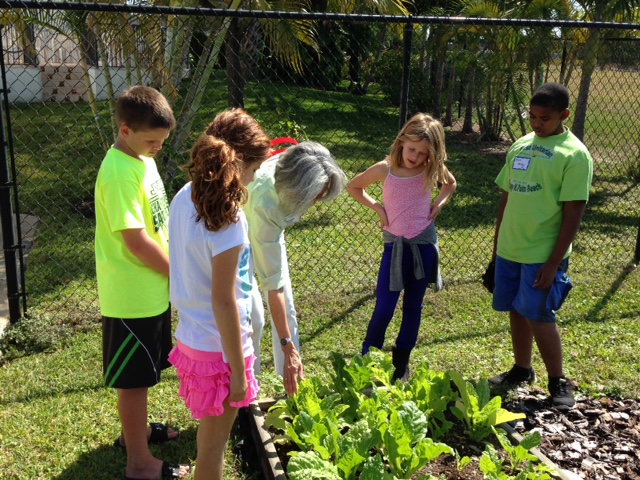
Swiss chard tastingAnd I think they are hungry for adults who are giving them their full attention. So let me describe my class in pollination, organized for the elementary grade children and part of their religious education (you bet!) I came prepared with some visual aids from the fabulous Xeces Society, and I had brought some pollinator nests fashioned from bamboo sections, string, and a couple of ready-made birdhouses.  Apparently, insects like every other form of life, need rest and respite.

The first thing I noticed was how happy these kids were to be outside, sitting on the grass, looking around, breathing fresh air.  Maybe more classes should be held outdoors. Each wanted to be the first to answer my question: What did you have for breakfast? Eggs, fried cheese, cereal, fruit. And they were attentive when I explained how pollinators like bees and other insects, birds and bats interact with plants, and how that contributes to the food we eat. School age kids have been trained, like puppies, to stay even when clearly, they’d rather be moving their bodies. I was grateful that there were no hand-held devices in evidence (perhaps it’s a rule), except for a camera, and that for the most part, they made eye contact with me.

But they really wanted to run around, chase each other, and climb trees and even the AC equipment (until called down).  I corralled them into the raised vegetable bed area by saying they could pick anything they promised to eat. That’s when the religious education class really came alive. Even the camera-toting boy who said he hates tomatoes and didn’t want to know they are the main ingredient for ketchup, was in.   Cherry tomatoes, beans, Swiss chard, all enthusiastically sampled and pronounced good. Maybe they’ll remember what just-picked vegetables warmed by the sun taste like.  Perhaps it will inform their own choices when they grow up.  I know I will remember their bright faces in that moment.

It’s experiences like these that reinforce my conviction that we must stop forcing our kids into our narrow views of what success in life looks like.  We could be wrong, especially in the future many scientists foresee. We need to nourish their imaginations and sense of wonder about the Earth and all life. We need to get kids back into the woods and swimming holes, into tents under starry skies, cooking over campfires, on hiking trails and whitewater rafts, where they can discover what they are capable of. We need to let them learn, to paraphrase poet, Theodore Roethke, by going where they have to go.

Possibly, this is a lesson we could all use.  See Guardian columnist and author of Feral, George Monbiot’s Civilization is Boring.  And my future blog posts on re-wilding.

7 Tips for a Zero-Waste Kitchen

Love what you’re doing!

Anne-Marie Bonneau's avatarZero-Waste Chef

my refrigerator

I love my (nearly) zero-waste kitchen routine. I eat a delicious, healthy diet and have simplified my shopping habits. But it did take me a couple of years to (nearly) perfect this routine and I may never achieve complete zero-waste. (Remember calculus class? You merely approach zero.)

When I shop at the bulk store, for example, I still indirectly generate a small amount of waste. The food arrives at the store in paper or (gulp) plastic packaging after all. Also, I refuse to give up butter and the paper does go in the trash. So, until I buy a farm and produce all my food myself, I will create some waste somewhere. Then again, if I live on a farm outside the city, I’ll have to drive everywhere and burn more fossil fuels…So, I suppose as a precursor to these tips, I should add—above all—don’t strive for perfection. That and cook everything…

View original post 868 more words

The Road Taken

Like many classic American adventures, this one was propelled by a vehicle: a school bus, fitted out to become a home, transportation, and learning center for Nando Jaramillo and Blair Butterfield, and their two children, Luciano, 4, and Imogen, 2 1/2. In three years, the family covered 8,000 miles to visit sustainable cities across the country, and bring the ideas back to their home base in Miami.  Concrete ideas like a bicycle-propelled compost collection service (wow!).  And intangible lessons about generosity, experimentation, a willingness to ask ‘why’ and ‘why not,’ old-fashioned skills blended with leading edge technology.   They came home to work on their dream: to help make Miami the ‘greenest city’ in America.

Last evening, some 30 people came to the Transition Palm Beaches monthly meeting at the Friends Meeting House in Lake Worth, to hear about what happened next and pepper the couple with questions.  It was perhaps the most diverse group and liveliest meeting to date.

Although the presentation began with some standard environmental disaster imagery, this is a good story, a model for what is possible when motivated people marry their deeply held values – in this case to live and raise their children in as green and sustainable a way as possible — to committed action.

Blair and Nando began by forming a nonprofit organization – Art of Cultural Evolution (ACE) — and establishing a pilot on a vacant lot on 34th Street in Miami. There they worked to restore the soil, plant an organic garden, compost, harvest rainwater, and experiment with solar energy. The neighbors noticed, and soon began to plant their own yards with vegetables. Volunteers showed up. Fifteen families were fed from a single growing season.

Brewing kombuchaNext, working with local groups, the 34th Street Sustainable Land Lab (as it was then called) began to offer public workshops, classes, and movies about organic gardening, CSAs, and other related subjects. They were creating, you might say, a buzz. A fortuitous meeting with a City of Miami commissioner – Nando, an art director for film and television, grew up in Miami – helped clear the way to a 50 year lease of land for what is now known as Colony 1, an environmental arts and science education center, at 550 NW 22nd Street in the Wynwood arts district of Miami. When it is built out, it will be a 2,500 sq. ft. space, constructed entirely of 11 shipping containers, chosen for their availability and durability. (I, for one, will never look at a container quite the same way.) Think Tiny House x 11.

It is going to take funding to make this $200,000 dream come true, and the drive is on. Take a look at the site: http://www.artofculturalevolution.org/ and see where you might want to plug in as volunteer, partner, donor, or all three. Brewing your own kombucha, mending your own garments, or growing medicinal herbs, are all worthy endeavors. It’s when you teach others how, and they teach others, that it starts to become something greater: a learning community, a movement toward sustainability.

More about their journey:

Edible magazine’s article, and much more detail.

https://www.facebook.com/culturalevolution

Telling the Good Stories of 2014

Crisis and opportunityWhen climate activists in South Florida meet, the mood is often serious bordering on grim, and I usually head out the door with a to-do list and a heavy heart. We know what we’re up against in our state legislature, so one doable strategy is to attempt to convince our local municipalities, one mayor and/or commissioner at a time, that we are holding them accountable for the preservation of our towns and cities, and our safety. For this we need local citizen volunteers to join in the effort. My team mates have developed a terrific script suitable for phone or email.

This is good, worthy work, yet I fear we may not attract many takers without the leavening agent of uplifting stories, and the truth is, 2014 was a pretty good year for the environmental movement. Last December, I tapped into Mongabay for positive stories, and this year, some that appeared on its current Top Ten list are also on mine:

  1. The ban on fracking in New York State shows what can happen when the people don’t give up, and keep the heat on indecisive elected officials. It worked in Denton, Texas, the state where fracking was born. Another small victory: would be frackers got fined in Florida. We have only begun to fight. Stay tuned, and keep an eye on other fracking news.
  2. Pope Francis, whose agenda for 2015 includes a rare papal encyclical to 1.2 billion Roman Catholics, an address to the United Nations, and a summit of the world’s religious leaders. His Holiness has connected the dots that many miss:

    “An economic system centered on the god of money needs to plunder nature to sustain the frenetic rhythm of consumption that is inherent to it.”

  1. The Climate Pledge between the U.S. and China, a savvy move by President Obama to sidestep an obstructionist Congress. What he will do on the KXL when it is (most likely) reintroduced, remains to be seen.
  2. Breakthrough in palm oil plantations as Kellogg, L’Oréal and Nestlé, signed a declaration pledging to help cut tropical deforestation in half by 2020 and stop it entirely by 2030.  You don’t mess with Harrison Ford.
  3. EPA ruling on power plant emissions comes under the Clean Air Act. Unless the Supreme Court changes its mind, this should stand. Thanks again to crafty POTUS.
  4. September Success: Over 400,000 people from diverse groups join in the climate march in New York City, and in smaller demonstrations elsewhere: Transition Palm Beaches, EcoArt South Florida, The Sierra Club and Raging Grannies (among others) in Delray Beach.
  5. The business connection.  Earlier this year, I found my way to the B Team whose stated mission is to ‘catalyse a better way of doing business for the wellbeing of people and the planet.’   http://bteam.org/about/ I figure any group that includes Muhammed Yunus (founder, the Grameen Bank of micro-loan fame), Arianna Huffington and Mary Robinson (former president of Ireland and member of The Elders) is a vote for humanity.
  6. The Transition movement continues to grow in the U.S. You can avail yourself of great, free seminars with some of the smartest, forward thinkers around, e.g. Cecile Andrews, author of Living Room Revolution: A Handbook for Conversation, Community and the Common Good.In partnership with the U.S. Department of Arts and Culture, Transition US announced the People’s State of the Union, the first in a series of new, participatory civil rituals. From January 23-30, 2015, people across the country are invited to convene “story circles” with neighbors, friend, and community members to respond to three prompts:
  • Tell a story about a moment you felt true belonging – or the opposite – in this country or your community
  • Describe an experience that showed you something new or important about the state of our union
  • Share about a time you stood together with people in your community.

May 2015 bring about an awakening to both our perils and possibilities, and action as our conscience dictates.

Raising Fields: What History Can Teach Us

When you come in for a landing at Palm Beach International, you pass over a network of blue waterways, canals, inlets, and bays that link pastel buildings and homes to the Atlantic Ocean and Intracoastal.  In fact, the Atlantic Intracoastal Waterway that touches my life and yours if you live and work here, is a much larger network that runs North-South, from Norfolk, Virginia to the Florida Keys, some 1,090 miles of navigable interstate.  This Blue Highway is what makes our part of the state so attractive to boat-loving vacationers and retirees alike.  It is also what puts South Florida’s future as a tourist mecca, retiree haven, and agricultural giant (second to California) at great risk from sea level rise (SLR). The experts in local government and higher education know this:

The risks from sea level rise are imminent and serious. This is not a distant problem, but one that is affecting us now and will certainly affect our children.  Sea level rise will impact millions of Americans and threaten billions of dollars of building and infrastructure. — Sea Level Rise Summit 2013

And so do the insurers and activist organizations, and all have our work cut out for us, given the denial in Tallahassee and among billionaire developers.  The latter are (for now), as one Facebook comment had it, so 20th Century.

???????????????????????????????Attorney Mitchell Chester isn’t waiting for anyone’s blessing to bring the message of SLR to whomever will hear it and act upon it. The fastest way to get up to speed on sea level rise is to visit his site SLRSouthFlorida for the latest news on the subject. It’s not good news for us coastal dwellers, but it may also represent an opportunity to save the Florida that people have loved almost to death, and to prosper in an entirely different way (and I don’t mean Waterworld).

I first heard Mitchell Chester speak at a breakout session at the Second Annual Sea Level Rise Symposium in July, sponsored by The Arthur R. Marshall Foundation for the Everglades, the Oxbridge Academy and the League of Women Voters of Palm Beach County.  The session addressed the need for our legal and financial systems to “engage the shared emergency of sea level rise.”  Meaning, of course, that they are not doing so in any significant way.  Currently, for example, you will not find any warning about the threat of a rising sea to your property in your real estate disclosure documents.  Mortgage documents also reflect the same myopia.

Last week, I heard Mr. Chester making an electrifying presentation to the Climate Action Coalition meeting about his idea to save the billion dollar South Florida agriculture, “some of the best growing fields in the U.S.”  He was here, he said, “to bring reality to the recommendations” of adaptation and mitigation contained in the South Florida Regional Climate Action Plan.  Without action, our ability to grow 250 food crops (and feed the country) could end “as soon as the second term of the incoming American president.”  Whoa!  That’s within 10 years.

In a nutshell: “For [Florida’s] agriculture, it’s either up or out.” As he pointed out, the strategy of containing the sea by building up the land is nothing new. The Dutch have been doing it for centuries, and are still the masters of their dike-and-windmill system in modern times.  The Maya and Aztec also created farm lands on human-made mounds and managed excess water with canals, according to Raising Fields, the website created by Mitchell Chester to educate and make a case for adaptation of this kind.

While the ocean will advance and someday cover Southeast Florida, the use of mound farming and elevated agricultural strategies will serve to extend the life of valuable rural properties and precious growing fields.

For us South Florida residents, it could be an idea whose time has come.  And, as if to anticipate the drum beat about jobs gained or lost that plays through every political discussion, this proposal has an answer.  To build a new agriculture for a wetter, water-logged South Florida — and continue to feed all those urbanites who rely on farmers they’ll never meet — it will be everybody in, everybody working together: engineers, economists, architects, agronomists, water experts, farmers, environmentalists, mapping experts, permitting agencies, planners at many levels. And that’s before the first shovelful of soil.

Links to help you dig in 🙂

SLRSouthFlorida
Raising Fields Blog  — you can back up into the main site
South Florida Regional Climate Action Plan
EPA Climate Change Adaption SE
That Sinking Feeling – NBC Report


Greenier Than Thou?

OK, I’ll admit that our switch from Florida Power and Light to Pear Energy, a renewable energy broker over a year ago, right after we began our lease of a Nissan Leaf, made me feel a tad smug. Competitions about one’s carbon footprint don’t seem out of line, given the state of the Planet.  Not to mention that I managed to convince a small number of friends to make the switch.

Pear Energy imageWe stuck with Pear despite accusations in social media that the company was engaged in ‘green-washing,’ because here in South Florida, there seemed to be no better choice.  The company’s move from Miami to Amherst, MA, gave me pause but it was business as usual. Here’s a link to the discussion between that convinced us we’d rather fight than switch back: http://www.greenwashingindex.com/pear-energy-how-green/ I’ve written some damage-control PR in my life, so I appreciated how Pear answered its critics:

… it is important to keep in mind that we are an independent REC seller, which is a different model than that of a local utility’s green energy program. Local utilities are established, profitable businesses that simply add REC sales into their mix of services, as one very small share of their overall operations. These established utilities do not need to generate additional revenue through REC sales because they use their profits from selling electricity generated by coal, natural gas, and nuclear energy to provide a tiny subsidy to their purchases of clean energy RECs. By contrast, because REC sales are one of Pear Energy’s main activities, a portion of our charges must go to supporting our staff and our business operations. So, to summarize: 100 percent of all of our business activity supports the development of green energy in the U.S.

So imagine my surprise yesterday, when I received this email.

Dear Marika Stone,

Your Pear Energy account is officially closed as of November 10, 2014. As previously mentioned, Pear Energy is no longer offering our residential renewable energy service for homes and small businesses.

  • You will receive utility bills again. Please make payments directly to FPL normally. In addition, you may be receiving a verification email from your utility due to the recent changes made on your account.

Thank you again for supporting renewable energy and helping to build the green economy.

Sincerely,

The Billing Department
Pear Energy
(877) 969-7327
www.pear-energy.com

Apparently, I wasn’t the only customer who was upset at the news because today, another email arrived from Pear Energy offering us renewable energy via one of its partners, Acadia Power.  We’ll look before we leap, of course.  I won’t be surprised if there is a whole lot more of this kind of shaking out as we move toward renewables, and neither should you be.  In fact, I welcome it. Stay tuned

REC – Renewable Energy Certificates

https://www.facebook.com/PEARenergy

Walk to the grocery store challenge

I’ve decided to take this challenge in my suburban town.

Jesse Bailey's avatarWalkable West Palm Beach

Strong Towns recently issued a challenge for its readers to walk to the grocery store. The idea is to get out of the car and experience this essential activity from a different perspective that doesn’t involve driving, whether it be walking, biking, or taking public transportation. There will be more of these “Strong Citizens” challenges and the hope is to involve increasing numbers of people in everyday ways to make our communities stronger places. If you have a Strong Citizens idea, you can submit it here.

I’m well situated to walk to the grocery store because my neighborhood makes it an easy choice. Notice I didn’t say “I’m lucky to live near a grocery store”. Living in a neighborhood with a high walk score and low car dependency was very much a conscious choice, a lifestyle choice. I would go as far to say that I choose the…

View original post 997 more words

Symphony of the Soil, Part II

When I teamed up with fellow activists, Mary Jo Aagerstoun of EcoArt South Florida and Brian Kirsch of Gray Mockingbird Community Garden, to bring Symphony of the Soil, Deborah Koons Garcia’s documentary, to a packed Muvico cinema in West Palm Beach last year, I had no idea that 14 months later, I would be up to my own elbows in dark, rich-with-compost soil and a new community garden.

This project, a first-of-its-kind partnership between CROS Ministries, the gleaning organization that supplies thousands of pounds of food to local food pantries, and my home congregation, 1st UU of the Palm Beaches, is itself symphonic in that it is composed of many different elements blending harmoniously.  As our minister, Rev. CJ McGregor, realized that 1st UU has plenty of well-drained open land on the congregation’s property, most of it bathed by 6-8 hours of sunlight, year round, he didn’t need much persuading to take the next logical step.  CROS Ministries brings dedication to feeding people in need, experienced volunteers, and growing knowhow.  Gleaning director, Keith Cutshall, has the patience and kindness of someone with deep practice in soil management, growing vegetables, and working with volunteers of all ages. CROS Ministries also supplied its own truck for transport of soil, mulch and other necessaries.

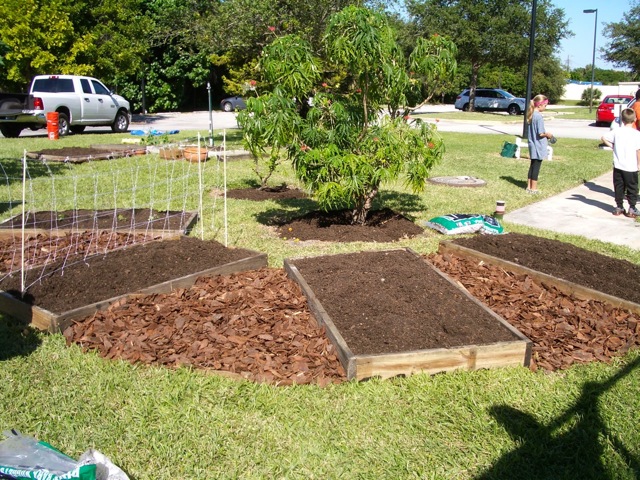
garden expansion1We received a gift of dark, compost-rich soil from Green Cay Farm, the life and work of Ted Winsberg, farmer, soil scientist, and local philanthropist.  Ted and his wife, Trudy, are well-known in their community of Boynton Beach as instrumental in the creation of Green Cay Wetlands and Nature Center on 170 acres they sold to Palm Beach County for one-third of its appraised value in 1997, specifically for that purpose.  Ted also provided our project five sturdy wood frames for the raised beds, all built of recycled lumber on his farm.

This enabled us to follow the no-till method of raised bed growing, developed by the University of Florida Extension, originally introduced to us by the garden founder, the late Wayne Reynolds, after whom the garden is named.  In addition to saving enormous amount of labor, albeit supplied by an enthusiastic team of volunteers within the congregation, a not unimportant side benefit of the no-till method is that no heavy earth-moving equipment is needed so the surrounding area is left unscarred.   When you’re planting among established trees and shrubbery, the value of this is obvious. First, we had to determine an overall layout for the garden.  For aesthetic reasons, we decided to organize the boxes in a semi-cigarden expansion17 step 1rcle around existing vegetation, mulching around them so the whole becomes a no-mow area. Mulching on the planted areas after seeds sprout, will also help conserve water. Thanks to another generous gift, we will be investigating drip and soaker hose type irrigation. Ground cloth goes down first, right on the grass, followed by the wooden frame which helps anchor it.  Keith Cutshall had picked up the wood boxes from Green Cay Farm earlier in the week and delivered them to our site.

garden expansion 18garden expansion 20

Recycled cardboard — the kind of sturdy box-stock movers, supermarkets and liquor stores have in abundance for the asking, get split and laid over the cloth next.  This also helps keep the soil moist and the grass out of the growing area.  Soil was hand shoveled from the truck and hauled over by wheelbarrow and bucket.

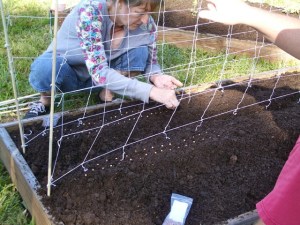
You can see a little bit of our earlier experiment with cinderblock for a raised bed in the above photo.   Wood looks more attractive, but cinder block can be painted and the open areas can also be used for planting complementary herbs or marigolds to control pests without artificial additives.  Here is the sugar snap pea bed, readygarden expansion5 for the time when they need a place to climb.  Just look at the color of the soil! Seeds — pole beans, peppers, tomatoes and sugar snap peas — were also donated by Eden Organic Nursery Service, and El Sol‘s Sunshine Community Garden, already a partner of the congregation, supplied us with hardy tomato seedlings.  El Sol’s weekday hot lunch program will be the beneficiary of our harvest of fresh, locally-grown vegetables.  CROS Ministries will remain on the project, Keith assured us, their volunteers helping ours to tend the growing beds from now through harvest time, and beyond.  When the work was done for this sunny, cool Saturday, we celebrated with an ample lunch supplied by another 1st UU volunteer.  It’s a win-win situation for everyone — just another day in the life of a constantly surprised convert to the power of growing food and community.
Miami Dice

I love Miami. I love the amiable mix of cultures, the scene at Hoy Como Ayer in Little Havana, the outdoor murals of Wynwood, the new South Pointe Park, the art deco homes, the new Perez Museum, built inexplicably enough on Biscayne Bay, next to new science museum under construction. Miami is a mere 77 miles from my hometown and along the same coast, so what happens in Miami isn’t going to stay in Miami. My county may be a foot or so higher in sea level, but we share the same porous limestone, the same array of barrier islands with their luxury high rises, and the same professional climate change deniers.

The sense of carpe diem might have had as much to do with our choice of Miami as a destination to celebrate our 30th anniversary this past summer as the city’s many undeniable attractions. So, we treated ourselves to three nights at the Marriot on Biscayne Bay where the management – alerted to the occasion by a child – gave us an upgrade that included a sweeping view of the Bay, Causeway and cruise ships. To my surprise, this Marriot (as in West Palm Beach) is growing food on site for its restaurants. Lettuces, tomatoes and herbs are the edible landscaping by the pool area.

That ‘farm to table’ glimmer aside, I am worried about Miami. It is clearly failing the test in how coastal cities will need to adapt to a rising sea. The $500 million earmarked for a new pumping system for Miami Beach is already acknowledged as a mere stopgap. I am concerned about friends there who recently spent weeks and a small fortune to install stronger new windows in their ground floor condo. I fear for the stalwart efforts to forestall what appears inevitable, even if we were able to cease using fossil fuels immediately. One of these is a permaculture food forest, right in the heart of the city, designed by Deva Marcus Thompson, founder of Permaculture Miami, whose intensive at The Mounts Botanical Garden I attended this weekend. Eve Mosher’s High Waterline project to show just how high the water will rise, is another. Also, Colony1, a sustainability research center that combines art and science. Closer to home, and heart, Transition Palm Beaches.

Sunshine_State_movie_posterIt is uplifting to see smart, persistent media coverage on the climate crisis, e.g. a feisty overview of what keeps The Sunshine State from becoming a solar energy giant in a blog post from Fred Grimm in The Miami Herald last Friday: Florida Utilities Stay Shady…  While Florida denies, he writes, neighboring Georgia is preparing to add 900 megawatts of solar by 2016, thanks to an unlikely alliance between environmentalists and the Tea Party, aka, The Green Tea Party (the latter on free-market principles).  When you realize that some $12 million has been allocated by our largest utilities to fund, “on average, one lobbyist for every two [Florida] state legislators each legislative sessions between 2007 and 2013,” you know what we are up against.   The choice at the polls has never been clearer.  Or the need to rid politics of money.

On the local level, my Unitarian Universalist congregation has become a partner in the Climate Action Coalition of South Florida, joining the UU Fellowship of Boca Raton, The Arthur R. Marshall Foundation, Oxbridge Academy, the local chapter of Organizing for Action, and League of Women Voters, among others. Our goal is to educate our municipalities on the risks we face as small cities and citizens, and get them to sign the Southeast Florida Regional Climate Action Plan. We hope to bring Eve Mosher’s High WaterLine to our area.  There is mounting evidence that local politics may yet do, piecemeal, for Florida what the big boys can’t, see: Pragmatism on Climate Change Trumps Politics … 

Pitch in, please, every way you can. It sure beats relocation to … Anchorage.

Read more:

High Water Line: http://grist.org/cities/street-artists-trace-against-time-and-sea-level-rise/

http://highwaterline.org/building-a-resilient-miami/

High Tide on Main Street, John Englander

Safer Cities