Living Large with Less

Last week was the kind that provides comics like John Oliver and his merry band of satirists plenty of fodder. First, the Senate passed the Energy Policy Modernization Act of 2016, which looks like an unusual example of bipartisan agreement until you notice that S.2012 is an odd, something for everyone kind of bill that manages to avoid mention of climate change while including language about energy efficiencies and support for more pipelines and LNG exports. “All the above” revisited, in other words.

I also plan to keep the champagne on ice for now, despite the grand theater of 171 nations coming together at the UN to sign to sign the Paris accord. As you probably realized, the agreement is nonbinding on signees, a kind of letter of intent. In how many ways does Secretary General Ban Ki-Moon have to remind us: We are in a race against time?

Cue the sun. A lot of people are putting all or most of their eggs in the technology basket, and it is a tempting sell. Last week also saw the first airing of a stunning presentation on nuclear fusion, the ‘holy grail’ of energy, by VICE, HBO’s investigative series. Click on either link and catch Shane Smith chatting with alternative energy rock stars, Elon Musk and Taylor Wilson, who at age 14, achieved nuclear fusion. In his garage. (VICE, season 4, edition 9). Proponents believe nuclear fusion can supply all the clean energy we need virtually forever.

vice-on-hbo-future-of-energy-trailer-1460395092Not to be a party-pooper, but solving for energy doesn’t address how we will feed a population heading to 10 billion when my teenage grandchildren hit middle age. And then there’s the less sexy subject of waste. Although fusion does not produce waste (and may actually convert it to energy), just about all other human activity does. Fortunately, you don’t need to be a nuclear scientist to cut your own contribution to the North Atlantic garbage patch.  And plenty of people are addressing just this. Here’s a cool list of tips, tools and ideas (my personal skim) to consider:

Gadget upgrade fever is how the Fruit and its Silicon Valley peers stay in business. Your iPhone is meant to be replaced in three years, your Mac in four. Surprise!  But you don’t have to play along.  What if maintenance could be the next, next thing?  What if you could learn to love the ones you’re with.  Keeping your discarded electronic gear out of the waste stream is a biggie for obvious reasons.

How to make waste-free living chic and creative? Advice abounds, well-produced blogs on how to eliminate plastic packaging from your life (cloth bags); where and how to shop, prepare and store food with minimal impact (farmers markets, the bin section of your organic HQ, toting your own containers); how to go vintage and practice upcycling.  Zen and the art of maintaining everything. Have fun checking these out. I did!

Zero Waste Chef — Anne-Marie Bonneau. Start collecting your glass jars! Best sour dough instructions.

Going Zero Waste — Kathryn Kellogg. Making your own natural cosmetics, worm bin composting (once you get past the ew factor).

Trash Is For Tossers – Lauren Singer, also sells green alternatives on her site, also inspired by Zero Waste Home – ‘Guru’ Bea Johnson.

A Small and Delicious Life – homesteading tips by a sustainability and behavior change guru, Ruben Anderson.

No Impact Man Project – what Colin Beavan is up to now that he’s a single dad.

Mr. Money Mustache – Peter Adeney’s wildly successful blog on thrift. Also his piece on a road trip by Tesla.

Ecological wearable art: Trash Fashions, created by Aidana Baldassarre (local) and Zero Waste Fashion (New York Times).  Mostly for the young and skinny, but love those upcycled totes.

Repurposed clothing on Esty. Much more than artfully slashing your old jeans for a new look.

Thrift Shops in Palm Beach County – Google thrift in your area for a similar list.

The Renegade Seamstress – DIY fashions

LifeEdited – DIY Murphy bed is just the beginning. Sign up for the newsletter. One of the few that doesn’t immediately pepper you with unwanted advertising.

Craig’s List How To Nice of them to give us a hand.

Facebook ‘Virtual Garages Sales’ for your area. As long as we keep moving on and up, there will be lightly used furniture and household stuff available.

Finally, here’s a calculator that shows you where you are now and where/how/how much you could lessen your carbon impact. Wish they had considered the EV in their calculations. http://coolclimate.berkeley.edu/calculator

Like Water For Avocados

After an announcement about a possible shortage of Hass Avocados caused near panic (and perhaps some welcome publicity), Mexican food chain, Chipolte, tried to soothe its fans with an announcement that there is no “guacapocalypse” in the offing.  Really?  Avocados are a thirsty crop, second only to another California favorite, the endangered almond.  According to Mother Jones, it takes 74.1 gallons of water to grow one pound of avocados as opposed to strawberries (9.8 gallons) or lettuce (5.4 gallons). For the time being, the California Hass is big business for the state: “… about 80 percent of all avocados eaten worldwide and … more than $1 billion a year in revenues in the United States alone.”  (California Avocado Commission).  

Headlines like this one from Newsweek 3/13/15: NASA: California Has One Year of Water Left, should be setting off alarm bells in the Congressional denialist camp on the basis of the economic impact alone, with the nation’s food security right up there next to it.  So it’s particularly bad news for all of us who love avocados — heck, like to eat regularly! — that Senator Ted Cruz now heads the Senate Science Committee, and that he has told NASA to stick to space and drop its climate investigations.  We need to pay close27_smap20150224-16 attention to what happens next.  After all, budget cuts that could threaten programs like NASA’s Jet Propulsion Laboratory, the Soil Moisture Mapper (SMAP)  — a satellite that can improve weather forecasts, monitor droughts and predict floods —  will hurt us all, now and in the immediate future. Maybe we should take a page from Senator Snowball’s playbook and start jamming the inboxes of legislators of his ilk with our favorite guacamole recipes.  This sounds like a job for Beautiful Trouble, fearless artist/activists.  Hi-jinks and hackery that exercise our creativity and even soothe our souls.   

It’s great to learn that Al Gore is newly optimistic that we can bring ourselves back from the brink, but yesterday on World Water Day, I couldn’t help thinking about what ordinary Californians are doing about a drought so severe, it has its own website?  Not nearly enough, according to figures from January this year which showed that conservation of water dropped from 22% to 9%, possibly spurred by an end of the year rainy period.  We are so addicted to short-term — or maybe it’s magical — thinking!  No wonder we are so easily distracted by shiny new things, blockbuster movies, and gossip about people we’ll never meet or particularly want to.

So I decided to ask a friend who lives in Huntington Beach about the water crisis, and she assured me that although some of her neighbors still have lawns (and presumably, have not as yet been prohibited from watering them), she has embraced a more desert scape, that is, rocks and succulents.  OK, it’s something, and granted, this is a minuscule sample.  But isn’t this typical of a common mismatch between the complexity of the issues we face — economic, health, safety, civil society — and the response of too many people like my well-meaning friend, as well as those in positions of power?  California officials, writes Jay Famiglietti, a senior water scientist at the NASA Jet Propulsion Laboratory, are “staying in emergency mode and praying for rain.”

Although drought isn’t an issue for Florida at the moment, we have our own water challenges: a rising sea (flooding, coastal erosion, threat to infrastructure and property) and the migration of salt into the agricultural water supply.  So much for the idea that California’s agricultural losses might be somewhat mitigated by Florida’s food growing power.  For more on this including the Sea Level Rise Symposium 2014, see my blog posts from last July, Water: Next Capitalist Tool? and November, Raising Fields.  Not enough water or the wrong kind — none of this is good news for living things.  But compared to what many see as the threat of water wars in the not too distant future, these issues are a drop in the bucket.

What can we do?  First, recognize that climate change is with us here and now and that we humans have no history or experience with the kinds of change it will likely produce in our lives.  On a beautiful, cool morning in South Florida as I write this from my patio, it’s possible to imagine that we have a decade or two before we are forced to adjust, to take action, or possibly, flee for higher ground. Even if that were true, it’s cold comfort for our children and grandchildren. Second, cut your consumption: repair, reuse, repurpose, skip the upgrade, minimize air travel, and make do while these are choices we can still make freely. Third: ask yourself to imagine a world without your favorite food (yes, avocados), a beloved bird, flower, tree, pollinators in general, a particular beach, a cherished vacation spot, a life experience you now take for granted (hiking a pristine trail, growing vegetables, access to a wide variety of fresh food, taking a hot shower, feeling safe on my streets and in my home, are all on my list).  What would you do to preserve these ordinary treasures, for yourself and those you love?  Do it.

See also: The Dark Mountain Project and Movement Generation

So Happy Together

Co-housing, a form of communal living launched in Denmark, sans the back-to-the-land 60’s hippie vibe, has interested me for close to 20 years, and it coming up on my radar once again, a combination of my age and my realization of how closely the principles of cohousing – community, shared resources, resilience, environmental values – align with those of the Transition movement. And also because, via Transition, I’m learning about urban planning and even participating in some ‘interventions.’

Suburban sprawl, even as pretty as the lushly-planted, pool-and-tennis-court sprinkled complexes such as the one I live in, doesn’t support a healthy, well-functioning community, let alone enlightened society. A shopping mall is not the village green, although Teens and Tweens do their best to make it so. We became successful as a species because we are social animals, and that may be how we will figure a way out of the mess we’re in now. So I find it puzzling that we have accepted design that expresses a preference for privacy, even anonymity, over community; that values speed and efficiency – cars and service vehicles at the expense of pedestrians or bicycles; that submits to conformity and obedience. (Checked your HOA rules lately?)

Being in my early 70s with an older spouse and many friends in the same age cohort, has sharpened the focus on issues of isolation and loneliness, and what it looks like when the care (cleaning, repairs, financial management, etc.) of a home you once shared becomes your sole responsibility. In cultures (including the one I was born into) where elders are valued, these issues don’t exist.

I never want to wind up in an assisted-living facility or senior residence. These artificial environments are like permanently moored cruise ships, with every need attended to, except the need to feel needed, to contribute to something bigger than yourself, to feel connected.

We have to design for the way people really want to live. And, in many instances we are beginning to.  Senior cohousing, ‘granny’ flats, i.e. moving in with the kids, and NORCs – naturally occurring retirement communities — like the Beacon Hill Village in Boston, to name a few, where people remain not only in their homes, but as contributing members of the larger community. Whenever we can share space and not duplicate infrequently-used possessions, we all benefit, and so does the Planet. For this aging yogi, for all those reasons, an ashram looks good.

On the other end of the age spectrum, it is no accident that the Millennial generation is flocking to walkable cities, inventing ways to live and share space, equipment, work, that seem more inspired by Seinfeld than The Brady Bunch. Think also of AirBnB, and even Couchsurfing (for the truly adventurous traveler), two more recent variations on the sharing theme. For Angelo, a young Italian I was chatting with last night at the Transition meeting, enjoying a year of study in the U.S., courtesy of his host family, is just how things are done back home.   Humans are endlessly creative in response to change, and the evidence of this lifts me whenever the news about climate change, peak resources, and corrupt regimes gets too dire.

As much as I quake at the idea of another move, I find myself thinking more deeply about what would support us better in the next phase of our life. Where to next? And when?

cohousing photoWe discovered cohousing around 1997 while living in Hoboken, NJ, a small town that, in those days, was best known for being the birthplace of baseball and Frank Sinatra. The town hadn’t completely outgrown its somewhat seedy past and wasn’t without issues. But we loved our 100-year-old redbrick townhouse and the town itself for its walkability – a word yet to be invented – the friendly neighborhoods, the mom and pop stores, and easy access to New York where I had a strong client base. But change was happening fast as long-promised waterfront development began, bringing rising home values and a soaring real estate tax that would soon become unsustainable, even for a two-income couple. Gentrification has its price. A lot of people like us cashed in and moved out, making room for a younger professional crowd.

So that Spring, we attended a cohousing conference at the Liberty Village Cohousing in Libertytown, MD, to learn more about this new way of housing ourselves. A few months later, we had organized visits to four other cohousing communities, including two in Canada. Three of the four were in early stage development; one, a couple of years old. In retrospect, we might have taken the plunge then had we come across an established community. Most take years not months to go from idea to reality, and many enthusiasts claim that it is the process of dealing with whatever comes up – difficult local ordinances or neighbors, a failure of the group to gel, integrating new people – gives a community its particular character. But most important, the consensus-based approach to planning, designing, managing and maintaining your cohousing community requires a lot of patience. Perhaps this time around, we might be ready.

I was able to check up on the four we actually visited, a prerequisite for membership. Cantine’s Island in Saugerties, NY, is a village within a village on the Esopus River. Trillium Hollow, which won a spot in the cue because our married children lived nearby in Portland, Or.  Windsong, in Langley, about 45 minutes outside Vancouver, an architecturally designed cohousing community where we were invited to share a meal and spend the night. The entire community was under glass, a reminder of those cold Canadian winters. Finally, Quayside, a brilliant joining of existing buildings on a corner of a block in North Vancouver. Of all, the best fit: urban, no two spaces alike, a great intergenerational vibe. Glad to say, all are thriving!

Read more:

History of Cohousing

Senior Cohousing

On Being Prepared

We are having a family conference this week on climate change and including grandchildren, three boys, 15, 13 and 11, and as it happens, all Boy Scouts.  The subject, while not exactly the elephant in the room, has been off-limits to date, even among the adults — as uncomfortable as money, politics, or the fact of death.  Environmental education exists in Florida, see Pine Jog Environmental Educational Center, despite deniers in high places.  But I wanted to know how global warming/climate change was being presented to young people by various groups, including the Boy Scouts of America.  So this morning I did some research (see links at the end of the post).  Laurie David,  a global warming activist and the producer of the Academy Award-winning film An Inconvenient Truth and the HBO documentary Too Hot Not to Handle, has collaborated with Scholastic publishing to produce an excellent guide to the science of global warming and what families can do to mitigate its impacts.  The graphics are delightful and on target.

be-prepared2There is a measured tone to this guide (and others) that reminded me of President Obama’s response to NBC 6 Chief Meteorologist John Morales’ ‘what now’ questions (upon the release of the National Climate Assessment): more fuel efficient cars and Energy Star appliances and letting one’s elected officials know ‘this is important.’    It all seems so sensible and doable, like doubling up on recycling and changing out lightbulbs, and in some ways easier to swallow than adaptation*, which is where most climate experts and savvy political leaders are beginning to put their attention.  For their part — and I commend them for it — the Boy Scouts of America have added a new Sustainability Merit Badge  to the existing one covering the Environment.  Eagle Scout candidates need at least one of the two to qualify.  Not so surprising given the 100 year old organization has been devoted to nature and conservation throughout its history.  There are 100 million scouts worldwide, making it the largest youth organization on the planet, so this is big news.

What lit a fire under my seat about getting the family together now was the release of the National Climate Assessment with its segments on regional impacts.  For Floridians, as I’ve noted here before, preparing for hurricane season is an annual ritual, albeit some people have been reassured by a succession of relatively quiet years. Preparedness is a mindset one can work with when it comes to serious talk about climate, simple as the Boy Scout motto.  Because as the Southeast regional report makes clear, Florida is exceptionally vulnerable to all the impacts of global warming, among which flooding due to sea level rise and salt water contamination of our drinking water and soil, are perhaps the most immediate and most worrying.  First, we have to be willing to get it all out on the table: confusion, denial (whatever form that takes), fear, distrust.  What will be important is to recognize that every day we waste politicizing the facts of climate science is a day we don’t take action.  We need to leave the ‘debate’ to those whose interests it serves, and get on the same page in terms of risk assessment.  You can bet the insurance industry IS paying attention.

“You won’t find many climate change doubters these days within the property insurance business.”  ~ David Kodama, senior director of research and policy analysis for the Property Casualty Insurers Association of America, or PCI. (Bankrate)

Our strategy so far has been to show more than tell (although we’ve done some of that, too), and it is by now quite clear to everyone in our immediate and extended family and circle of friends, that we are tree-hugging climate activists.  None of the things we have done so far — KXL protest march, EV, renewable energy for our utilities, tree-planting, vegetables from a local farm, no CAFO’s, organizing for Transition, feels like a big deal sacrifice.  It’s child’s play compared to what we — and that means every capable person — may yet be called to do.

*Mitigation and adaptation

Down to Earth (Scholastic), Laurie David’s guide

The National Science Foundation’s Exploratorium, great for older kids

The EPA’s Climate Change and Kids site, multi-age groups

Turn, turn, turn

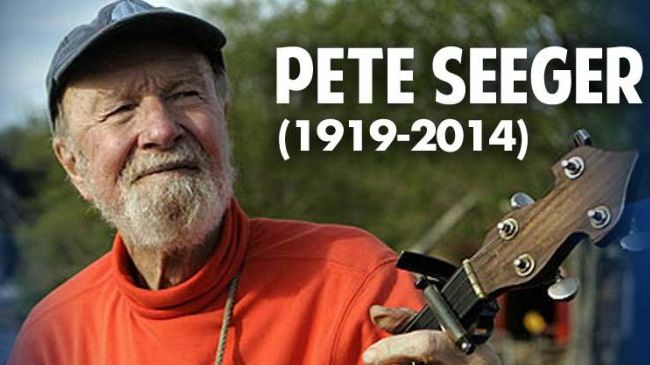
The activist’s activist, Pete Seeger, left behind a legacy of standing up for social justice and the environment, and a collection of protest songs that still pack an emotional punch. Yesterday, at the Unitarian Universalist Church of Fort Lauderdale, at a sold-out celebration performance of Pete Seeger’s music by local musicians, it was déjà vu all over again for me, and I suspect many of the mostly gray-haired Seeger fans.   As heart-felt and enjoyable as the event was, the fact that the issues that Pete Seeger spent a lifetime addressing are still with us — only more so — is not good news for the weary.

pete seegerBut that’s exactly why we need to celebrate our ‘preaching to the converted’ moment, in solidarity with street theater peace activists, Raging Grannies, Matt Schwartz of South Florida Wildland Association (raising the alarm about fracking), Occupy Ft. Lauderdale, Broward Move to Amend, Pax Christi (economic and social justice and respect for creation), the National Lawyers Guild, (lawyers, law students and legal workers for change in the political/economic system), and SOA Watch, (ending oppressive U.S. foreign policy in Latin America), among others.

I draw a lot of energy from a love-in like this one; we all do, whatever our political leanings.  The inconvenient truth is, we prefer to be with like-minded people and the more the merrier. It’s another form of confirmation bias, that is, our tendency to surround ourselves with people and information that confirms what we already believe. Uh-oh. It may be hard-wired into our species in service of the survival instinct, but it’s not working anymore..

I wasn’t thinking about this particularly when I landed hard last evening with a particularly unnerving episode of Years of Living Dangerously, but it’s coming up for me now as a major element of our difficulty as activists, and the challenges we will face.

If you’ve been paying attention to climate change, the Leslie Stahl segment in Living Dangerously carried few surprises, with the possible exception of actually hearing what ice sounds like as it begins to break apart. Terrifying. But it was the other report, about the stubborn (or I could say steadfast) denial of basic climate science by one large, well-funded religious sect, was especially disturbing for me, because 1. I am surrounded by and constantly reminded of this kind of thinking here in mega-church-land, 2. Florida is exceptionally vulnerable and denial now will be very costly later, and 3. I fear for my grandchildren, indeed, all grandchildren. So I have the deepest respect for climate scientist/evangelical Christian, Katherine Hayhoe, the star of an earlier Living Dangerously episode, for modeling a way of reaching out to those whose views differ from her own.   The world we have created in ignorance will demand nothing less.

Pete Seeger would approve.

Food Fight and Seed Bombs*

“Seed is not just the source of life. It is the very foundation of our being.”  – Vandana Shiva

 If the name Vandana Shiva doesn’t ring a bell, you probably don’t know jack about why saving and sharing seeds from your organic produce is the ultimate act of rebellion against the corporatocracy.  No matter.  Just know that this food fight is anything but a frivolous venting of teenage high spirits.  In fact, with California’s drought worsening and threatening crops, and Monsanto scoring big in legal battles to continue privatizing nature, the timing couldn’t be better.  If you eat, this fight is your fight. Consider yourself enlisted.

Vandana Shiva 2Dressed in her beautiful saris and signature bindi, physicist, author, ecofeminist and seed activist, Dr. Shiva hardly looks the revolutionary. But spend a few minutes in her company – there are plenty of videos to choose from – and she will make a powerful case for why you absolutely must 1. Support your local organic farmer and grow what food you can sustainably and 2. Save your seeds – see links below on how to do that – and/or start a small seed-sharing circle. The goal is nothing less that long-term food security and reclaiming your rights as a world citizen.   It is food democracy that benefits everyone in the food chain.

“We need to build the direct relationship between those who grow the food and those who eat it. Care for people has to be the guiding force for how we produce, process, and distribute our food…We need to shift the paradigm of economics to measure the well being of people not the profits of the oligarchs.”

Shiva’s organization, Navdanya, is a network of seed keepers and organic producers across 16 states in India. It has helped set up 54 community seed banks across the country, and has trained half a million farmers in sustainable agriculture. According to Dr. Shiva, these actions were also aimed at stemming an epidemic of farmer suicides as farms and livelihoods were lost to Big Ag’s invasion of India.

Maybe farming isn’t in your blood or your future. Perhaps converting a patch of your lawn into a vegetable garden isn’t your thing. Don’t expect an automatic deferral. You can still be a part of the support corps, carefully conserving seeds from your produce — easy in the case of squash, pumpkins, melon and peppers – and a little more challenging with tomatoes. Tip: just cut a small section from the next great organic tomato you eat and put it in a pot to sprout. More specifics from Organic Gardening. Organic potatoes and sweet potatoes give you a clue about what to do next by sprouting conveniently in your vegetable bin. Plant one in a pot and follow these directions from Container Gardening.

All of this seems pretty mild mannered as revolutionary action goes, although you may encounter some strong resistance from HOA’s that love pouring your money down the drain (into the water system) to maintain large expanses of grass, or communities hell-bent on upkeeping standards of conformity.   (Backyard chickens, hold the fort.)

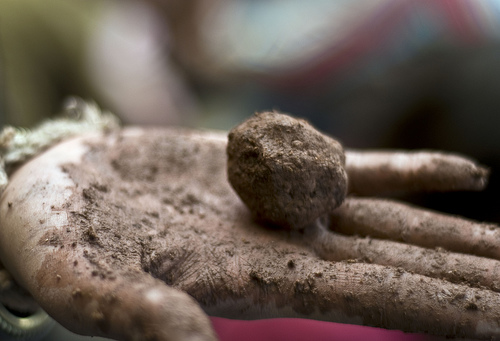
seed bombYou could waste a lot of time fighting city hall.  So here’s one of my favorite weapons of grass destruction: the seed bomb. These come in many forms – balls of clay embedded with seeds and organic fertilizer, eggs filled with the same, and seed pills, all the above in miniature.  These little projectiles are perfect for challenging locations, “spontaneous floral attacks,” and vegetable gardening below the radar. You can carry a seed bomb (or pill) in your pocket and launch an attack of edible landscaping in the least expected public places. Think of this as a time-bomb that does some good in the world. Sneak back for the harvest, if you dare.

*Seed bombing is a technique of introducing vegetation to land by throwing or dropping compressed bundles of soil containing live vegetation (seed balls).

More good reads:

http://www.cornucopia.org/2014/04/vandana-shiva-cultivating-diversity-freedom-hope

http://www.guerrillagardening.org/ggseedbombs.html

http://www.organicgardening.com/learn-and-grow/saving-seeds-for-next-season?page=0,1

http://seedlibraries.weebly.com

https://www.facebook.com/seedtheuntoldstory

http://www.huffingtonpost.com/tag/corporatocracy

‪http://youtu.be/Z2PaLEmSFi8

Transition and Occupy

Transition and Occupy  *  Rob Hopkins responds  *  Can We All just Get Along?

Is Transition like Occupy?  A good question can raise the stakes; inject some excitement, into any presentation. I’ve experienced this fewer times than I would like.  But last Saturday, I was the person on the receiving end during my presentation on Transition to Ashley Moore’s permaculture course at Gray Mockingbird Community Garden in Lake Worth.

SONY DSCIt’s always helpful to say, Good question! and in this case, I meant it.  The answer is, No, and … Occupy and Transition have some obvious similarities.  Both are grassroots movements; both emerged from a conviction that the economic/political system was broken; both were rooted in action: Occupy, in the physical occupation of public spaces to demand change; Transition in community projects to make change.  Occupy is against business-as-usual; you could say Transition is focused on a better way to do business.

Many in my liberal religious congregation were very supportive of Occupy.  We have a strong tradition of social justice and our own martyrs of the Civil Rights Movement.  So in no time, there arose a cadre of people willing to demonstrate regularly on the sidewalks in front of our property. We held a Saturday workshop on Occupy, including a session on Single Payer and another on songs of protest.  Protesting can produce a high, no doubt.  And, whatever happens to the Occupy movement now, we will not soon forget its identification with the 99%.

Although it’s not my thing, I have supported and/or engaged in protest actions for a specific goal:  equal rights for women, Move to amend, stopping the KXL pipeline.  So, although I agree that business-as-usual is in great need of a major course correction, I decided to remain on the sidelines of Occupy, and have happily found a home in the Transition movement.

Attempting to differentiate between Occupy and Transition led to some lively conversation and I’m very grateful that the question was raised.  But there is no more articulate spokesperson than Rob Hopkins himself in how the movements differ.  Here’s a response after he visited as a speaker during the Occupy London action in 2011.  Here are some key quotes (links to the entire article and others follow).

First, like the appreciative enquirer that he is, Hopkins gave tribute to the value of Occupy:

What Occupy is doing that matters so much is that it is holding a space.  It is holding a space where the discussions can take place on their own terms about what is broken and what needs fixing.  It is underpinned by a realisation that this is a crucial time of change where everything is on the table, where business-as-usual is no longer an option.  It isn’t making demands because that would put the power in the hands of the people in power to decide whether or not to respond to them.  It is holding the space for the conversations, and is doing so on its own terms.  I admire that.

And here were some key divergences:

You can’t … just base deep change on an analysis of what is wrong.

Transition says to people “take this model and do it where you are”, whereas Occupy suggests coming together to suspend your life while you explore, with others, the question of what’s the best thing to do now.  Transition is about building that into your own life, right now.

…what everyone can do, in a time when it is increasingly clear to anyone who thinks about it, that business as usual is no longer a runner and that new thinking is needed and soon, is to occupy, in their own lives, that sense of possibility, that space for asking the questions that matter.

You might say that Occupy suggests occupying, for example, Wall Street, while Transition suggests occupying your own street, putting up runner beans and solar panels rather than tents.

Can We All Just Get Along?

That is the bigger question.  What would it look like if we reached beyond our differences and found common cause?  Sometimes, it seems possible, see: Fissures in G.O.P. as Some Conservatives Embrace Renewable Energy.  And A Green Tea Party?

So whether you are a 20-something in a tent city demanding change in the current system that rewards wealth at the expense of everyone else, or a 70-something grandmother who believes that we have to live with less so that others – including future generations – can simply live, we have to work together.  Because putting to rest the notion that we can grow or technologize ourselves out of this unprecedented planetary crisis, is too big a job for any one movement.

A Day at Occupy London
Comments are interesting, too.

How to Engage Occupy Movement

The Green Tea Coalition

Will The People Who Need to Read it, Read it?

flight-behaviorThis question, from my Book Group last Saturday, has haunted me — someone who writes regularly about my response to climate change with the certainty that I am (mostly) preaching to the choir, and a small one at that. As Winston Churchill famously asserted, Americans are a people ‘divided by a common language.’  Of course, it is much larger issue than regional dialects and accents. Miscommunication among diverse groups who do not understand each other (or attempt to) is a commonplace of a multicultural society and one that deserves more attention than it gets.

Failure to communicate is but one strand in the weave of Flight Behavior, which Kingsolver’s official site describes as: “… a heady exploration of climate change, along with media exploitation and political opportunism that lie at the root of what may be our most urgent modern dilemma.”  But it is an important theme.  Who is not reading this book is as important as who is, because a good story like this one has the power to convince when facts alone fail (and we are talking about an alarmingly high percentage of skeptics), and to motivate those who are informed and have yet to act in any meaningful way, no small number.

With her trademark empathy for the people she writes about, Kingsolver shows us what one impact of climate change looks like to a community in rural Appalachia that is 1. Out of the loop, and therefore deeply suspicious of outsiders (climate scientists, media, environmentalists toting ‘sustainability pledges”), and 2. Likely to be upended by its effects.  She describes what happens when the larger world – researchers, media, logging interests, climate activists, the curious public — comes to fictional Feathertown, Tennessee.  We begin to see, as the wisdom traditions teach, there is no Other.

“Cultural differences are really exciting territory,” Kingsolver said in an interview, “not just for the literature but for learning in general, because sparks fly when there’s friction among different viewpoints. People invest themselves differently in the same set of truths.”  So to Rev. Bobby and his congregation, the unprecedented migration of monarch butterflies takes on religious significance.  To scientist, Ovid Byron, and his research team, it is another distress signal from a world out of whack.  For the Womyn group of knitters, it is an opportunity to speak for nature. With whom do we identify?

Like the other strong female characters of Kingsolver’s best-selling fiction, Dellarobbia Turnbow, is the voice of Flight Behavior.  We are sympathetic witnesses as her understanding of what the butterfly phenomenon means, catches up with ours.  When our Book Club leader asked what we had learned from the novel, there was a thoughtful silence.  We only know what we can know.  So it comes as no surprise that the media will manipulate the protagonist’s story and ignore the experts.  We are familiar with the power of YouTube to save (or wreck) reputations.   We know Dellarobbia is smart, but it is the unexpected changes within her that make this a compelling narrative, and provide a drop of hope.  There is her growing self-respect and newfound passion for research, her appreciation for the quiet strength of her husband, and for her mother-in-law, whose rich knowledge of native plant life provides an unexpected bond. And here was a big takeaway for me: in Kingsolver’s Feathertown, despite difficult physical labor, limited career options, crushing debt, and abysmal schooling which guarantees more of the same, we find a community with admirable habits of generativity, interdependence and thrift.  Valuable lessons, all.

“The biotic consequences of climate change tax the descriptive powers, not to mention the courage, of those who know most about it,” Kingsolver writes in her Author’s Note.  With Flight Behavior, her training as a scientist and narrative gift nudge her readers in the right direction if we are willing to go.  I would like to believe that there are hundreds of readers, like the members of the Second Saturday Book Club, who having read and discussed Flight Behavior, are on to the more important question: what then shall we do?

The EV: What’s Not to Like?

Today’s Smart Planet has a take on the EV, which prompts me to reflect on the joys of the Nissan Leaf which we have been driving for a year, and mull about what the future of EV’s could look like.

Eight reasons I love my Leaf:

1. A driving range of 60-69 miles makes you more mindful of your driving habits, and that spills over into other driving you may do with a conventional vehicle.  Fewer trips by planning ahead vs. many short hops means less wear and tear on another energy system: You.

2. The Leaf is very quiet.  In an increasingly noisy world, this is a gift.  The sound system is superb.

3. No oil, so no oil changes, in fact, maintenance is minimal.

4. The Leaf’s dashboard is loaded!   You may be stumped by some of it, but chances are your grandchildren or other young people you know won’t be.   What an opportunity or some instruction and intergenerational bonding.

5. You are not ‘burning’ anything waiting at a light, stop sign, in backed-up traffic, drive-through banking, or car pool.   Zero emission means just that.

6. Next to a free hug, it is a great conversation starter with perfect strangers.  “Really, you plug it in at night, that’s it?”  Next question: effect on the utility bill.  A: Negligible.

7. Looks like a SUV — hatchback and fold-down seats — so you can haul stuff like four dining chairs or several bags of compost.  Not to mention seating for three adults.

8. Although the Leaf handles like a luxury car and is loaded with navigation features, it has frugal, battery-conserving touches like manual seat adjustments.  Makes me nostalgic for my 1972 VW Beetle (and my 1972 self).

Nissan_Leaf

Currently, the Nissan Leaf is an attention-getting solo act in our neighborhood, although there has been a proliferation of the 2013 Prius as more folks take advantage of year-end deals.    All good.

On the Walk for Our Grandchildren, we met a couple of dedicated environmentalists who had driven their Chevy Volt from Virginia to D.C., and had mastered the art of the dual fuel.  In their opinion, the Volt was the car of the future.   They may be right.  From the wonderful folks who tried to Kill the EV, comes the latest word on a Volt with a 200-mile range, all electric.   This is encouraging news because Nissan only sold 15,000 Leafs in the U.S.  in 2013, I suspect largely due to its limited driving range. Competition should improve both those numbers.

As a Leaf fan, I’m glad to see that The City of West Palm Beach has added free charging stations at the Clematis Street garage, to support the fleet of Leafs on order, thanks to a grant from the U.S. Department of Energy.   Charge your EV while you shop or dine.  What a concept!  Will more retailers like more environmentally-savvy Kohl’s get on board?  I’m betting on it.

A New Take On Giving

Trust Center for a New American Dream to come up with a new take on giving just in time for the holidays.  It’s called So Kind, the Alternative Gift Registry, and I love, love, love it!  Anyone can create a registry for any occasion and samples include a wedding registry and baby shower.  Most of the gifts are not stuff, no surprise.  It works a little like a time bank in the sense that you can make requests and/or offer gifts.  The best kinds of gifts are enjoyed by both giver and receiver, right?

christmas_gift_187449I’ll admit I get nostalgic for Christmases past when my children were little and contented with one or two well-chosen items.  I even liked assembling those sleds and other things with many moveable parts — an evening of playing Santa’s Elf, sipping a glass of good Cabernet, after the children were tucked away.   Of course, the boxes were often more interesting and conducive to creative play than the toy — wagon, doll house, etc. they held — and although I haven’t taken a poll on this, I suspect that may still be true.   I’m no cultural historian, so I can’t put my finger on exactly when things got out of hand with holiday gift-giving, both in terms of the duration of the retailing season leading up to Christmas Day itself, and the outsize expectations to which we have become conditioned.  Cars?  Really?

All I want for Christmas this year is to disappoint a few Big Box stores, and to reward people who think out of the box about where we are going as a consumer culture.  Recently, Transition founder, Rob Hopkins announced that he quit Amazon (they didn’t make it easy).  His thoughtful, timely essay about what this means is just such a gift.  It came one day after 60 Minutes (and Panorama in the UK) did reports on how Amazon operates and its plans for the future, e.g. 30 minute delivery of your package by drones.  Maybe it’s just me, but I think the money we’re spending on these clever solutions to very trivial ‘problems’ could be better spent elsewhere.  An end to hunger and homelessness?  Relief work around the globe?   If you are of like-mind, you might consider this a good time to make gifts in a friend’s name to Paul Farmer’s Partners in Health or Doctors Without Borders (USA)*, to name just two necessary organizations.  These are also gift alternatives that will keep on giving when the last bit of tinsel has been vacuumed off the carpet.

*Both are highly rated by Charity Navigator, which could also use your support.