How Rupi Kaur Does It

Now that I have about 20 poems on a single theme — water — I’m considering self-publishing a chapbook. This is often an early career choice, especially for poets, whether or not they go the traditional route of submitting to a publisher or DIY.

In my case, it’s a late in life choice. My writing career does include a published self-help book, but I have little to show for the submissions of poetry, except that I did, and continue to, enjoy writing poetry whether it ever sees a bigger audience than the occasional open mic or family events. I love to create a personal chapbook/card for a special anniversary or birthdays. In a sense, this bears out the theory that no one reads poetry other than other poets, except when a poem is need for an inauguration, celebration of life, or milestone birthday. Is this true? Popular poets like Mary Oliver and Billy Collins would beg to differ. But even then, they had to teach and give readings to eat.

I discovered Rupi Kaur’s the sun and its flowers inadvertently. Someone had left it open on a bus. What a way to get one’s work around! I’d love to know the story behind this, but …well I have better things to do. I enjoyed the book, her plain-spoken poems got me. Come to learn that Rupi Kaur is the queen of self-published poetry, with millions in sales, book tours, and lately live show produced by Amazon. Beside her a series of self-published books, she has a clothing line, tattoos, music, fashion covers. A one-woman business with world-wide following. She began the way a lot of young people do these days, open mics, poetry festivals, social media, to build a loyal following. Then, and only then, did she decide to publish herself. Hers is a version of the author who sold all his unpublished books to women’s groups and book clubs, from his van. Eventually, he didn’t have to do that.

That self-help book I mentioned? My co-author (and spouse) knew a thing or two about publicity, marketing and sales. We had a website, we created a contest, we worked the press. And eventually, Penguin Plume (now PenguinRandomHouse) picked us up and we negotiated a very respectable contract. Today, a lot of books like ours are print-on-demand, so no, we didn’t have to load up our Honda with unsold books and hit the road. You can still get a copy of Too Young to Retire: 101 Ways to Start the Rest of Your Life. And we are happy that it did help some folks rethink their later years. But for a blockbuster success, here’s Rupi Kaur’s story.

I have some of my poems on this blog, if you’re curious. I am feeling excited and a bit apprehensive about taking on this project. For one thing, at 83, I’m unlikely to get out and do the legwork I once found fun. There is something satisfying about being an author, holding a book with your name on it, maybe even signing it for a fan. When this materializes, you’ll be the first — well, maybe second — to know.

Normal

recommended beach reads

graduations engagements weddings

obits – situation normal*

ask the mother weeping over nine

white shrouds of her children

a farmer who voted for a better life

struggling to save his farm

look into faces of those erased by a signature

see fear in the eyes of those waiting

for the next shoe to drop

refuse choose otherwise

*SNAFU

Touch Me

This, the last poem in Stanley Kunitz’s Collected Poems (2000), touches me every time I read it. I thought of it often during the months of isolating and social distancing, though my hugging-averse friends have a point that we do entirely too much indiscriminate touching here. Handshakes could go, especially in ‘flu season, even with diligent hand-washing.

Covid Haiku

I want a hug as much as the next person,

But I’m not dying for one.

Posted to my social media page, this got the biggest response ever.

Touch is necessary to human thriving, but the pandemic has taught us to be more selective about who we touch and how. Maybe we could do better than hokey-jokey elbow bumps of politicians. Eye contact, a nod. Hand on heart. Palms pressed into namaste, say, or Japanese-style bows.

As I learned in Japan, one quickly adopts and adapts, even if a few rules of etiquette are mangled in the process. For example, who initiates the bow? Gender differences? How low to go? Can you bow and exit gracefully? Do you bow to an elevator attendant? Maître d’ but not server? This is probably all covered in a handbook for business travelers.

In Tokyo, particularly on public transportation or in crowds – impossible to avoid – it was common to see people wearing masks. At the time of my visit, I found it noteworthy. But isn’t it just common courtesy, common sense, to avoid spreading a cold, the ‘flu, or worse? No big deal in a nation that puts community good ahead of personal convenience.

This afternoon, I’ll be meeting my book group on Zoom, once again. Omicron transmission is still a factor in South Florida where I live, though many of my fellow citizens are resisting vaccination and refusing to wear masks. (Neil Gorsuch, for shame!) When we began talking about books just before Covid, we took turns entertaining and we all miss that face to face intimacy, and yes, hugging. However, like most people I know, I’ve adjusted to Zoom (even if I haven’t mastered how to make myself look less cadaverous).  

Thanks to Zoom, I am part also of the Montclair Writers Group that used to meet in the local library. I live and raised my children in Montclair, New Jersey, earned two degrees from Montclair State U, so I feel I’m home, in some sense. These weekly meetings where we write poetry or prose to prompts for about 20 minutes each, then ‘gather’ to read and share some writerly tips and ideas, was the inspiration for my 80th birthday poetry reading on Zoom last October. About 50 friends and family members from around the U.S., plus England and Germany, joined in. High tech; high touch! Intimate as one could get in, in our little lighted Hollywood squares. Brought to us by Covid-19. Who would have thought?!

Delray Laundromat

Saturday night on Atlantic Avenue:

flashy cars slow-mo on restaurant row

as a see-and-be-seen crowd

crosses wherever. Laughter.

Smoke from grills, cigarettes, weed.

I have shish kebab on my mind,

the final night of a poetry festival.

Must have passed the Laundromat

Dozens of times without pause.

Must be the fluorescence that limns

faces this Saturday night: people making

change while making eyes, could be.

Could be singles night for the lonely —

between relationships, between jobs,

between homes, shifts. Hands smoothing

tee-shirts, stacking jeans, while sneakers

in the dryer summon a disco beat.

Could be me.

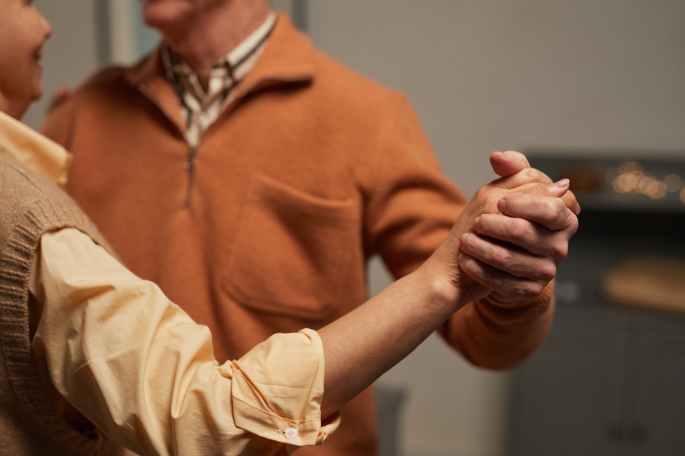
Dancing in Our Living Room

When we rearranged the living room
to make a passage between kitchen
and patio, we found enough room
for dancing.  

The other day you said when life
returns to normal, we could
take some lessons.

I don’t want to wait for someone
to teach my body how to move when
a tune I love starts playing.

We didn’t need lessons in how to find
each other across a room, either,
though we had come to the party
with other people, and would
go home with them.

I pull you to your feet and kick off
my sandals. The Tennessee Waltz
is playing its old sad story of lost love.

And here we are in the middle
of our 36th year of married love,
in the middle of our Oriental rug,
cutting it.  

©March 1, 2021, Marika Stone

Something There is That Doesn’t Love a Tree

I stopped once to hear a sitar
played in a leafy shade.
A carpet had been laid to soften
spreading roots, and when the musician
paused, he rested his instrument
against a sturdy trunk.

Felled for a utility pole, says the young gardener
with outraged face. Couldn’t they
have found another place?

Now, where just a week before
we gathered in uncommon grace,
a stump and side-lying trunk.
Growth rings slowly weep sap.
Severed branches collect in a heap.

Something there is that doesn’t love a tree,
that sees only expendability; sees logs,
split and stacked for firewood;
sees timber, 2 X 4’s, cash.

That looks at shade and wants full sun;
that wants to make way for a lawn,
a fairway, a putting green.

©July 29, 2020
#68 of my 100 Poem Pandemic Challenge

Revised 1/12/21 with Susanna Rich