Will The People Who Need to Read it, Read it?

flight-behaviorThis question, from my Book Group last Saturday, has haunted me — someone who writes regularly about my response to climate change with the certainty that I am (mostly) preaching to the choir, and a small one at that. As Winston Churchill famously asserted, Americans are a people ‘divided by a common language.’  Of course, it is much larger issue than regional dialects and accents. Miscommunication among diverse groups who do not understand each other (or attempt to) is a commonplace of a multicultural society and one that deserves more attention than it gets.

Failure to communicate is but one strand in the weave of Flight Behavior, which Kingsolver’s official site describes as: “… a heady exploration of climate change, along with media exploitation and political opportunism that lie at the root of what may be our most urgent modern dilemma.”  But it is an important theme.  Who is not reading this book is as important as who is, because a good story like this one has the power to convince when facts alone fail (and we are talking about an alarmingly high percentage of skeptics), and to motivate those who are informed and have yet to act in any meaningful way, no small number.

With her trademark empathy for the people she writes about, Kingsolver shows us what one impact of climate change looks like to a community in rural Appalachia that is 1. Out of the loop, and therefore deeply suspicious of outsiders (climate scientists, media, environmentalists toting ‘sustainability pledges”), and 2. Likely to be upended by its effects.  She describes what happens when the larger world – researchers, media, logging interests, climate activists, the curious public — comes to fictional Feathertown, Tennessee.  We begin to see, as the wisdom traditions teach, there is no Other.

“Cultural differences are really exciting territory,” Kingsolver said in an interview, “not just for the literature but for learning in general, because sparks fly when there’s friction among different viewpoints. People invest themselves differently in the same set of truths.”  So to Rev. Bobby and his congregation, the unprecedented migration of monarch butterflies takes on religious significance.  To scientist, Ovid Byron, and his research team, it is another distress signal from a world out of whack.  For the Womyn group of knitters, it is an opportunity to speak for nature. With whom do we identify?

Like the other strong female characters of Kingsolver’s best-selling fiction, Dellarobbia Turnbow, is the voice of Flight Behavior.  We are sympathetic witnesses as her understanding of what the butterfly phenomenon means, catches up with ours.  When our Book Club leader asked what we had learned from the novel, there was a thoughtful silence.  We only know what we can know.  So it comes as no surprise that the media will manipulate the protagonist’s story and ignore the experts.  We are familiar with the power of YouTube to save (or wreck) reputations.   We know Dellarobbia is smart, but it is the unexpected changes within her that make this a compelling narrative, and provide a drop of hope.  There is her growing self-respect and newfound passion for research, her appreciation for the quiet strength of her husband, and for her mother-in-law, whose rich knowledge of native plant life provides an unexpected bond. And here was a big takeaway for me: in Kingsolver’s Feathertown, despite difficult physical labor, limited career options, crushing debt, and abysmal schooling which guarantees more of the same, we find a community with admirable habits of generativity, interdependence and thrift.  Valuable lessons, all.

“The biotic consequences of climate change tax the descriptive powers, not to mention the courage, of those who know most about it,” Kingsolver writes in her Author’s Note.  With Flight Behavior, her training as a scientist and narrative gift nudge her readers in the right direction if we are willing to go.  I would like to believe that there are hundreds of readers, like the members of the Second Saturday Book Club, who having read and discussed Flight Behavior, are on to the more important question: what then shall we do?

It’s Complicated, Part I

gas flare fracking site Bradford County PennsylvaniaWhen you hear a scientist call fracking* “complicated,” you don’t know whether to be reassured or scared out of your natural mind.  Complicated is a word like “debate” which has been so successful in sowing doubt in the minds of many people, a cadre of fence sitters, about climate change.  When the scientist also happens to be your beloved, respected, meditation teacher, well, the reaction is probably too complicated to be contained in a single blog post.  So here’s Part I.

I was reporting that I had viewed the HBO screening of Josh Fox’s Gasland, Part II (on New Year’s Day, no less).   The documentary is a sequel to Fox’s Gasland, and both have been attacked by oil and gas industry-funded operations such as Energy in Depth, which exists to defend the technology.  (A favorite EID target is environmentalist, Bill McKibben.)

If you spend even a few minutes reading any of the material put out by this organization, you’ll notice some tactics.  First, it will attempt to discredit critics on the basis of personal behavior, e.g. McKibben was sighted leaving a climate rally in a gas-guzzler.  Second, it seeks to cast doubt about the impacts of fracking on the environment.  In this case, it argued that methane (the gas that ignited from the end of a water hose in an iconic scene of the film) was naturally occurring in the water in the area, independent of fracking.  (And the Earth is just going through a warming phase, independent of human contribution.)

A day after the HBO screening, The Diane Rehm Show invited Josh Fox and EID spokesperson, Steve Everley, to duke it out.  As a landowner in Pennsylvania with some personal exposure to fracking, Rehm’s bias was evident.  Here’s the transcript.   Like Ms. Rehm, I found Gasland, Part II, convincing, especially the documentation of scientists from the academic community about the high risk of ground water contamination and gas leaks into the atmosphere.  You don’t have to be an expert to figure out that with thousands miles of pipeline to maintain – not unlike our highway and bridge system — something is likely to go wrong.  And then there’s that Halliburton Loophole.  Why the exclusion if the chemicals used in the fracking process are really safe?

It doesn’t really matter who did a better job defending their positions (I give it to Josh Fox, by a wide margin).   Hydraulic fracking currently has the support of President Obama who has hailed it as energy for 100 years.  The elephant in the room question for future generations: And then what?  The infrastructure already exists to exploit every shale deposit in the country and ship liquid natural gas around the world.  In this race, renewable energy is a distant also ran.  It’s not easy to imagine what could arrest this momentum with so much power and money (read campaign contributions) behind it.  But we must try, because gasland is coming to your neighborhood.

According to a Palm Beach Post article from March 2013, fracking the Everglades is on the table.   Even if you think the jury is still out on the safety of fracking, and you’re not fazed by noisy drilling rigs in your backyard, no one denies the technology requires vast amounts of water – Florida’s most precious commodity.  So it behooves you to learn as much as you can about it, as I plan to do.

*BTW, Spellcheck doesn’t recognize “fracking.” Perhaps by the time I get to Part II, it will.

Some resources to start with:

Huffington Post
The New York Times, Drilling Down Series
Op-Ed Piece re: leaks

Seeing the Light

To be an environmental activist these days and keep your balance, you have to be, or be willing to become, bipolar.  It also helps to be relentlessly interested in the subject, even if it can be the love that dare not speak its name in some circles.

So, it’s nearly the end of 2013 and rather than look back in anguish, though there are reasons for that, I want to look forward with hope, in the Emily Dickinson, thing-with-feathers, sense.  I had a short list of items for the year’s thumbs up column, but knew there were many I had overlooked.  And that’s how I stumbled upon Mongabay.com to my delight, and I trust to yours.

Founded in 1999 by Rhett Butler (he credits the name to his parents’ sense of humor and a brief family connection to Clark Gable), Mongabay is one of those sources that are so rich and thorough about its subject – The Rainforest and its inhabitants – you wonder how you have not encountered it before.  And there I did find a list of Top Ten Happy  Environmental Stories of 2013.  Enjoy and cheer for them all! Not the least because not one of them includes mention of the ubiquitous Pope Francis, leaving that for me.  Read on.

1. Warren Buffet is investing big in wind energy.  I’ve been an admirer of Buffet for some time, because he is a member of the 1% who refuses to live or behave like one in his personal life.  And for his smart investments, this being one of them.  Kudos to the State of Iowa, too.

2. China’s solar boom – competition will drive innovation and lower prices.  I live in a state that gets enough sunshine in a year to fuel itself and sell the extra to, um, Bellingham, WA.  Here’s China, with terrible pollution problems thanks to its race to the top, doing something different that will change the game. Another culture and continent: Scotland’s energy now 40% renewables.  We can do this.

Sprout_Lightbulb

3. Pope Francis gets it.  From the many examples of the style and substance of his radical leadership, let me chose his phone call to Carlo Petrini, founder of Slow Food, in which the Pope said: There is much need for people and organizations that encourage the cultivation and protection of Creation. Cultivating and protecting Creation is an instruction from God given not just at the start of history (see Genesis 2:15), but to each of us, in order to responsibly make the world grow, transforming it into a place habitable for everyone.

4. While I’m on the subject, Slow Food International did some amazing work during 2013, including a new partnership with the FAO (Food and Agriculture Organization of the UN) in support of small farmers.  This is the kind of leadership we need.   Join Slow Food and The American Farmland Trust in this country.  Make a donation and get your own No Farms, No Food bumper sticker.

5. Rob Hopkins is no jetsetter, but his US tour gave Transition USA a big boost, practical in some places (here’s his Letter#5 from Milwaukee to sample) and inspirational for those of us who could not catch up with his schedule.  Keep up with the work of Transition, including training and stimulating teleclasses, here.

6. How many ___ does it take to change a light bulb?  Ask no more.  As of January, your little hoard of 60- and 40-watt bulbs will become the relics they deserve to be.  We owe this phase out, which will reportedly save Americans $13 billion on their annual energy bills, to none other than George W. Bush’s Energy Independence and National Security Act of 2007.   OK, it’s more symbolic than substantive, but any sign of sanity from any quarter gets my attention.  Curl up with the new technology.  You have to start somewhere.

The EV: What’s Not to Like?

Today’s Smart Planet has a take on the EV, which prompts me to reflect on the joys of the Nissan Leaf which we have been driving for a year, and mull about what the future of EV’s could look like.

Eight reasons I love my Leaf:

1. A driving range of 60-69 miles makes you more mindful of your driving habits, and that spills over into other driving you may do with a conventional vehicle.  Fewer trips by planning ahead vs. many short hops means less wear and tear on another energy system: You.

2. The Leaf is very quiet.  In an increasingly noisy world, this is a gift.  The sound system is superb.

3. No oil, so no oil changes, in fact, maintenance is minimal.

4. The Leaf’s dashboard is loaded!   You may be stumped by some of it, but chances are your grandchildren or other young people you know won’t be.   What an opportunity or some instruction and intergenerational bonding.

5. You are not ‘burning’ anything waiting at a light, stop sign, in backed-up traffic, drive-through banking, or car pool.   Zero emission means just that.

6. Next to a free hug, it is a great conversation starter with perfect strangers.  “Really, you plug it in at night, that’s it?”  Next question: effect on the utility bill.  A: Negligible.

7. Looks like a SUV — hatchback and fold-down seats — so you can haul stuff like four dining chairs or several bags of compost.  Not to mention seating for three adults.

8. Although the Leaf handles like a luxury car and is loaded with navigation features, it has frugal, battery-conserving touches like manual seat adjustments.  Makes me nostalgic for my 1972 VW Beetle (and my 1972 self).

Nissan_Leaf

Currently, the Nissan Leaf is an attention-getting solo act in our neighborhood, although there has been a proliferation of the 2013 Prius as more folks take advantage of year-end deals.    All good.

On the Walk for Our Grandchildren, we met a couple of dedicated environmentalists who had driven their Chevy Volt from Virginia to D.C., and had mastered the art of the dual fuel.  In their opinion, the Volt was the car of the future.   They may be right.  From the wonderful folks who tried to Kill the EV, comes the latest word on a Volt with a 200-mile range, all electric.   This is encouraging news because Nissan only sold 15,000 Leafs in the U.S.  in 2013, I suspect largely due to its limited driving range. Competition should improve both those numbers.

As a Leaf fan, I’m glad to see that The City of West Palm Beach has added free charging stations at the Clematis Street garage, to support the fleet of Leafs on order, thanks to a grant from the U.S. Department of Energy.   Charge your EV while you shop or dine.  What a concept!  Will more retailers like more environmentally-savvy Kohl’s get on board?  I’m betting on it.

Externalities

An interesting word I’m betting we’ll be hearing a lot more.   Merriam Webster definition: A secondary or unintended consequence <pollution and other externalities of manufacturing>.

Externalities are not necessarily negative, though the current usage implies that they are.  Example: today the Supreme Court will hear a case about air pollution caused by burning coal for electricity generation blowing across state lines.  Who pays, is the issue.  The underlying idea is that with an externality, neither the cost (or benefit, for that matter) is accounted for in the event, whatever it might be.  So if you are barbecuing in your yard (in the example from Marketplace) and the smoke drifts across into your asthmatic neighbor’s yard, who is responsible for the harm done?  It’s akin to the irrational notion that in the interdependent web of life that is our world, there is such a thing as ‘away.’

No-Away In terms of our current food system, unaccounted for costs include everything from the impacts on the environment (transportation, farming methods), to waste (1/3 of all food), to the healthcare impacts from poor nutrition, e.g. the obesity epidemic that comes from a diet high in cheap fats and sugars, that is, processed and fast food and sodas.

If these externalities were included in the actual cost of our food, we might be surprised to find that local, organic and sustainably-farmed food is actually cheaper.  What are the chances externalities will become part of the business equation any time soon?  It may be trending, but I’m not holding my breath.  However,  a new report from Harvard School of Public Health, see the article in Smart Planet, indicates we don’t have to wait for the powers that be to act in our behalf.  It found that although a diet rich in fruits, vegetables, fish and nuts costs more than one based on processed foods, the difference is about $1.50.  The difference in your well-being: beyond calculation.

For an even more complete discussion on this important topic, check out: How Different Would the World Be If We Paid the True Cost of Food and Farming.


A New Take On Giving

Trust Center for a New American Dream to come up with a new take on giving just in time for the holidays.  It’s called So Kind, the Alternative Gift Registry, and I love, love, love it!  Anyone can create a registry for any occasion and samples include a wedding registry and baby shower.  Most of the gifts are not stuff, no surprise.  It works a little like a time bank in the sense that you can make requests and/or offer gifts.  The best kinds of gifts are enjoyed by both giver and receiver, right?

christmas_gift_187449I’ll admit I get nostalgic for Christmases past when my children were little and contented with one or two well-chosen items.  I even liked assembling those sleds and other things with many moveable parts — an evening of playing Santa’s Elf, sipping a glass of good Cabernet, after the children were tucked away.   Of course, the boxes were often more interesting and conducive to creative play than the toy — wagon, doll house, etc. they held — and although I haven’t taken a poll on this, I suspect that may still be true.   I’m no cultural historian, so I can’t put my finger on exactly when things got out of hand with holiday gift-giving, both in terms of the duration of the retailing season leading up to Christmas Day itself, and the outsize expectations to which we have become conditioned.  Cars?  Really?

All I want for Christmas this year is to disappoint a few Big Box stores, and to reward people who think out of the box about where we are going as a consumer culture.  Recently, Transition founder, Rob Hopkins announced that he quit Amazon (they didn’t make it easy).  His thoughtful, timely essay about what this means is just such a gift.  It came one day after 60 Minutes (and Panorama in the UK) did reports on how Amazon operates and its plans for the future, e.g. 30 minute delivery of your package by drones.  Maybe it’s just me, but I think the money we’re spending on these clever solutions to very trivial ‘problems’ could be better spent elsewhere.  An end to hunger and homelessness?  Relief work around the globe?   If you are of like-mind, you might consider this a good time to make gifts in a friend’s name to Paul Farmer’s Partners in Health or Doctors Without Borders (USA)*, to name just two necessary organizations.  These are also gift alternatives that will keep on giving when the last bit of tinsel has been vacuumed off the carpet.

*Both are highly rated by Charity Navigator, which could also use your support.

10 Ways to Defeat Post-Project Blues

Top 10 winnerPost-project blues today, as the intensity of the last weeks on Symphony of the Soil begins to retreat from my body mind.   Cheer up strategy: Top Ten things I want to appreciate and remember:

  1.  Deborah Koons Garcia is a true visionary, and as un-Hollywood-ish, unassuming and nice as the girl next door.  No assistant; no entourage; no problem.  Even accepted a congratulatory kiss on her cheek from my spouse.
  2. So far, I’ve done no postmortems re: what could have gone better (maybe I’m done with that for good).  Better, some thoughts about where to go from here: Sow It Forward How to fund your garden. Maybe an herb and butterfly garden for my congregation.
  3. A couple of dozen friends attended or bought tickets even if they couldn’t (thank you!), and everyone who saw it was moved by the film.  May its message lodge in their hearts and minds.
  4. Kindness of strangers, e.g. the Muvico staff are helpful and very nice, especially the manager named Minty.
  5. Teaching myself how to use Twitter effectively (even about hash tags) and connecting with some journalists I hadn’t known before.  Fun!
  6. Walking the mile from the parking lot behind Clematis up to City Place, confirmed that West Palm Beach is a very likable, liveable city, and even has a hill (well, for Florida).
  7. The margaritas at Longboards (upper Clematis) are world class!  Especially when you are thirsty for one and indulge infrequently.
  8. But Malpeque oysters at $3 a pop?  Not even for this foodie.  Great blackened Mahi tacos, though.
  9. Crowded into a booth with some interesting new people at the post-event reception.  Laughter non-stop.  Food-sharing.  My scene.
  10. This has made me ultra-ready for a Slow Thanksgiving.  Slow Everything.  Next event I’m planning, a ‘memory potluck’ for Slow Food Gold and Treasure Coast.  Everyone brings a dish with a story behind it, and shares both.  Tweet me if you want to come @MarikaStone1

Image credit: http://www.mariaandtom.com/agent_files/top-ten-blue.jpg

Food Politics Can Be Funny!

Rain, yay!  My two little vegetable plots will be so happy.  Perfect day to prepare for the first meeting of the North Palm Beach Slow Food Book Club this week, courtesy of Slow Food Gold and Treasure Coast and Books-a-Million in Jupiter, November 13, 6-8 pm.  Our first book, Marion Nestle’s latest title, Eat Drink Vote, is not only a wry nod to the earlier best seller on a completely different Eat-Drink-Vote-Cover-Imagesubject, it is also wry on its own account, which is a good stance to take in the world of food politics.  By that I — and the book, mostly — mean the disconnect between what is known to be healthy for humans and what provides the most profits to those who grow and process food, and the role government plays (huge!).  Food politics, of course, also plays out in more personal ways when people who have every right to seek out what is best for their own health, turn it into a food fight.  But that’s a topic for another time, maybe.

It seems especially poignant to be reading Eat Drink Vote a day after the banning of trans fat, which gives me hope that eliminating HFCS and GMO seeds from American food production may also be possible in my life time.  And it’s probably no accident that I’m reading this book during a period of concentrated work on Symphony of the Soil, which comes to a close November 17 with the local screening.  Healthy soil = healthy crops = healthy food.  Thank you, Deborah Koons Garcia!

How we feed ourselves and the impact on the environment (soil, water, air) and other creatures have been inseparable concerns since the summer day I found, in a Cape Cod vacation rental, a little book called The Higher Taste compiled by The International Society of Krishna Consciousness based on the teachings of its guru.  I won’t say everything in that small volume resonated with me, but it did make me quit eating red meat.  And if that wasn’t enough, my work in public relations took me to a meat packing plant in the Midwest around the same time.  Frances Moore Lappe’s Diet for a Small Planet followed and more recently the work of Mark Bittman and Michael Pollan.

So, what do you do with a book that is almost 50 percent cartoons?  Exactly.  So I already know I’m not going to learn a whole lot from Eat Drink Vote about how we got into this mess.   The very first cartoon is on the cover — an upended pizza slice labeled New Congressional School Lunch Food Pyramid — will tell you where Nestle is going.  And I also realize that Fixing the Food System: The Food Movement (Chapter 10) depends upon “participants in this movement [voting] with their forks every time they make a food choice.”  This is the only way to get something done in our democracy, it bears repeating.  So, even though Eat Drink Vote is preaching to a convert, I love a good argument, especially when it tickles my funny bone.

The Dark Side of Stockpiling

foodstorage copyIf you’ve visited your local hardware store (yes, a few still exist), you may have noticed that the canning section is much larger and better stocked than it used to be a few years ago.  A larder like the one pictured here would be familiar to member of The Greatest Generation (that of my parents) who understood what it meant to preserve, conserve, repair, and maintain.  These skills about preparing for anticipated shortages or disruption in supply are slowly coming back into fashion, like vegetable plots and backyard chickens.

Usually, the only time serious stocking up enters my mind is during  hurricane season, an annual ritual for Floridians and blessedly unnecessary in recent memory.  But I started to thinking about stockpiling a little differently after a conversation the other night with someone who used to work for one of the largest retail conglomerates in the country.  He and I agreed that the public response to global warming lacks appropriate urgency, but as a businessman, he had a novel — to me — idea as to one possible cause.  At least some of it had to do with stockpiling, he said, and he offered the following example.  His cable provider (and ours) has the technology to greatly improve its service to customers, but is apparently hampered by the fact that a lot of money is tied up in hardware dedicated to the existing system.  Until that was used up, the logic apparently goes, upgrades don’t make economic sense.  It’s like my friend who understands why she needs to switch ASAP to energy-efficient CFLs, but wants to use up her current supply of conventional light bulbs first.

Setting urgency aside for a moment, this seems a crippling form of scarcity mentality (vs. abundance, see Stephen Covey’s 7 Habits of Highly Effective People) and I began to wonder how pervasive it really is.  I didn’t have to look too far to find out.  Banks?  Definitely, hoarding cash during the recent government shutdown, on the premiss that there would be a run by depositors a la the Depression.  But, more weirdly, also after the TARP bailout, despite the understanding (unregulated) that they would put the cash into the economy.  In 2012, U.S. Corporations broke records for stockpiled  cash — $147 trillion.  Might  not some of that wealth have helped alleviate unemployment?  Even Apple Computer is reportedly hoarding cash at an unprecedented rate, 70% of it overseas. And then there are all those spare auto parts tucked away in dealerships and repair shops all over the country, standing in the way of a more robust adoption of the EV.  Remember the EV1?   Could it be deja vu all over again?

I think my adopted state is in for some difficult times ahead as sea level rise and salinization of the water supply begin to impact the most vulnerable communities.  We are going to need an abundance mindset to get through it, not the zero-sum game of scarcity or mattresses stuffed with cash or coin.

Too Big to See?

“Sometimes the fate of the Earth boils down to getting one person with modest powers to budge.”   So writes Rebecca Solnit in a recent HuffPo piece,  Bigger Than That.  She describes what happened when a bureaucrat defending the status quo (because he is stuck in ‘ordinary-time’ thinking) meets Divest activists who want to defund the fossil fuel industry, one endowment at a time.  The article itself is bigger than that and  worth your time.  Solnit is well-versed in, and passionate about, her subject yet manages to inspire optimism against all the odds.

The_Elephant_in_the_Room_Banksy-Barely_legal-2006

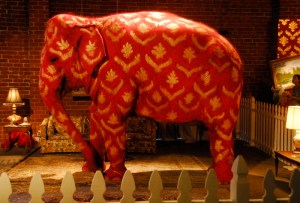
That climate change is the elephant in the room is a cliché.  We get a lot of support for failing to recognize the big, obvious issue that we are all, to one degree or another, complicit in the melting of Artic ice, drought in  Australia, forest fires and monster storms.  It’s easy these days to blame media, corporations and government lackeys for inaction on global warming.  It can make you feel powerful, yet is a waste of time and energy, of which we have neither.  Better to find the one thing you can do, and do it, because if nothing else, it can be a very humbling exercise.

Support the divest movement if you can’t physically join the students at Harvard or Brown calling their respective schools to account.  Hooray for The Harvard Crimson taking a stand in an Open Letter to President Faust: …we believe it will take the world’s most renowned academic institution to reign in the world’s most wealthy, powerful, and destructive corporations.

Today, Congress is negotiating the Farm Bill.  Do you understand what this could mean for the future of food in our country?  Why are so many people opposed to GMO seeds?  Who is Vandana Shiva anyway?  Why is the  health of our soil vital to life on the planet?  What is Rob Hopkins, founder of the Transition movement, up to these days?  How does the Slow Food movement fit into the big picture of climate change?   More questions.  Few answers.  I have made food security my thing because I can. What’s yours?

Here’s Wendell Berry on Moyers and Company recently: We don’t have a right to ask whether we’re going to succeed or not. The only question we have a right to ask is what’s the right thing to do? What does this earth require of us if we want to continue to live on it?