What We Can Know

Like transplants from elsewhere, we go to Florida’s beautiful, relatively uncrowded beaches in summer to fill our lungs with salt air, press our bare feet into the sand, and look for turtle tracks. It turns out that 2015 has been a record year for turtle nesting in Florida, Georgia and the Carolinas.  Sure enough, there were plenty of fresh tracks in evidence on a recent Sunday morning, many new nests, and a researcher on dune buggy taking his morning tally.

Preserving life other than our own is for many people an instinctive response, one that affirms our interconnection with and interdependence on all living things, including the Earth itself.  Some years ago on this same stretch of beach, we rescued about 20 turtle hatchlings by keeping hungry seagulls in the air while the young made a dash for the waves. This race that relatively few actually win, apparently also hones the turtles’ survival skills and increases their chance of living into adulthood and reproducing. We were giddy with joy that morning, though none the wiser about the way of turtles, e.g. how do they know which way the water is? Or how is it that their mothers, and some day these newly hatched females grown to adulthood, catch a ride on the Gulf Stream and return to this very beach to lay their eggs? Loggerheads, Leatherbacks and green turtles are (unlike urban trees, alas) protected by law, so evidence that they are thriving is reason for celebration. But more than that, I’m curious about how significant this shift, if indeed it is a lasting one, could be in big picture terms. What might it suggest about the future health of our world if turtles, like bald eagles, any life form for that matter, do well enough to be removed from the endangered list? Or when damage can be reversed as we step back and let nature takes its course. We don’t always know what will work until we see what happens.

You have to be encouraged about the most recent news about bees, too, as well as for ‘a new breed of bee keepers‘ who are swelling the ranks, according to a recent story in the Palm Beach Post’s business section. The newcomers are entering the business as a sideline, drawn by the high demand for honey, but what if they could become part of a citizen movement to preserve and strengthen bee colonies? An associate professor of entomology is quoted as saying that CCD (colony collapse disorder) is “gone or pretty minimal,” which suggests that a turnaround via human intervention is possible. And bees are kind of important to our food security.

Whatever drives us to discovery, anyone of us can only know a small fraction about our world relative to what there is to know, and most of what we discover is through hands-on experience, experimentation and observation. But I believe we are obligated to engage with and learn whatever we can, and in that process come to love the world and want to save it. In that context, here’s a photo of one of our grandsons, an incoming high school senior who aspires to become an aeronautical engineer, Shaw harnesses the winddoing an experiment of his own with wind power on Mousam Lake, Maine. Earlier, he and his youngest brother successfully ‘sailed’ their canoe across this same lake using this same outsize umbrella. When you recall that before the discovery and rapid implementation of fossil fuels, humans explored the known — and unknown — world entirely under sail, perhaps this augers well for the great re-skilling, a back-to-the-future, intergenerational strategy I believe is inevitable for our survival as a species. I am glad to leave speculating on origins and causation to scientists, philosophers and those of religious persuasion. And when we need a little humility to prick our 21st century techno-arrogance bubble, we might channel rock star astrophysicist, Neil deGrasse Tyson, who reminds us that something called Dark Matter is accelerating the expansion of our universe, but we don’t even know what it is. I highly recommend his terrific on-demand StarTalk Radio Show, a combination of Car Talk (a lot of joking and boisterous laughter) with great interviews and razor sharp observations. In the recent edition that included snippets of deGrasse Tyson’s interview with Ariana Huffington, she noted that far from being in opposition, scientists and people of faith are united by a sense of wonder. One cool woman. The show ended with a call for greater scientific literacy for everyone. May it be so, and may it begin in the home, in schools, and the House.
Unplug Yourself

Here’s a tip for a healthier, more resilient future: get outdoors more and leave your smart phone at home when you do. There’s plenty of evidence that suggests we need what nature gives us for free: refreshment, relaxation, and a sense that we are part of something larger than the manmade environment in which we spend most of our waking hours. In South Florida, indoors automatically means air-conditioning 24/7, breathing recirculated air. Like being on an endless plane ride. Children who spend time playing outdoors every day are not only less likely to become obese, they do better in school. Even elderly shut-ins benefit from being near some green plants, particularly if they care for them. High touch.

Indoor living, whether at work or home, or at a popular restaurant like Duffy’s, is screen time, all the time.  I love to cook but increasingly go to the Internet for a recipe rather than consult one of the many cookbooks I own. Lately, I find myself checking the weather on my smartphone instead of opening a window or going outside to sniff the air. I confess I am hopelessly addicted to The Skimm for my quick dose of news, about all I can take. Most bedtimes, the urge to check email or Facebook one last time is all but irresistible. In wakeful periods during the night, I’m on my tablet reading a novel or catching up on one of the blogs I follow. At least I notice how these habits are changing me in ways I don’t like, stoking impatience and compulsive behavior. You have no doubt realized that Big Brother Internet is watching your searches and online shopping.

Here’s something else I find worrying, for myself and even more for my grandchildren who already exhibit serious dependency on screens (don’t even get me started on video gaming!). We are learning to depend on our visual, and to some extent auditory, senses at the cost of other senses that make us complete human beings. Since touch and smell are more connected to the emotions, is it possible that our addiction to screens themselves — not to mention our compulsion to miss nothing — is changing our relationships with each other as well as with our life support system.

Screen Addiction is Taking a Toll on Children writes personal health columnist, Jane Brody, in a report that is sure to resonate with grandparents and add to our concerns for their future. Perhaps you, too, have witnessed your grandchildren gradually change from affectionate, engaging pre-schoolers who were delighted to see you, always ready to play a game or share a joke, into Tweens or Teens who are so captivated by their devices, they barely acknowledge your presence. To be sure, adolescence is hard on everyone including the ones going through it, but this feels different from familiar teen angst, much more invasive and scary and with ramifications we may not fully comprehend. “Many come to view the real world as fake,” writes Brody. For those of us concerned about the effect of violent video games on children, this is chilling news indeed. Brody’s not letting adults off the hook either.  Her advice is sound: How to Cut Children’s Screen Time: Say No to Yourself First. 

Screens also interfere with our experience with the actual.  Ever noticed how many parents at a recital or school play are making a video of the event as opposed to just experiencing it?  So can they be said to be truly present, or to put it another way, what exactly were they present for? Pixels on a tiny screen?  And what will they remember later: being there, or just what the video tells them they saw? Comic and social critic, Louis CK, does a riff on this subject that is typical of his style: you’re laughing and feeling a chill down your spine at the same time.

kids walkingHey, I love my smartphone. I love texting and sharing photos. I love the built-in GPS that gets me places, the restaurant reviews that save me time and money, being able to leave the heavier equipment at home when I’m on the go and still stay in touch. But we all need to give it a rest. Screen addiction is not healthy for children and other living things and it is not healthy for the Earth. The good news — and there has been more of this lately, from Pope Francis’ encyclical to the rise of solar power through unlikely alliances (see Green Tea Coalition) — is that we can do something about it.  We won’t save the world and our own skins by changing our lightbulbs and shopping greener, but a re-engagement — all senses open — with what we have and what we stand to lose: the only home we have, just might. Turn off, unplug, go hug a tree or a friend.

Bye-Bye Indie Movies

The closing of the Mos’Art Theater in Lake Park this past week is a small, personal tragedy for those of us who loved the great selection of independent and foreign films found there for the last five years. We’ve seen Oscar-nominated documentaries, animated films and features, and even got to vote on them. We’ve attended benefits at the Mos’Art like the showing of The Vessel, co-sponsored by the local National Organization for Women and Emergency Medical Assistance.  Most recently, the 2015 Oscar-nominee for Foreign Language Film, Wild Tales, drew an appreciative audience. To catch films of this caliber now, means driving at least 20 minutes on a hair-raising stretch of I-95 to the only other cinema of its kind in northern Palm Beach County. But even more than the inconvenience, it saddens me to see this promising venue, on the same block as our other favorite local hangout, The Brewhouse Gallery, go dark. A vibrant community needs more thriving small businesses, not fewer, more foot traffic, not less.

indie_logoLake Park has a more diverse population than our home town, and just like the other artsy, colorful, interesting town of Lake Worth, diversity also brings with it more security issues and various defensive strategies.  I notice, for example, that Saigon Market where we shop for a terrific array of Asian ingredients, and the Vietnamese pho/hot-pot restaurant its owners opened last year, pull down metal shutters over their display windows and door at night.  It’s common practice in fringe neighborhoods in any urban area, and one choice retailers can make to protect themselves. But a fortress does not a community make. More venues like The Brewhouse Gallery and its neighbor, Art on Park, both of which cater to emerging artists, are a better way to go. I say this even while recognizing that today’s artists’ haven is tomorrow’s high-rent district. Hello Miami’s Wynnwood.

We live less than 5 miles from Lake Park, in a family oriented town we landed in more than a decade ago, following one set of grandchildren to the sunshine of South Florida. It has its virtues — low crime rate, good schools, two excellent community centers with pools and other sports facilities, more large shade trees, a Whole Foods Market, the Gardens Mall, and of course, a multiplex theater featuring the usual fare of blockbusters. Developers of Downtown, and the newer Midtown, have tried to infuse a sense of community around the collection of shops and restaurants, with comfortable public seating, periodic art shows and free music on the weekends in the season (that is, not the hotter summer months).  Downtown features a carousel and a train for tots that also goes round and round each evening, clanging bell and all. But the design approach doesn’t seem to be moving us in the direction of a real town center as a community gathering place. The farmers market is somewhat better, but without some effort, it’s too easy to be ships that pass in the night. Even the kids don’t seem to be having much fun, except occasionally when they cut loose from their parents and play with other kids. They set a fine example.

I’ve made the point here before that as shoppers, diners or spectators, we’re more likely to stick to our companions. Mingling or chatting with people we don’t know would be an exception rather than the rule, and that’s a seriously bad trend for community life, let alone the kind of resilience the future may demand of us. I don’t think our little corner of Palm Beach County is an isolated example (but I’d be delighted to have that view challenged).  If we aren’t comfortable with the people we meet in the commons, how can we become better at talking with each other in community meetings where an issue of mutual interest is being discussed, let alone in a more politically charged gathering?  Shouldn’t we all be concerned about the silo lifestyles and bland conformity so many of us have adopted, and adapted to, without understanding what and whom we are sacrificing?  I think so, and the indie-minded among you might agree. I’ll leave you with some links worth checking out:

Transition Streets  — just launched website

Strong Towns

Walkable WPB

Where’s the Beef?

The answer is: not in my diet, for reasons ethical, environmental, and health-related.  If you share this preference, you already know it can make you a problematic dinner guest, not quite of the gluten-free or raw food variety (no offense to either), but close.  But recently I made an exception for my meat-loving family, a special birthday celebration — my first born’s 50th! — in a recipe for buffalo chili from an Andrew Weil cookbook.  I am fortunate to have a local source for verified grass-fed meat thanks to Farriss Farm, a small farmers-market-based enterprise run by Robert and Paula Farriss who have seen their business turn around by a burgeoning demand.

ChiliBut the Where’s the Beef line that everyone over a certain age remembers from a Burger King commercial, is a good question for all of us Americans.  Our habits of consumption,  including but not limited to a diet high in meat, means each of us needs approximately 5 times the resources — food, water, energy — the Earth can provide for each human now alive. Our allowable ‘personal planetoid’ is about 4.5 acres. You don’t need to be a math whiz to figure that someone somewhere is getting the short end of the stick now, and with the population projected to reach 9 billion by 2050, something is going to give.  From Pope Francis’ encyclical published today: “… a minority believes that it has the right to consume in a way which can never be universalized, since the planet could not even contain the waste products of such consumption.” You and I know this, and even so, it’s difficult to accept personal responsibility for a problem so complex it took Pope Francis 184 pages to cover.

If you are a fan of small, specific tasks, you may also be cheered by an elevator speech (love them!), How to Fix America’s Beef Problem in Under 2 Minutes, by co-author, Denis Hayes, of  Cowed: The Hidden Impact of 93 Million Cows on America’s Health, Economy, Politics, Culture, and EnvironmentUnlike the daunting title, this video (thank you, Grist!) is upbeat and accessible like The Story of Stuff series and others of its ilk, and inspiring on multiple levels. Hayes, whose bona fides as an environmentalist are impeccable, isn’t trying to do the impossible: turn 317 million burger-chomping Americans into vegans overnight. Like Michael Pollan (“Eat food. Not too much. Mostly plants.”), he offers a reasonable goal of 50% reduction in meat usage, still way beyond what the average citizen in the developing parts of the world consumes.

You may also enjoy the case made by Small Footprint Family for returning to pastured livestock because, among other things, it helps improve soil depleted by agribusiness mono-cropping and sequesters carbon. The article references Alan Savory’s sensational TED Talk  How to Fight Desertification and Reverse Climate Change (over 3 million views).  Savory’s experiment has since drawn fire for being unscalable and for promoting more rather than less meat in the diet. If you can get your hands on a copy of the DVD, Symphony of the Soil, a film it was my pleasure to help introduce in my area, offers a balanced view.

More mindful food choices seem like one of the easier things we can all do to trim our ecological footprint as well as preserve our well-being (which considering the cost of healthcare, is itself a public good). Transition’s 10% local food challenge is a great place to start, whether you are an omnivore, vegetarian, vegan, or raw food enthusiast. Switch 10% of your food purchases to what is produced nearby and keep your small farmer in business.

We aren’t looking to increase the intake of meat in our household, but I must admit that the buffalo chili, flavored with Ancho chili, cumin and dark chocolate, was worth the wait. Glad to share the recipe. Just ask in the comment section.

Small FootPrint Family

What Would Happen If The Entire World Lived Like Americans

http://www.radicalsimplicity.org/footprint.html

Where’s the Beef? Everywhere

Local Food Shift

Losing/Finding My Voice

Based on my albeit short career in climate activism, I believe too many of us are struggling with massive, relentless stress that takes a toll on our relationships with each other, the quality of our work, and inevitably, and on our own body-minds.  We want change but our methodology is missing the mark. We preach to the choir in deadly, PowerPoint, fact-filled meetings, replete with pressure to sign away our free time to various on-going actions. Given this is South Florida, the list is long. When we keep pounding away with the facts, the values, our values, the humanity of our words and actions, remain off the table. We must replace finger wagging with a vision of life so compelling, people will want to create it. We need, as Rob Hopkins, founder of the Transition movement insists, new stories to inspire and model change, and the ability to tell them well. Moreover, we need Marketing 101, because those who are fighting just as hard for business as usual are employing it more effectively. See George Lakoff (Don’t Think of an Elephant).

Last week, a climate activist buddy and I both found ourselves stricken with an upper bronchial infection that is making the rounds and rendered speechless with laryngitis, ah the irony.  When we found our voices again, we had a chat about the work we do and its impact on our health and that of those in our circle. We are on the same wavelength that new approaches are sorely needed, a lightness of being.  I think of Wendell Berry’s great quote: Be joyful, although you have considered the facts. She is, as are others, often able to ‘push through’ fatigue and illness, even to the point of offering comment on the Regional Climate Action Plan of 2009, at last on the West Palm Beach commissioners’ agenda.  The good news and kudos to my colleagues: RCAP was signed. But I can’t help wondering why it took this long, and why only three municipalities in Palm Beach County have signed it so far.

When I feel unwell I tend to want to tough it out, but when I woke up one morning unable to so much as whisper, it seems a good time to save my vocal chords, hold my peace, and see what might happen. Teaching my yoga classes was impossible, but I did some gentle, restorative yoga at home. And thanks to my mindfulness meditation practice, I noticed how it felt to be without a voice.  I allowed myself to enquire, become curious about whether this lack had anything to teach me. Curiosity, says Buddhist nun and author, Pema Chödrön, is “A much more interesting, kind and joyful approach to life … whether the object of our curiosity is bitter or sweet.”

conversationWhile I was sans voice, I happened to be reading a great book … about talking! Living Room Revolution:A Handbook for Conversation, Community and the Common Good by Cecile Andrews is both a convincing case for the need for civil discourse and a manual for the same. It argues that nothing less than our democracy depends on our reclaiming of the lost art of conversation, an exchange of equals in a respectful, convivial atmosphere, pub, salon or living room. Public spaces where people could gather spawned revolutions in the past, including that of our nation.  Today, many of us rely on other means, e.g. email, texting and social media, to stay in touch, usually with our friends, real or virtual. Texting can be great for refining a plan as you go, a lesson we can learn from the young. But these techniques don’t help us widen our circles of association or get practice talking with people with whom we might not agree on everything. And that does not promote the common good.

Andrews’ formula is deceptively simple: a study circle that gathers “a small group of people talking about three questions, the first being about personal experience, the second about cultural forces that defeat your goals, and the third about actions you can take to accomplish your goals.”  Other suggestions: Enlist commitments to meet weekly for eight weeks.  Get consensus about what makes a good conversation.  Use a timer to limit each speaker to 3 minutes.  Done right, these study circles encourage every participant to become a storyteller and possibly a change maker.  I love these three beginning questions:

1. When in your life have you experienced supportive community and a sense of belonging?

2. What forces in society make it difficult for you to have community?

3. What short-term and long-term actions can you take to introduce more community into your life?

My spouse is naturally gregarious, always the one who will strike up a conversation with a seat mate at the theater or on public transportation while my head is buried in a program or book, or worse, checking my smart phone.  But I’m determined to break these habits.  So at last Sunday’s Farmers Market, while he was getting us coffee, I sat down at a picnic table next to a someone I didn’t know. Because we smiled at each other, I took the plunge and asked his opinion about the various breakfast vendors, and he was delighted to make some recommendations. That opening was enough to spark a conversation of about 30 minutes, as my spouse arrived with the coffee and the two men quickly bonded as fellow New Yorkers from different boroughs. By the time we had covered some family and work history — he was a subway driver for the #7 line — I realized that we were on the same page about some hot topics: the disappearance of the middle class and the sorry state of education, with some ideas on how to address both. When was the last time that happened to you? As we shook hands, exchanged names, and went our separate ways, I felt the afterglow of having made a human connection at what has become another shopping opportunity, albeit with better vegetables and sometimes decent live music. Much as I enjoy social media, it doesn’t do it for me.  The art of conversation — let’s bring it back.

Mad Max and Mega-Drought

With recent analyses of the record-breaking drought in the Western states in front of mind, I thought a big budget movie about what happens in an age of peak everything, would be just the ticket. So this Memorial Day Weekend, I went to see Mad Max: Fury Road.

For you fans of the Mad Max I, II, and III*, this stunning new 3D release picks up the post-apocalyptic narrative of resource depletion – fuel, water, women of child-bearing age – where a constant state of warfare on the move is the norm. In these, and in others of its ilk, humanity has done something profoundly stupid and profane to the environment and each other, and a price must be paid. The Mad Max franchise sets a high bar for fast-paced chases and thrilling stunts, and this one is no exception. Critically acclaimed, it will likely be around through this summer for your viewing pleasure, and may even make back its sizeable budget.

Our fascination with end of the world narratives is of ancient origin. Most share plot lines familiar enough to be plausible, and possibly serve as a morality tale, even a way forward. In the post-apocalyptic format, humans survive to face a world only movie makers can imagine. Sometimes, they end with more whimper than bang, e.g. The Road, based on Cormac McCarthy’s book of the same title. Critically well-regarded, The Road was only a modest success. For a big box-office hit, we want heroes; we prefer that someone (or something) intervenes and saves humanity in a splashy and surprising way. Enter Mad Max (Tom Hardy), but equally, Imperator Furiosa (Charlize Theron). Cue the dusty, ragged, cheering extras in the final scene of Mad Max: Fury Road, when the chief villain has been dispatched, and precious water, stored in giant aquifers beneath The Citadel, is released. As in a classic Western to which it has been compared, Fury Road offers resolution, if not quite redemption, at the end. Max survives his inner and outer demons and melts into the tumult; Furiosa, revived by a transfusion of his blood, lives to fight another day. You are probably not surprised that the script for the sequel, Mad Max: Furiosa, is already written and the leads cast.

We walk away from this movie with enough adrenalin coursing through our systems to last all evening, and plenty of substance to talk about. The latter, for me, is what makes a film great. As I poked around the reviews, I was surprised and pleased to discover this note: “Eve Ensler, author of ‘The Vagina Monologues’ consulted with [Director, George] Miller on the script—which suggests that women, as the creators of new life, will, inherently, always be the gender that holds hardest onto hope for the future. Furiosa looks at the insanity of the male leadership around her and decides enough is enough.” Rogerebert.com. Go Vuvalinis!

drought-california-trailerBut we don’t know who to cheer for, who will roll the credits on the story of drought, or how this movie may end. For some educated guesses and possible plot twists ahead, I recommend you take in two fine reports on California’s drought from recent editions of The New Yorker. The most personally resonant is Dana Goodyear’s The Dying Sea: What Will California Sacrifice to Survive the Drought? Sacrifice? What an old-fashioned, Greatest Generation, idea that is. And yet, browner lawns and shorter showers don’t begin to match what will be required to address drought in the West, and not just by the locals.

The dying sea of the title is the Salton Sea, a shallow, increasingly saline, giant inland lake located on the San Andreas Fault (another summer blockbuster to be released) and in the farm-saturated Imperial and Coachella Valleys. When we owned a condo in the Palm Springs area in the 90s, we once took a detour to find a lunch spot at the Salton Sea on the way to Phoenix. It was already well past its heyday as a resort, dotted now with a full array of seedy motels and diners, and biker gangs. But the defunct towns and film noir aspects of the region are the less important story. The health emergency for local residents caught in a modern Dust Bowl is the real wake up call. Here’s the link.

The opening photo of the parched, cracked earth of Lake Mead tells the story before you read a word of Where the River Runs Dry: The Colorado and America’s Water Crisis, by David Owen (currently, The New Yorker’s most popular article). The article gives a dense and fascinating history of water battles of the past and yet to come for a region dependent on one, endangered water source, the Colorado River, “The legal right to use every gallon [of which] is owned or claimed by someone.” If you think it is easy to distinguish the heroes from the villains in this unfolding story of water rights that “originated in the California Gold Rush,” you’re better off turning once again to the Hollywood version, Chinatown, the 1974 Oscar favorite, “set in 1937 and portray[ing] the manipulations of a critical municipal resource [for the city of Los Angeles] – water – by a cadre of shadowy oligarchs.” (Wikipedia)  It’s an old story, and we need a new one with a better outcome.

See also my reposting from Zero-Waste Chef for more on what we in other parts of the country can do to mitigate California’s water crisis now. Stop buying bottled water, and for your fruits and vegetables, stay local, my friends.

More Reading:

Peak Everything, Richard Heinberg, New Society Publishers

Chinatown, Roger Ebert review

*1979 cult classic film Mad Max, directed by George Miller, presents a world in which oil resources have been nearly exhausted. This has resulted in constant energy shortages and a breakdown of law and order. The police do battle with criminal motorcycle gangs, with the end result being the complete breakdown of modern society as depicted in Mad Max 2 and after nuclear war as depicted in the third sequel film Mad Max Beyond Thunderdome. The opening narration of Mad Max 2 implies that the fuel shortage was caused not just by peak oil, but also by oil reserves being destroyed during a large-scale conflict in the Middle East. The remnants of society survive either through scavenging, or in one notable case, by using methane derived from pig feces. (Wikipedia)

Letter from California (Part II)

Doable things to help California in this time of drought. What happens to California, happens to all of us.

Anne-Marie Bonneau's avatarZero-Waste Chef

Dear Reader,

In my last letter, I wrote about the water conservation measures I have taken at home as the mega-drought here in California rages on with no end in sight. Although I am happy to have incorporated these practices into my daily life—I find them easy enough to do—ordinary citizens like myself do not consume the majority of water in this state. To put some of the numbers below into perspective, the average American family consumes about 110,000 gallons of water per year.

The current state of affairs in California

View original post 717 more words

Earth Hour 2015: Lights Out

Where were you when the lights went out? If you are of a certain age and lived in the Northeast United States, you’ll remember at least one major blackout, with those of 1965 and 1977 perhaps the most indelible because normal life was disrupted for so many people across a vast region.

I was caught in a blackout in New York City in the early 80’s while on a research assignment in Brooklyn for Technology Magazine – the irony sank in sometime later.  Fortunately for my co-worker and me, we were above ground when the power went out, not trapped in a subway car or skyscraper office.   We, along with hundreds of others hit the streets, giddy with relief.  It was late afternoon when we crossed the Brooklyn Bridge, into Lower Manhattan and the Village. There, a party was in progress as restaurants who had lost their refrigeration, were turning out meals on make-shift charcoal grills and offering them, along with slightly warm beer, to whomever cared to take them up on their offer. Although that particular blackout would prove to be relatively local and short-lived, there was no way to know at the time.  “It’s tempting to ask why if you fed your neighbors during the time of the earthquake and fire, you didn’t do so before or after,” writes Rebecca Solnit of the San Francisco earthquake in  A Paradise Built in Hell: the Extraordinary Communities That Arise in Disaster.

Eventually, I got my foot-weary self to the Port Authority Bus Terminal that evening to wait with other New Jersey commuters for the power and interrupted bus service to resume.  Here, too, there was unusual cooperation and camaraderie.  We riders of the DeCamp 66 and 33 who barely exchanged a word before, were talking, exchanging stories and phone numbers, discovering we were neighbors after all.

unpluggedEarth Hour, 8:30-9:30 pm local time, when the Strip in Las Vegas, Times Square and the Eifel Tower intentionally go dark to raise awareness about climate change, was launched in Australia in 2007 by the World Wide Fund for Nature and has become a global movement.  Getting millions of people to power down for one hour a year doesn’t seem like much to ask, even of the electronic device-addicted populace of our century. In our home, we mark the occasion with an hour of candlelight, a glass of wine, a ukulele, some songs, enjoying the respite from the mixed blessing of an always-on, always-connected life that we have embraced so wholeheartedly.  Viewed in long-range or aerial images, Earth Hour is spectacular, and more than a little unnerving.  I would like to think that this scale of community arts activism will help us wrap our heads around what is impossible to contemplate, even for climate advocates: a world without power; life as we’ve come to know it, unplugged.

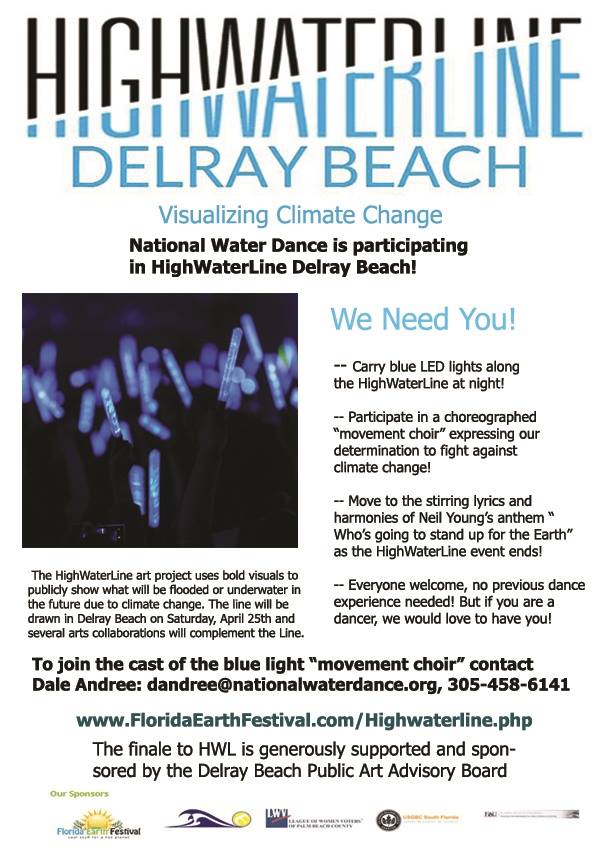
Artists of all kinds have often taken the lead in making the invisible (under-appreciated or ignored) visible, because they can.  Some are using their gifts to wake people up to the really wicked, society-transforming problem of climate change and a rising sea, e.g. The HighWaterLine project. The brainchild of artist, Eve Mosher, the HWL helps communities visualize the impact of climate change in our own neighborhoods and streets. Mosher began her work in 2007 in Lower Manhattan and Brooklyn, mapping areas predicted to be impacted by flooding during storm surges. After deep research into climate science and Google maps of flood zones, she spent six months using chalk and a sports field marker to draw the 10-ft. above sea level line in the streets and on the buildings. Yes, that was five years before Sandy.  Click here for more on the HWL.

Blue LightsAs residents of one of the states most vulnerable to sea level rise, Floridians are fortunate that Eve Mosher will be making a return engagement, this time in Palm Beach County later this month, chalking sea level rise for the HighWaterLine Delray Beach event. This day-long performance is part of the 2nd Annual Florida Earth Festival, a series of workshops and demonstrations that runs April 18 through 25, including a weekend of intensives at the Unitarian Universalist Fellowship of Boca Raton, 2501 St. Andrews Blvd.  Volunteers are needed for all kinds of tasks during the festival, and if you are able, I urge you to find what speaks to you and sign up.  For this yoga instructor and lover of dance, it is the prospect of being in the grand finale of the HWL mapping: a ‘movement choir’ of dancers holding blue glow lights and moving to Neil Young’s new anthem: Who Is Going to Stand Up for the Earth.

I’ve also signed up for the Beautiful Trouble workshop in the hopes that it will help me hone my new-found voice as a spoken word artist (thanks Vagina Monologues!) into a poetry flash mob or open mic performance on environmental themes.  In any case, it sounds like way more fun than climate advocacy usually is, Greenpeace Gorilla suits and the Raging Grannies notwithstanding.  These trainings are intended to serve as “A Toolbox for Revolution.” Bring it on.

Earth Hour visuals

Earth Hour, March 19, 2016

Biggest Blackouts in History

HighWaterLine Action Guide

Like Water For Avocados

After an announcement about a possible shortage of Hass Avocados caused near panic (and perhaps some welcome publicity), Mexican food chain, Chipolte, tried to soothe its fans with an announcement that there is no “guacapocalypse” in the offing.  Really?  Avocados are a thirsty crop, second only to another California favorite, the endangered almond.  According to Mother Jones, it takes 74.1 gallons of water to grow one pound of avocados as opposed to strawberries (9.8 gallons) or lettuce (5.4 gallons). For the time being, the California Hass is big business for the state: “… about 80 percent of all avocados eaten worldwide and … more than $1 billion a year in revenues in the United States alone.”  (California Avocado Commission).  

Headlines like this one from Newsweek 3/13/15: NASA: California Has One Year of Water Left, should be setting off alarm bells in the Congressional denialist camp on the basis of the economic impact alone, with the nation’s food security right up there next to it.  So it’s particularly bad news for all of us who love avocados — heck, like to eat regularly! — that Senator Ted Cruz now heads the Senate Science Committee, and that he has told NASA to stick to space and drop its climate investigations.  We need to pay close27_smap20150224-16 attention to what happens next.  After all, budget cuts that could threaten programs like NASA’s Jet Propulsion Laboratory, the Soil Moisture Mapper (SMAP)  — a satellite that can improve weather forecasts, monitor droughts and predict floods —  will hurt us all, now and in the immediate future. Maybe we should take a page from Senator Snowball’s playbook and start jamming the inboxes of legislators of his ilk with our favorite guacamole recipes.  This sounds like a job for Beautiful Trouble, fearless artist/activists.  Hi-jinks and hackery that exercise our creativity and even soothe our souls.   

It’s great to learn that Al Gore is newly optimistic that we can bring ourselves back from the brink, but yesterday on World Water Day, I couldn’t help thinking about what ordinary Californians are doing about a drought so severe, it has its own website?  Not nearly enough, according to figures from January this year which showed that conservation of water dropped from 22% to 9%, possibly spurred by an end of the year rainy period.  We are so addicted to short-term — or maybe it’s magical — thinking!  No wonder we are so easily distracted by shiny new things, blockbuster movies, and gossip about people we’ll never meet or particularly want to.

So I decided to ask a friend who lives in Huntington Beach about the water crisis, and she assured me that although some of her neighbors still have lawns (and presumably, have not as yet been prohibited from watering them), she has embraced a more desert scape, that is, rocks and succulents.  OK, it’s something, and granted, this is a minuscule sample.  But isn’t this typical of a common mismatch between the complexity of the issues we face — economic, health, safety, civil society — and the response of too many people like my well-meaning friend, as well as those in positions of power?  California officials, writes Jay Famiglietti, a senior water scientist at the NASA Jet Propulsion Laboratory, are “staying in emergency mode and praying for rain.”

Although drought isn’t an issue for Florida at the moment, we have our own water challenges: a rising sea (flooding, coastal erosion, threat to infrastructure and property) and the migration of salt into the agricultural water supply.  So much for the idea that California’s agricultural losses might be somewhat mitigated by Florida’s food growing power.  For more on this including the Sea Level Rise Symposium 2014, see my blog posts from last July, Water: Next Capitalist Tool? and November, Raising Fields.  Not enough water or the wrong kind — none of this is good news for living things.  But compared to what many see as the threat of water wars in the not too distant future, these issues are a drop in the bucket.

What can we do?  First, recognize that climate change is with us here and now and that we humans have no history or experience with the kinds of change it will likely produce in our lives.  On a beautiful, cool morning in South Florida as I write this from my patio, it’s possible to imagine that we have a decade or two before we are forced to adjust, to take action, or possibly, flee for higher ground. Even if that were true, it’s cold comfort for our children and grandchildren. Second, cut your consumption: repair, reuse, repurpose, skip the upgrade, minimize air travel, and make do while these are choices we can still make freely. Third: ask yourself to imagine a world without your favorite food (yes, avocados), a beloved bird, flower, tree, pollinators in general, a particular beach, a cherished vacation spot, a life experience you now take for granted (hiking a pristine trail, growing vegetables, access to a wide variety of fresh food, taking a hot shower, feeling safe on my streets and in my home, are all on my list).  What would you do to preserve these ordinary treasures, for yourself and those you love?  Do it.

See also: The Dark Mountain Project and Movement Generation

Solar is coming! Solar is Coming!

For my money, I would bet [Elon] Musk can upend a stodgy electricity business with little interest in innovation before it can beat out the behemoths who control the auto industry. – Daniel Sparks, The Motley Fool

Perhaps you’ve read about European utilities entering a ‘death spiral’ because they would rather go down fighting than switch to renewables like solar and wind? Expect something similar in the U.S. in the not too distant future. I’m with Daniel Sparks (quote above) that it’s billionaire entrepreneur, Elon Musk, along with partners like Google ($300 million in SolarCity) who will continue to give utility CEOs, and their legislative minions, agita in the years ahead and the rest of us, reason to hope and rejoice.

Could business-done-right leverage society into a new era of clean, affordable energy when government’s hands are tied? What if the innovative muscle and wealth of our most forward-thinking companies could reverse the damage of business as usual?

It’s energizing to think so, and there are plenty of signals that solar power will become inevitable when 1. Costs drop further and 2. The public demands it (that would be you and me).  So, I’m devoting this post to a series of annotated links in support of these possibilities. I urge you to learn all you can about solar power and how best to advocate for its adoption in your community. And if you have the wherewithal to do so, consider investing in solar, e.g. SCTY (Nasdaq).

Solar panel imageGenerating solar power isn’t difficult, especially where sunshine is abundant. Just remember, “Every hour the sun beams onto Earth more than enough energy to satisfy global energy needs for an entire year.” (Source: National Geographic)  If 89-year-old Québécois, Claude Morency, can keep his kidney-shaped pool at a cozy 80°F year round with solar panels on his North Palm Beach home, so can anyone with $1,500 to invest in installation. Payback is between 1.5 to 7 years, according to Florida Solar Energy Center, a great source of cost-comparisons and other information. In fact, Morency is no newcomer to solar. As a full-time sailor, he powered his live/work sailboat with solar batteries for at least a decade.

The tricky part has been power storage for use when the sun isn’t shining (or the wind blowing, for that matter). But that’s about to change. At the moment, our condo (powered by renewables, courtesy Arcardia) also powers up our leased Nissan Leaf with a nightly plug-in. Apparently, power can flow the other way in an emergency, which is reassuring here in the hurricane belt. But it gets better, according to Elon Musk, who has announced that his company is within six months of producing a battery-pack for the home. Do I have your attention yet?

What would a Tesla home battery look like? The Toyota Mirai, which uses a hydrogen fuel cell, gives owners the option to remove the battery and use it to supply electrical power to their homes. That battery can reportedly power the average home for a week when fully charged. Employees at many big Silicon Valley tech companies already enjoy free charging stations at their office parking lot. Now imagine if they could use that juice to eliminate their home electric bill. A more practical application for your car would be a backup generator during emergencies, which is how Nissan pitches the battery in its Leaf. – The Verge

You may have heard that this revolution will be local. Actually, they usually start there.  So while Congress and state legislatures fiddle, some forward-thinking municipalities are showing us why a clean energy is the only future, and why it makes economic sense right now. See: Burlington, Vermont Becomes First U.S. City to Run on 100% Renewable Energy.

Now admittedly, Burlington, population 42,000, is probably an ideal sized city for such a bold move. Most small towns simply don’t have the financial muscle to kiss their utility goodbye and negotiate their own power sourcing. Wrap your mouth around this possible solution: community choice aggregation (CCA), a system that enables “cities and counties to aggregate the buying power of individual customers within a defined jurisdiction in order to secure alternative energy supply contracts on a community-wide basis, but allowing consumers not wishing to participate to opt out.” (Wikipedia definition). Already happening in California, Illinois, Massachusetts, New Jersey, Ohio, and Rhode Island. Don’t hold your breath for Florida which is, I kid you not, attempting to ban the use of the phrase, ‘climate change.’

Not So Strange Bedfellows. Despite some pockets of open-mindedness (Go Solar Florida’s workshops, this Wednesday, March 11, 2015), one has to look beyond the Sunshine State for signs of intelligent life on this subject. And there is growing evidence the solar revolution may be fueled by people who don’t generally occupy the same meeting rooms, beginning to work together on common goals. At this moment, it matters not whether our motivation is to secure a future for our grandchildren via renewable energy, or we’re more driven by the right to choose based on our free market system. Maybe it’s time to shake hands with Debbie Dooley of the Green Tea Coalition and offer a high five to Barry Goldwater, Jr. of TUSK (Tell Utilities Solar won’t be Killed).

The sun also rises in Africa. Good news for the family of Kenyan villager, David Lodio, whose single solar panel now generates enough power to enable his children to do their homework, and for the 585 million who currently have no access to electricity.  For rural Africa (which largely skipped the fossil-fueled industrial revolution), solar power will change everything for the better. http://www.bbc.com/news/world-africa-31503424

Let me close this short chapter in an on-going solar success story with a news flash.  This morning, a solar-powered plane took off from Abu Dhabi for the first leg of what will be a round the world flight. The Wright Brothers II?  Up, up, and away!

Lots more information in the live links throughout and here:

36% of All New Electric Capacity in 2014 from Solar

Popular Mechanics on solar energy storage